Daei Farshchi Adli Amir, Jahanban-Esfahlan Rana, Seidi Khaled, Farajzadeh Davoud, Behzadi Ramezan, Zarghami Nosratollah
Department of Medical Biotechnology, Faculty of Advanced Medical Sciences, Tabriz University of Medical Sciences, Tabriz, Iran.
Department of Cellular and Molecular Biology, Faculty of Biological Sciences, Azarbaijan Shahid Madani University, Tabriz, Iran.
Adv Pharm Bull. 2021 Feb;11(2):385-392. doi: 10.34172/apb.2021.037. Epub 2020 Apr 15.
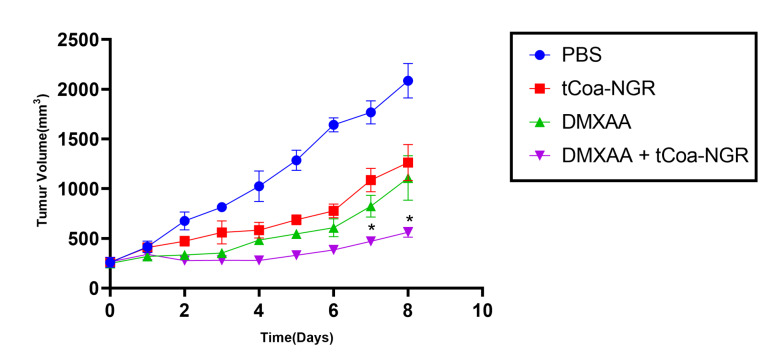
Tumor vascular targeting appeared as an appealing approach to fight cancer, though, the results from the clinical trials and drugs in the market were proved otherwise. The promise of anti-angiogenic therapy as the leading tumor vascular targeting strategy was negatively affected with the discovery that tumor vascularization can occur non-angiogenic mechanisms such as co-option. An additional strategy is induction of tumor vascular infarction and ischemia. Such that we used truncated coagulase (tCoa) coupled to tumor endothelial targeting moieties to produce tCoa-NGR fusion proteins. We showed that tCoa-NGR can bypass coagulation cascade to induce selective vascular thrombosis and infarction of mild and highly proliferative solid tumors in mice. Moreover, combination therapy can be used to improve the potential of cancer vascular targeting modalities. Herein, we report combination of tCoa-NGR with vascular disrupting agent (VDA), vadimezan. Our results show that synergistic work of these two agents can significantly suppress growth of B16-F10 melanoma tumors in C57/BL6 mice. For the first time, we used the simultaneous benefits of two strategies for inducing thrombosis and destruction of tumor vasculature as spatial co-operation. The tCoa-NGR induce thrombosis which reduces blood flow in the peripheral tumor region. And combined with the action of DMXAA, which target inner tumor mass, growth and proliferation of melanoma tumors can be significantly suppressed.
肿瘤血管靶向治疗似乎是一种有吸引力的抗癌方法,然而,临床试验结果和市场上的药物却证明并非如此。抗血管生成疗法作为主要的肿瘤血管靶向策略,其前景因发现肿瘤血管生成可通过非血管生成机制(如血管共选择)而受到负面影响。另一种策略是诱导肿瘤血管梗死和缺血。因此,我们将截短的凝固酶(tCoa)与肿瘤内皮靶向部分偶联,以产生tCoa-NGR融合蛋白。我们发现tCoa-NGR可以绕过凝血级联反应,诱导小鼠轻度和高度增殖性实体瘤的选择性血管血栓形成和梗死。此外,联合治疗可用于提高癌症血管靶向治疗方式的潜力。在此,我们报告tCoa-NGR与血管破坏剂(VDA)vadimezan的联合应用。我们的结果表明,这两种药物的协同作用可显著抑制C57/BL6小鼠中B16-F10黑色素瘤肿瘤的生长。我们首次将诱导血栓形成和破坏肿瘤血管的两种策略的协同作用作为空间合作。tCoa-NGR诱导血栓形成,减少肿瘤周边区域的血流。并与靶向肿瘤内部肿块的DMXAA的作用相结合,可显著抑制黑色素瘤肿瘤的生长和增殖。