Guo Hang, Wan Ji, Wang Haobin, Wu Hanxiang, Xu Chen, Miao Liming, Han Mengdi, Zhang Haixia
National Key Laboratory of Science and Technology on Micro/Nano Fabrication, Peking University, Beijing 100871, China.
Academy for Advanced Interdisciplinary Studies, Peking University, Beijing 100871, China.
Research (Wash D C). 2021 Apr 1;2021:4689869. doi: 10.34133/2021/4689869. eCollection 2021.
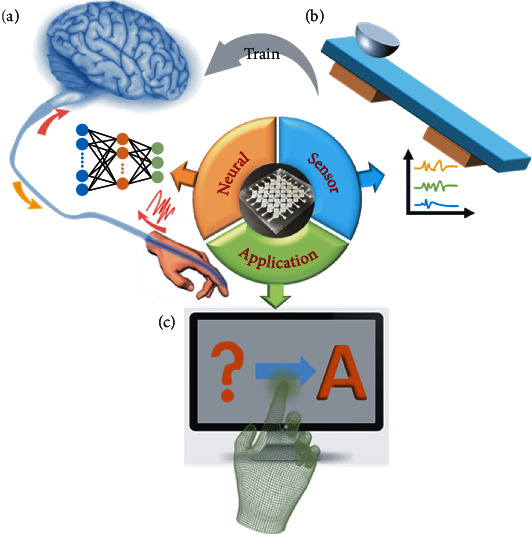
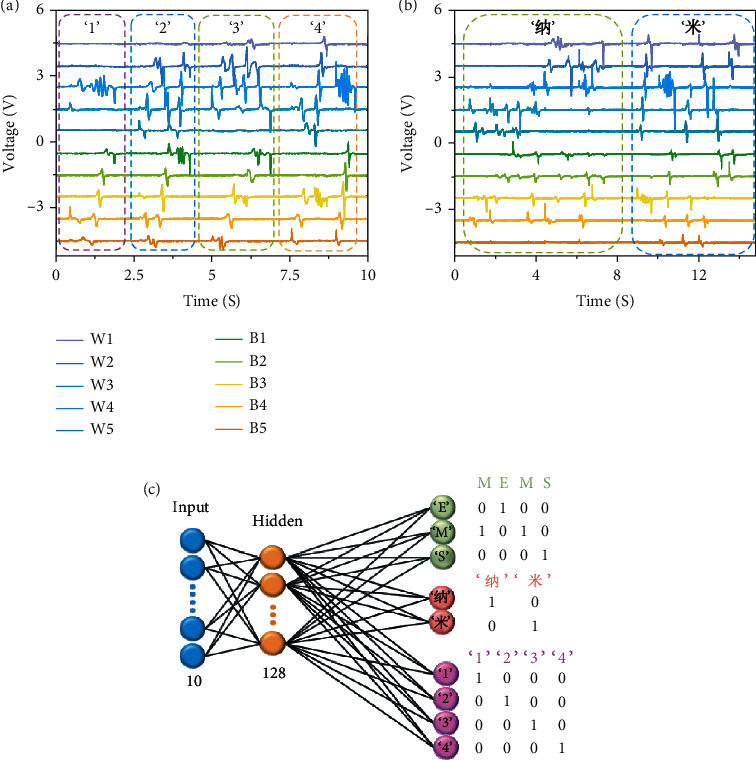
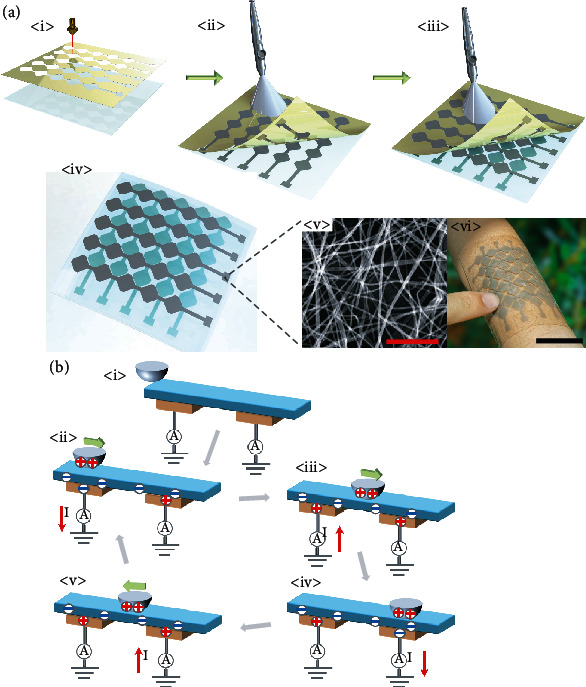
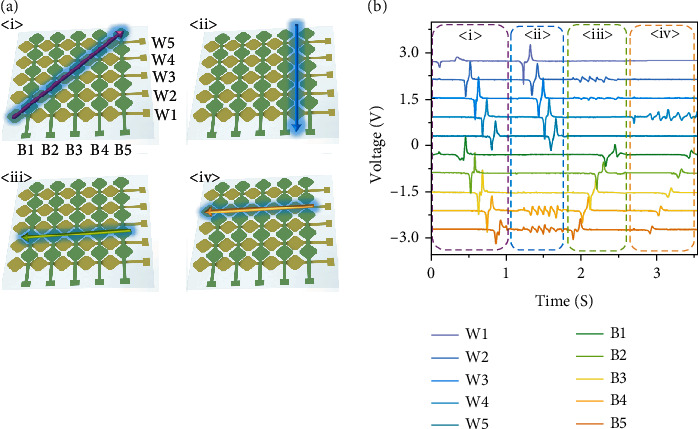
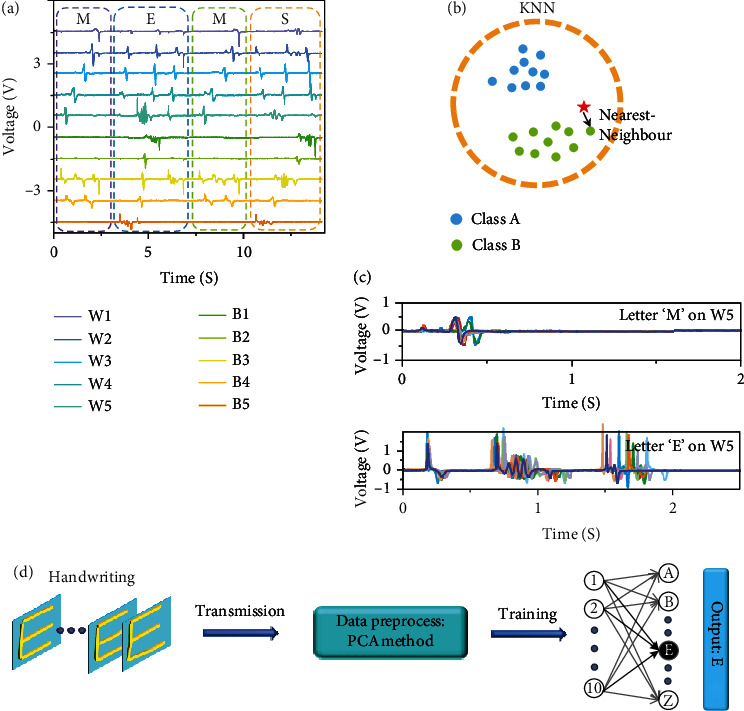
Handwritten signatures widely exist in our daily lives. The main challenge of signal recognition on handwriting is in the development of approaches to obtain information effectively. External mechanical signals can be easily detected by triboelectric nanogenerators which can provide immediate opportunities for building new types of active sensors capable of recording handwritten signals. In this work, we report an intelligent human-machine interaction interface based on a triboelectric nanogenerator. Using the horizontal-vertical symmetrical electrode array, the handwritten triboelectric signal can be recorded without external energy supply. Combined with supervised machine learning methods, it can successfully recognize handwritten English letters, Chinese characters, and Arabic numerals. The principal component analysis algorithm preprocesses the triboelectric signal data to reduce the complexity of the neural network in the machine learning process. Further, it can realize the anticounterfeiting recognition of writing habits by controlling the samples input to the neural network. The results show that the intelligent human-computer interaction interface has broad application prospects in signature security and human-computer interaction.
手写签名在我们的日常生活中广泛存在。手写信号识别的主要挑战在于开发有效获取信息的方法。摩擦纳米发电机能够轻松检测外部机械信号,这为构建能够记录手写信号的新型有源传感器提供了即时机会。在这项工作中,我们报告了一种基于摩擦纳米发电机的智能人机交互界面。使用水平 - 垂直对称电极阵列,无需外部能量供应即可记录手写摩擦电信号。结合监督机器学习方法,它能够成功识别手写英文信件、汉字和阿拉伯数字。主成分分析算法对手写摩擦电信号数据进行预处理,以降低机器学习过程中神经网络的复杂性。此外,通过控制输入神经网络的样本,它可以实现书写习惯的防伪识别。结果表明,该智能人机交互界面在签名安全和人机交互方面具有广阔的应用前景。