Bilinska Katarzyna, von Bartheld Christopher S, Butowt Rafal
L. Rydygier Collegium Medicum, Nicolaus Copernicus University, Bydgoszcz, Poland.
Department of Physiology and Cell Biology, University of Nevada, Reno School of Medicine, Reno, NV, United States.
bioRxiv. 2021 Jun 7:2021.04.11.439398. doi: 10.1101/2021.04.11.439398.
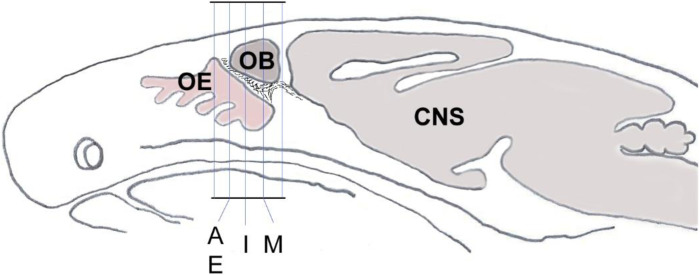
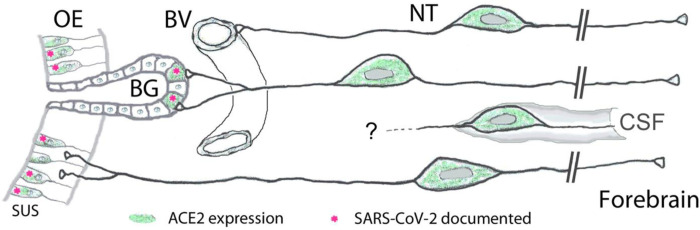
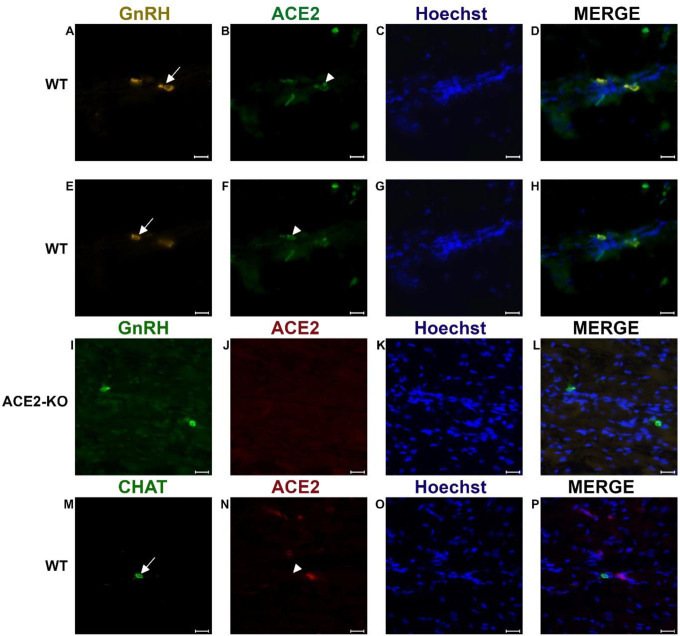
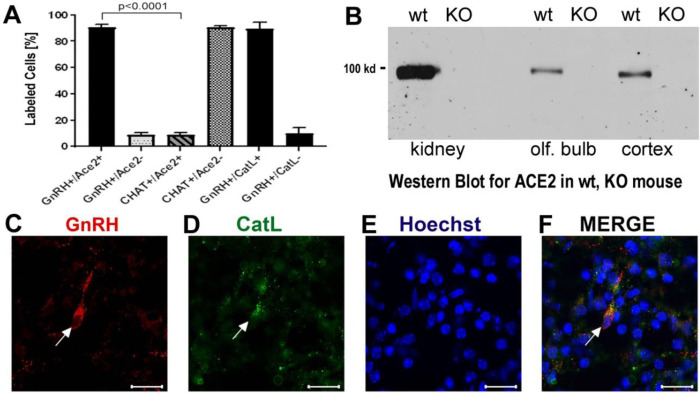
Previous studies suggested that the SARS-CoV-2 virus may gain access to the brain by using a route along the olfactory nerve. However, there is a general consensus that the obligatory virus entry receptor, angiotensin converting enzyme 2 (ACE2), is not expressed in olfactory receptor neurons, and the timing of arrival of the virus in brain targets is inconsistent with a neuronal transfer along olfactory projections. We determined whether nervus terminalis neurons and their peripheral and central projections should be considered as a potential alternative route from the nose to the brain. Nervus terminalis neurons in postnatal mice were double-labeled with antibodies against ACE2 and two nervus terminalis markers, gonadotropin-releasing hormone (GnRH) and choline acetyltransferase (CHAT). We show that a small fraction of CHAT-labeled nervus terminalis neurons, and the large majority of GnRH-labeled nervus terminalis neurons with cell bodies in the region between the olfactory epithelium and the olfactory bulb express ACE2 and cathepsins B and L. Nervus terminalis neurons therefore may provide a direct route for the virus from the nasal epithelium, possibly via innervation of Bowman's glands, to brain targets, including the telencephalon and diencephalon. This possibility needs to be examined in suitable animal models and in human tissues.
先前的研究表明,严重急性呼吸综合征冠状病毒2(SARS-CoV-2)病毒可能通过沿嗅神经的途径进入大脑。然而,人们普遍认为,该病毒必不可少的进入受体——血管紧张素转换酶2(ACE2),在嗅觉受体神经元中并不表达,而且病毒到达脑靶点的时间与沿嗅觉投射的神经元传递不一致。我们确定了是否应将终神经神经元及其外周和中枢投射视为从鼻子到大脑的潜在替代途径。对出生后小鼠的终神经神经元用抗ACE2抗体以及两种终神经标志物——促性腺激素释放激素(GnRH)和胆碱乙酰转移酶(CHAT)进行双重标记。我们发现,一小部分CHAT标记的终神经神经元,以及绝大多数细胞体位于嗅上皮和嗅球之间区域的GnRH标记的终神经神经元表达ACE2以及组织蛋白酶B和L。因此,终神经神经元可能为病毒从鼻上皮提供一条直接途径,可能是通过支配鲍曼腺,到达包括端脑和间脑在内的脑靶点。这种可能性需要在合适的动物模型和人体组织中进行研究。