Chebbi Alif, Tazzari Massimiliano, Rizzi Cristiana, Gomez Tovar Franco Hernan, Villa Sara, Sbaffoni Silvia, Vaccari Mentore, Franzetti Andrea
Department of Earth and Environmental Sciences -DISAT, University of Milano-Bicocca, Piazza della Scienza 1 -, 20126, Milano, Italy.
Department of Civil, Environmental, Architectural Engineering, and Mathematics, University of Brescia, Via Branze 43, 25123, Brescia, Italy.
Appl Microbiol Biotechnol. 2021 May;105(9):3825-3842. doi: 10.1007/s00253-021-11292-0. Epub 2021 Apr 20.
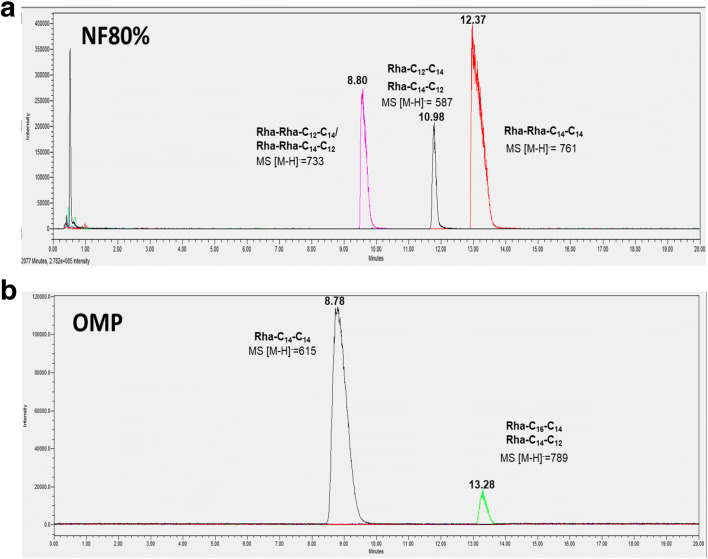
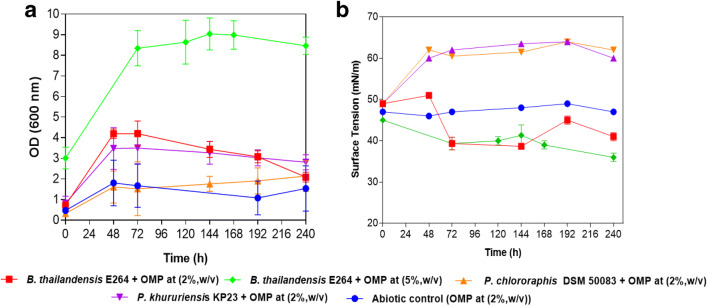
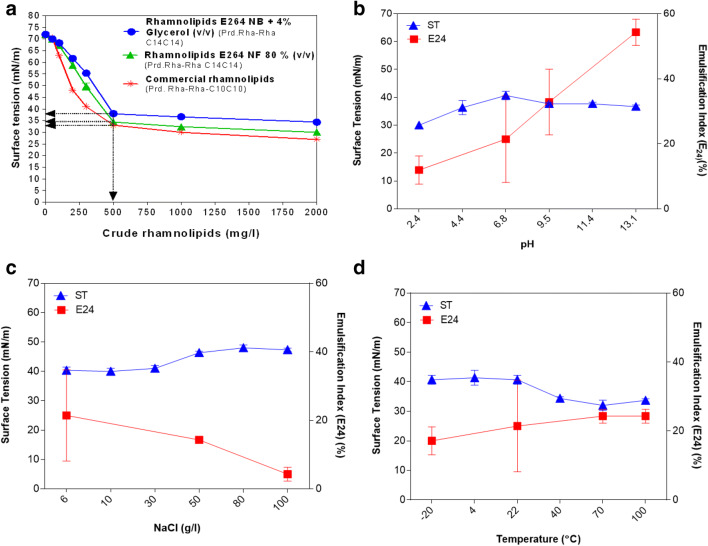
Within the circular economy framework, our study aims to assess the rhamnolipid production from winery and olive oil residues as low-cost carbon sources by nonpathogenic strains. After evaluating various agricultural residues from those two sectors, Burkholderia thailandensis E264 was found to use the raw soluble fraction of nonfermented (white) grape marcs (NF), as the sole carbon and energy source, and simultaneously, reducing the surface tension to around 35 mN/m. Interestingly, this strain showed a rhamnolipid production up to 1070 mg/L (13.37 mg/g of NF), with a higher purity, on those grape marcs, predominately Rha-Rha C-C, in MSM medium. On olive oil residues, the rhamnolipid yield of using olive mill pomace (OMP) at 2% (w/v) was around 300 mg/L (15 mg/g of OMP) with a similar CMC of 500 mg/L. To the best of our knowledge, our study indicated for the first time that a nonpathogenic bacterium is able to produce long-chain rhamnolipids in MSM medium supplemented with winery residues, as sole carbon and energy source. KEY POINTS: • Winery and olive oil residues are used for producing long-chain rhamnolipids (RLs). • Both higher RL yields and purity were obtained on nonfermented grape marcs as substrates. • Long-chain RLs revealed stabilities over a wide range of pH, temperatures, and salinities.
在循环经济框架内,我们的研究旨在评估非致病菌株利用酿酒厂和橄榄油残渣作为低成本碳源生产鼠李糖脂的情况。在评估了这两个行业的各种农业残渣后,发现泰国伯克霍尔德菌E264能够利用未发酵(白色)葡萄渣(NF)的粗可溶性部分作为唯一的碳源和能源,同时将表面张力降低至约35 mN/m。有趣的是,在MSM培养基中,该菌株在这些葡萄渣上的鼠李糖脂产量高达1070 mg/L(13.37 mg/g NF),纯度更高,主要为Rha-Rha C-C。在橄榄油残渣方面,使用2%(w/v)的橄榄果渣(OMP)时,鼠李糖脂产量约为300 mg/L(15 mg/g OMP),临界胶束浓度(CMC)类似,为500 mg/L。据我们所知,我们的研究首次表明,一种非致病细菌能够在以酿酒厂残渣作为唯一碳源和能源的MSM培养基中生产长链鼠李糖脂。关键点:• 酿酒厂和橄榄油残渣用于生产长链鼠李糖脂(RLs)。• 以未发酵葡萄渣为底物时,获得了更高的鼠李糖脂产量和纯度。• 长链鼠李糖脂在广泛的pH、温度和盐度范围内表现出稳定性。