Institute for Chemical Research, IIQ, CSIC-Univ. Sevilla, C/ Américo Vespucio 49, 41092, Sevilla, Spain.
Department of Organic Chemistry, Faculty of Chemistry, University of Sevilla, C/ Prof García González 1, 41012, Sevilla, Spain.
Chemistry. 2021 Jun 25;27(36):9429-9438. doi: 10.1002/chem.202100832. Epub 2021 May 26.
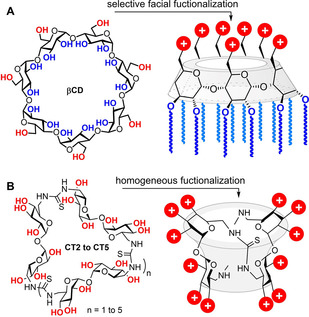
Instilling segregated cationic and lipophilic domains with an angular disposition in a trehalose-based trifaceted macrocyclic scaffold allows engineering patchy molecular nanoparticles leveraging directional interactions that emulate those controlling self-assembling processes in viral capsids. The resulting trilobular amphiphilic derivatives, featuring a Mickey Mouse architecture, can electrostatically interact with plasmid DNA (pDNA) and further engage in hydrophobic contacts to promote condensation into transfectious nanocomplexes. Notably, the topology and internal structure of the cyclooligosaccharide/pDNA co-assemblies can be molded by fine-tuning the valency and characteristics of the cationic and lipophilic patches, which strongly impacts the transfection efficacy in vitro and in vivo. Outstanding organ selectivities can then be programmed with no need of incorporating a biorecognizable motif in the formulation. The results provide a versatile strategy for the construction of fully synthetic and perfectly monodisperse nonviral gene delivery systems uniquely suited for optimization schemes by making cyclooligosaccharide patchiness the focus.
在基于海藻糖的三面大环支架中引入具有角向分布的隔离的阳离子和亲脂性结构域,可以利用模拟控制病毒衣壳自组装过程的定向相互作用来设计有斑点的分子纳米颗粒。所得的三叶形两亲性衍生物具有米老鼠结构,可以与质粒 DNA(pDNA)静电相互作用,并进一步进行疏水相互作用,以促进转染性纳米复合物的凝聚。值得注意的是,通过微调阳离子和亲脂性斑块的价数和特性,可以塑造环寡糖/pDNA 共组装体的拓扑结构和内部结构,这强烈影响体外和体内的转染效率。通过在配方中不加入生物可识别的基序,就可以实现出色的器官选择性编程。结果为构建完全合成且具有完美单分散性的非病毒基因传递系统提供了一种通用策略,特别适合通过将环寡糖的斑点结构作为重点来进行优化方案。