Fernández-Sanlés Alba, Sayols-Baixeras Sergi, Subirana Isaac, Sentí Mariano, Pérez-Fernández S, de Castro Moura Manuel, Esteller Manel, Marrugat Jaume, Elosua Roberto
Cardiovascular Epidemiology and Genetics Research Group, REGICOR Study Group, IMIM (Hospital del Mar Medical Research Institute), Dr Aiguader 88, 08003, Barcelona, Catalonia, Spain.
Pompeu Fabra University (UPF), Barcelona, Catalonia, Spain.
Clin Epigenetics. 2021 Apr 21;13(1):86. doi: 10.1186/s13148-021-01078-6.
The epigenetic landscape underlying cardiovascular disease (CVD) is not completely understood and the clinical value of the identified biomarkers is still limited. We aimed to identify differentially methylated loci associated with acute myocardial infarction (AMI) and assess their validity as predictive and causal biomarkers.
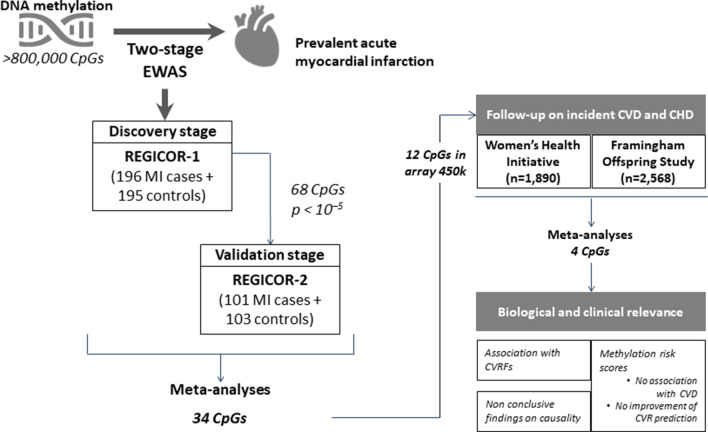
We designed a case-control, two-stage, epigenome-wide association study on AMI (n = 391, n = 204). DNA methylation was assessed using the Infinium MethylationEPIC BeadChip. We performed a fixed-effects meta-analysis of the two samples. 34 CpGs were associated with AMI. Only 12 of them were available in two independent cohort studies (n ~ 1800 and n ~ 2500) with incident coronary and cardiovascular disease (CHD and CVD, respectively). The Infinium HumanMethylation450 BeadChip was used in those two studies. Four of the 12 CpGs were validated in association with incident CHD: AHRR-mapping cg05575921, PTCD2-mapping cg25769469, intergenic cg21566642 and MPO-mapping cg04988978. We then assessed whether methylation risk scores based on those CpGs improved the predictive capacity of the Framingham risk function, but they did not. Finally, we aimed to study the causality of those associations using a Mendelian randomization approach but only one of the CpGs had a genetic influence and therefore the results were not conclusive.
We have identified 34 CpGs related to AMI. These loci highlight the relevance of smoking, lipid metabolism, and inflammation in the biological mechanisms related to AMI. Four were additionally associated with incident CHD and CVD but did not provide additional predictive information.
心血管疾病(CVD)潜在的表观遗传格局尚未完全明晰,已鉴定生物标志物的临床价值仍较为有限。我们旨在识别与急性心肌梗死(AMI)相关的差异甲基化位点,并评估其作为预测性和因果性生物标志物的有效性。
我们设计了一项针对AMI的病例对照、两阶段、全表观基因组关联研究(病例组n = 391,对照组n = 204)。使用Infinium MethylationEPIC BeadChip评估DNA甲基化情况。我们对两个样本进行了固定效应荟萃分析。34个CpG与AMI相关。其中仅有12个在两项分别针对冠心病和心血管疾病(CHD和CVD)发病情况的独立队列研究中(样本量分别约为1800和2500)可用。这两项研究使用的是Infinium HumanMethylation450 BeadChip。12个CpG中的4个与CHD发病情况相关并得到验证:AHRR基因座的cg05575921、PTCD2基因座的cg25769469、基因间区域的cg21566642以及MPO基因座的cg04988978。随后,我们评估了基于这些CpG的甲基化风险评分是否能提高弗明汉风险函数的预测能力,但结果并未显示其有改善。最后,我们旨在使用孟德尔随机化方法研究这些关联的因果关系,但仅有一个CpG具有遗传影响,因此结果尚无定论。
我们已鉴定出34个与AMI相关的CpG。这些位点突显了吸烟、脂质代谢和炎症在与AMI相关生物机制中的相关性。其中4个还与CHD和CVD发病情况相关,但并未提供额外的预测信息。