Pham Quynh, Hearn Jason, Bender Jacqueline L, Berlin Alejando, Brown Ian, Bryant-Lukosius Denise, Feifer Andrew H, Finelli Antonio, Gotto Geoffrey, Hamilton Robert, Rendon Ricardo, Cafazzo Joseph A
Centre for Global eHealth Innovation, University Health Network, Toronto, Ontario, Canada
Institute of Health Policy, Management and Evaluation, Dalla Lana School of Public Health, University of Toronto, Toronto, Ontario, Canada.
BMJ Open. 2021 Apr 21;11(4):e045806. doi: 10.1136/bmjopen-2020-045806.
Prostate cancer (PCa) is the most common cancer in Canadian men. Current models of survivorship care are no longer adequate to address the chronic and complex survivorship needs of patients today. Virtual care models for cancer survivorship have recently been associated with comparable clinical outcomes and lower costs to traditional follow-up care, with patients favouring off-site and on-demand visits. Building on their viability, our research group conceived the Ned Clinic-a virtual PCa survivorship model that provides patients with access to lab results, collects patient-reported outcomes, alerts clinicians to emerging issues, and promotes patient self-care. Despite the promise of the Ned Clinic, the model remains limited by its dependence on oncology specialists, lack of an autonomous triage algorithm, and has only been implemented among PCa survivors living in Ontario.
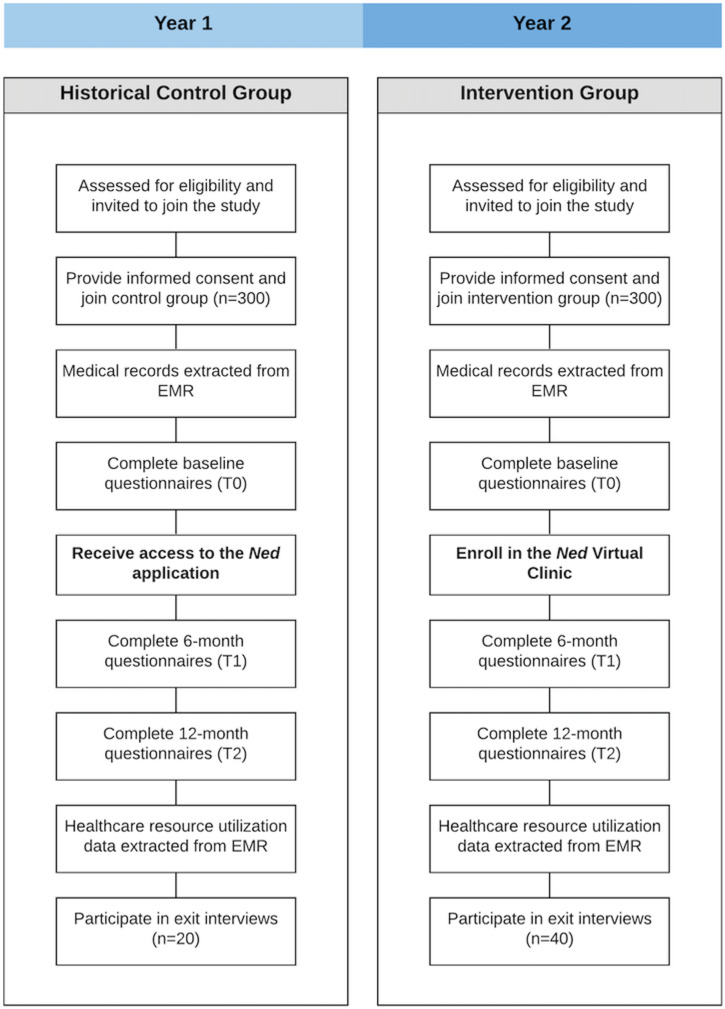
Our programme of research comprises two main research objectives: (1) to evaluate the process and cost of implementing and sustaining five nurse-led virtual PCa survivorship clinics in three provinces across Canada and identify barriers and facilitators to implementation success and (2) to assess the impact of these virtual clinics on implementation and effectiveness outcomes of enrolled PCa survivors. The design phase will involve developing an autonomous triage algorithm and redesigning the Ned Clinic towards a nurse-led service model. Site-specific implementation plans will be developed to deploy a localised nurse-led virtual clinic at each centre. Effectiveness will be evaluated using a historical control study comparing the survivorship outcomes of 300 PCa survivors enrolled in the Ned Clinic with 300 PCa survivors receiving traditional follow-up care.
Appropriate site-specific ethics approval will be secured prior to each research phase. Knowledge translation efforts will include diffusion, dissemination, and application approaches to ensure that knowledge is translated to both academic and lay audiences.
前列腺癌(PCa)是加拿大男性中最常见的癌症。当前的生存护理模式已不足以满足当今患者长期且复杂的生存需求。癌症生存的虚拟护理模式最近已被证明与传统随访护理具有相当的临床效果且成本更低,患者更倾向于非现场和按需就诊。基于其可行性,我们的研究团队构思了奈德诊所——一种虚拟前列腺癌生存模式,该模式为患者提供实验室检查结果,收集患者报告的结局,向临床医生提醒新出现的问题,并促进患者自我护理。尽管奈德诊所前景广阔,但该模式仍受到对肿瘤专科医生的依赖、缺乏自主分诊算法的限制,并且仅在安大略省的前列腺癌幸存者中实施。
我们的研究计划包括两个主要研究目标:(1)评估在加拿大三个省份实施和维持五个由护士主导的虚拟前列腺癌生存诊所的过程和成本,并确定实施成功的障碍和促进因素;(2)评估这些虚拟诊所对已登记的前列腺癌幸存者的实施和有效性结局的影响。设计阶段将涉及开发自主分诊算法,并将奈德诊所重新设计为以护士为主导的服务模式。将制定针对特定地点的实施计划,以便在每个中心部署本地化的由护士主导的虚拟诊所。将使用历史对照研究来评估有效性,比较在奈德诊所登记的300名前列腺癌幸存者与接受传统随访护理的300名前列腺癌幸存者的生存结局。
在每个研究阶段之前将获得适当的针对特定地点的伦理批准。知识转化工作将包括传播、推广和应用方法,以确保知识能够转化给学术和普通受众。