Moin John Sina, Glazier Richard H, Kuluski Kerry, Kiss Alex, Upshur Ross
Dalla Lana School of Public Health, University of Toronto, Toronto, Ontario, Canada
Institute for Clinical Evaluative Sciences, Toronto, Ontario, Canada.
BMJ Open. 2021 Apr 21;11(4):e045890. doi: 10.1136/bmjopen-2020-045890.
Multimorbidity has become highly prevalent around the globe and been associated with adverse health outcomes and cost of care. The built environment has become an important dimension in response to obesity and associated chronic diseases by addressing population sedentariness and low physical activity.
The aim of the following study was to examine whether there was an increased risk for multimorbidity for those living in less walkable neighbourhoods. It was hypothesised that participants residing in less walkable neighbourhoods would have a higher risk for multimorbidity.
City of Toronto and 14 neighbouring regions/municipalities within Ontario, Canada.
Study participants who had completed the Canadian Community Health Survey between the year 2000 and 2012, between 20 and 64 and 65 and 95 years of age, residing within a neighbourhood captured in the Walkability Index, and who were not multimorbid at the time of interview, were selected.
The Walkability Index was the key exposure in the study, which is divided into quintiles (1-least, 5-most walkable neighbourhoods). Participants were retrospectively allocated to one of five quintiles based on their area of residency (at the time of interview) and followed for a maximum of 16 years.
Becoming multimorbid with two chronic conditions.
Becoming multimorbid with three chronic conditions.
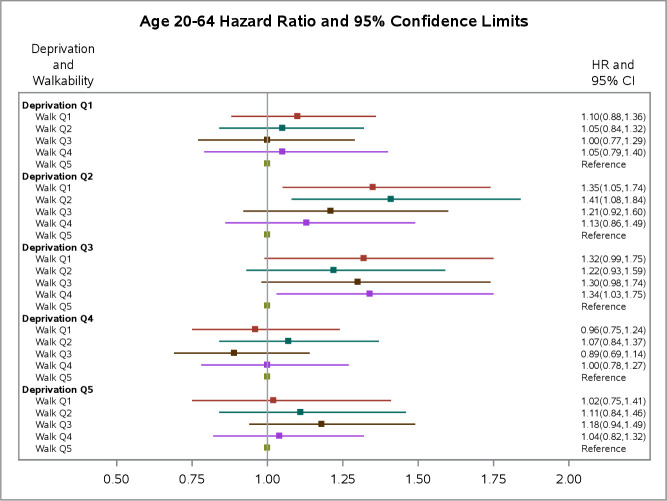
Risk for multimorbidity (two chronic conditions) was highest in least compared with most walkable neighbourhoods with an HR of 1.14 (95% CI: 1.02 to 1.28, p=0.0230). While results showed an overall gradient response between decreased walkability and increased risk for multimorbidity, they were not statistically significant across all quintiles or in the older-adult cohort (65-95 years of age).
Study results seem to suggest that low neighbourhood walkability may be a risk factor for multimorbidity over time. More studies are needed to examine whether neighbourhood walkability is a potential solution for multimorbidity prevention at the population level.
多病共存现象在全球范围内已极为普遍,并与不良健康结局及医疗费用相关。通过解决人群久坐不动和身体活动不足的问题,建成环境已成为应对肥胖及相关慢性病的一个重要方面。
以下研究的目的是检验居住在步行便利性较差社区的人群患多病共存的风险是否增加。研究假设居住在步行便利性较差社区的参与者患多病共存的风险更高。
加拿大多伦多市及安大略省内14个邻近地区/直辖市。
选取了在2000年至2012年期间完成加拿大社区健康调查、年龄在20至64岁以及65至95岁之间、居住在步行便利性指数涵盖的社区内且在访谈时不存在多病共存情况的研究参与者。
步行便利性指数是该研究中的关键暴露因素,分为五个五分位数(1 - 步行便利性最差,5 - 步行便利性最佳的社区)。参与者根据其居住地区(访谈时)被回顾性地分配到五个五分位数之一,并随访最长16年。
出现两种慢性病的多病共存情况。
出现三种慢性病的多病共存情况。
与步行便利性最佳的社区相比,步行便利性最差的社区患多病共存(两种慢性病)的风险最高,风险比为1.14(95%置信区间:1.02至1.28,p = 0.0230)。虽然结果显示步行便利性降低与患多病共存风险增加之间存在总体梯度反应,但在所有五分位数或老年人群队列(65 - 95岁)中,这些结果并无统计学意义。
研究结果似乎表明,随着时间推移,社区步行便利性低可能是患多病共存的一个风险因素。需要更多研究来检验社区步行便利性是否是在人群层面预防多病共存的一个潜在解决方案。