Hajat Cother, Stein Emma
The Vitality Group, United States of America.
Yale School of Public Health, United States of America.
Prev Med Rep. 2018 Oct 19;12:284-293. doi: 10.1016/j.pmedr.2018.10.008. eCollection 2018 Dec.
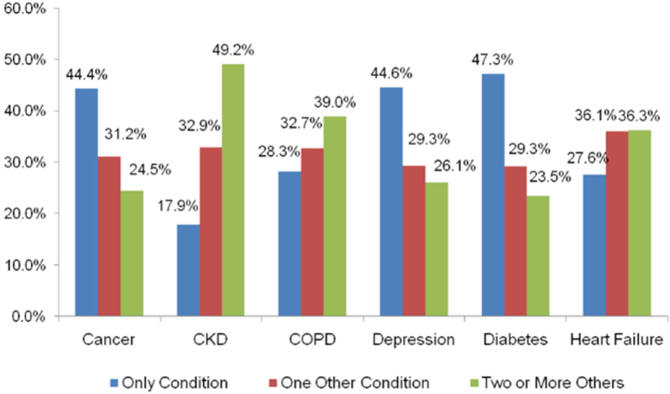
Globally, approximately one in three of all adults suffer from multiple chronic conditions (MCCs). This review provides a comprehensive overview of the resulting epidemiological, economic and patient burden. There is no agreed taxonomy for MCCs, with several terms used interchangeably and no agreed definition, resulting in up to three-fold variation in prevalence rates: from 16% to 58% in UK studies, 26% in US studies and 9.4% in Urban South Asians. Certain conditions cluster together more frequently than expected, with associations of up to three-fold, e.g. depression associated with stroke and with Alzheimer's disease, and communicable conditions such as TB and HIV/AIDS associated with diabetes and CVD, respectively. Clusters are important as they may be highly amenable to large improvements in health and cost outcomes through relatively simple shifts in healthcare delivery. Healthcare expenditures greatly increase, sometimes exponentially, with each additional chronic condition with greater specialist physician access, emergency department presentations and hospital admissions. The patient burden includes a deterioration of quality of life, out of pocket expenses, medication adherence, inability to work, symptom control and a high toll on carers. This high burden from MCCs is further projected to increase. Recommendations for interventions include reaching consensus on the taxonomy of MCC, greater emphasis on MCCs research, primary prevention to achieve compression of morbidity, a shift of health systems and policies towards a multiple-condition framework, changes in healthcare payment mechanisms to facilitate this change and shifts in health and epidemiological databases to include MCCs.
在全球范围内,约三分之一的成年人患有多种慢性病(MCCs)。本综述全面概述了由此产生的流行病学、经济和患者负担。目前对于多种慢性病尚无统一的分类法,有几个术语可互换使用且没有统一的定义,这导致患病率高达三倍的差异:英国研究中的患病率为16%至58%,美国研究为26%,城市南亚人群为9.4%。某些疾病比预期更频繁地聚集在一起,关联度高达三倍,例如抑郁症与中风以及与阿尔茨海默病相关联,而传染病如结核病和艾滋病毒/艾滋病分别与糖尿病和心血管疾病相关联。疾病聚集很重要,因为通过相对简单地改变医疗服务提供方式,它们可能非常有助于大幅改善健康和成本结果。随着每增加一种慢性病,医疗保健支出会大幅增加,有时呈指数级增长,需要更多专科医生诊治、急诊就诊和住院治疗。患者负担包括生活质量下降、自付费用、药物依从性、无法工作、症状控制以及对护理人员造成的沉重负担。预计多种慢性病带来的这种高负担还会进一步增加。干预建议包括就多种慢性病的分类法达成共识、更加强调多种慢性病研究、进行一级预防以实现发病压缩、将卫生系统和政策转向多疾病框架、改变医疗支付机制以促进这种转变以及在健康和流行病学数据库中纳入多种慢性病。