Fischer Petra
Medical Research Council Brain Network Dynamics Unit, Nuffield Department of Clinical Neurosciences, University of Oxford, OX3 9DU Oxford, United Kingdom
eNeuro. 2021 Jun 11;8(3). doi: 10.1523/ENEURO.0009-21.2021. Print 2021 May-Jun.
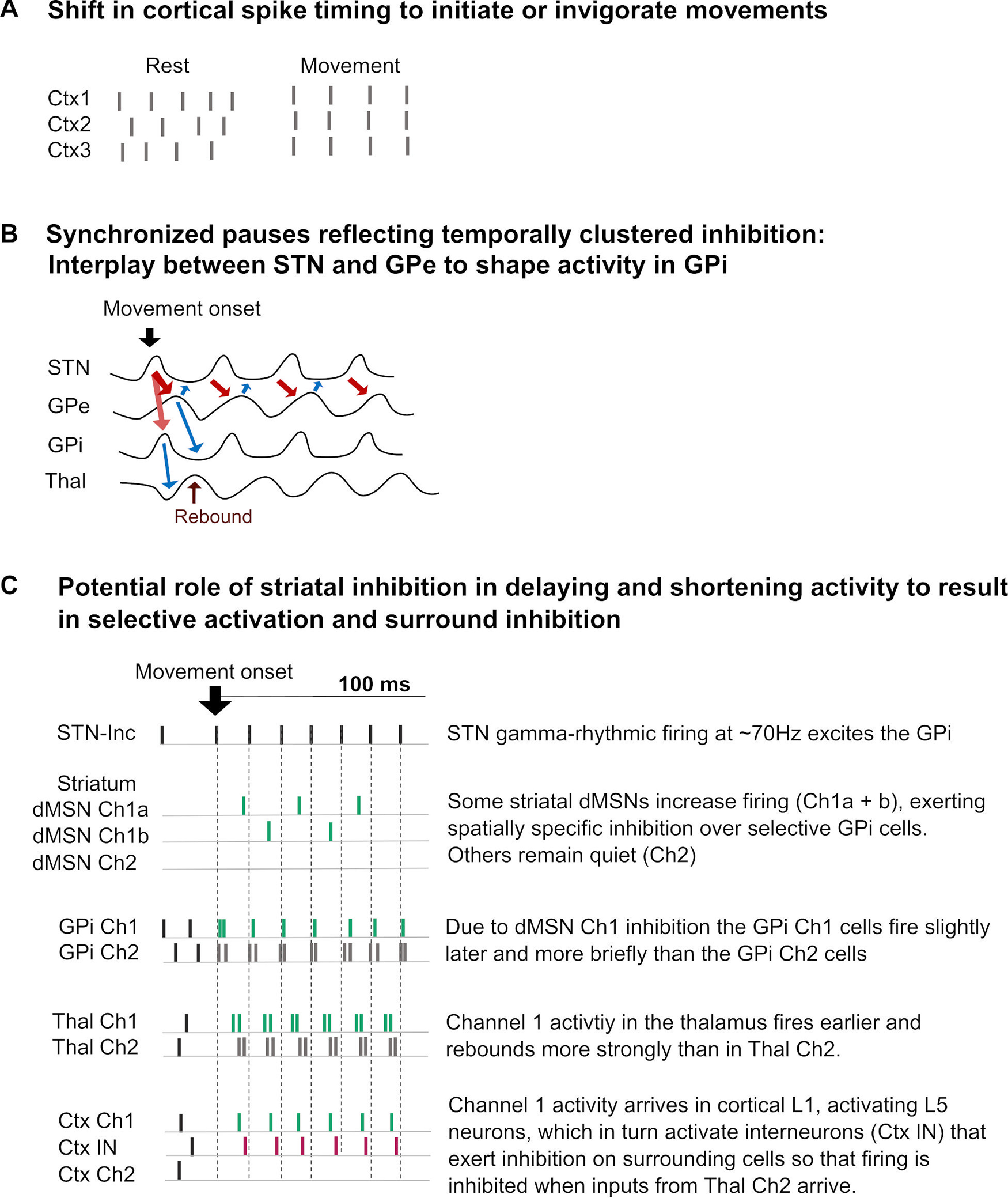
In humans, finely tuned γ synchronization (60-90 Hz) rapidly appears at movement onset in a motor control network involving primary motor cortex, the basal ganglia and motor thalamus. Yet the functional consequences of brief movement-related synchronization are still unclear. Distinct synchronization phenomena have also been linked to different forms of motor inhibition, including relaxing antagonist muscles, rapid movement interruption and stabilizing network dynamics for sustained contractions. Here, I will introduce detailed hypotheses about how intrasite and intersite synchronization could interact with firing rate changes in different parts of the network to enable flexible action control. The here proposed cause-and-effect relationships shine a spotlight on potential key mechanisms of cortico-basal ganglia-thalamo-cortical (CBGTC) communication. Confirming or revising these hypotheses will be critical in understanding the neuronal basis of flexible movement initiation, invigoration and inhibition. Ultimately, the study of more complex cognitive phenomena will also become more tractable once we understand the neuronal mechanisms underlying behavioral readouts.
在人类中,精细调节的γ同步(60 - 90赫兹)在涉及初级运动皮层、基底神经节和运动丘脑的运动控制网络中,在运动开始时迅速出现。然而,与运动相关的短暂同步的功能后果仍不清楚。不同的同步现象也与不同形式的运动抑制有关,包括放松拮抗肌、快速中断运动以及稳定持续收缩的网络动态。在此,我将详细介绍关于位点内和位点间同步如何与网络不同部分的放电率变化相互作用以实现灵活动作控制的假说。这里提出的因果关系揭示了皮质 - 基底神经节 - 丘脑 - 皮质(CBGTC)通信的潜在关键机制。证实或修正这些假说对于理解灵活运动启动、激活和抑制的神经元基础至关重要。最终,一旦我们理解了行为读数背后的神经元机制,对更复杂认知现象的研究也将变得更易于处理。