Division of Cell Biology I, The Netherlands Cancer Institute, Plesmanlaan 121, 1066 CX, Amsterdam, The Netherlands.
Department of Molecular Cell Biology and Immunology, Cancer Center Amsterdam, Amsterdam UMC, Vrije Universiteit Amsterdam, De Boelelaan 1117, Amsterdam, The Netherlands.
Sci Rep. 2021 Apr 21;11(1):8675. doi: 10.1038/s41598-021-88134-6.
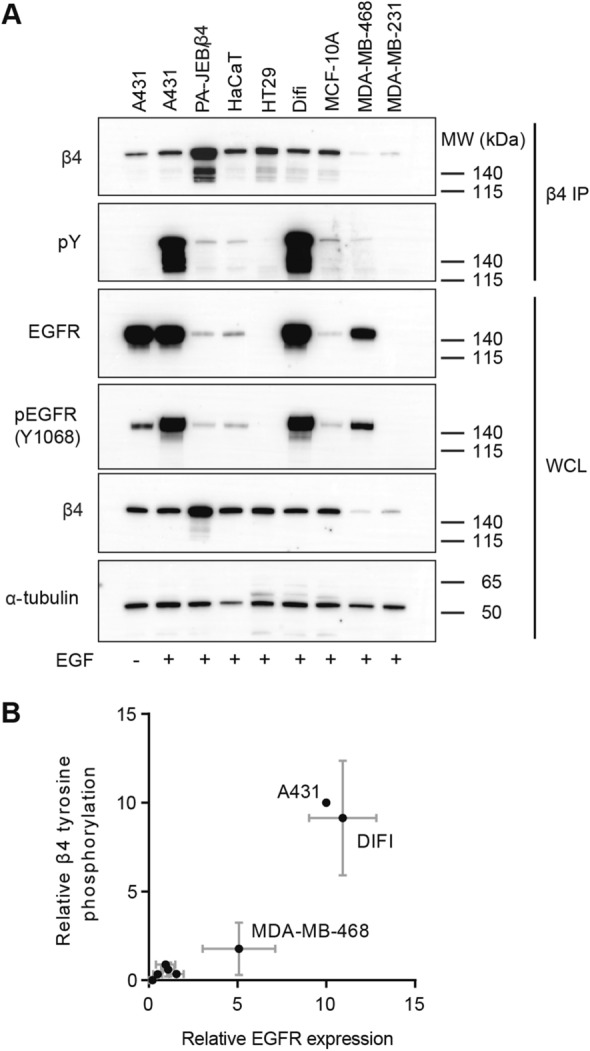
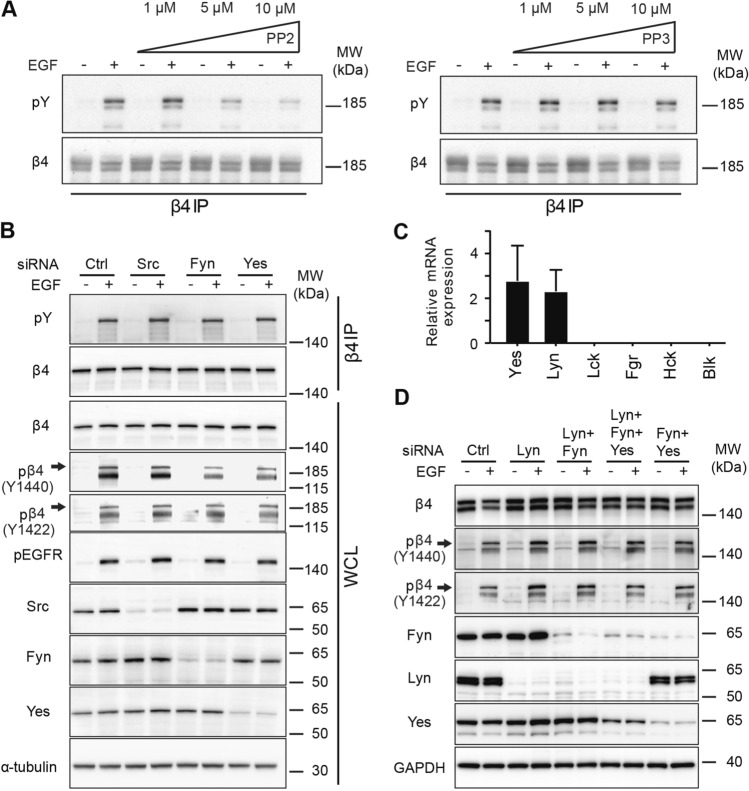
In epithelial cancers, the epidermal growth factor receptor (EGFR) and integrin α6β4 are frequently overexpressed and found to synergistically activate intracellular signaling pathways that promote cell proliferation and migration. In cancer cells, the β4 subunit is phosphorylated at tyrosine residues not normally recognized as kinase substrates; however, the function of these phosphotyrosine residues in cancer cells is a subject of much debate. In EGFR-overexpressing carcinoma cells, we found that the Src family kinase (SFK) inhibitor PP2 reduces β4 tyrosine phosphorylation following the activation of EGFR. However, siRNA mediated knockdown of the SFKs Src, Fyn, Yes and Lyn, individually or in combination, did not affect the EGF-induced phosphorylation of β4. Using phospho-peptide affinity chromatography and mass spectrometry, we found that PLCγ1 binds β4 at the phosphorylated residues Y1422/Y1440, but were unable to verify this interaction in A431 carcinoma cells that overexpress the EGFR. Furthermore, using A431 cells devoid of β4 or reconstituted with phenylalanine specific mutants of β4, the activation of several downstream signaling pathways, including PLCγ/PKC, MAPK and PI3K/Akt, were not substantially affected. We conclude that tyrosine-phosphorylated β4 does not enhance EGFR-mediated signaling in EGFR-overexpressing cells, despite the fact that this integrin subunit is highly tyrosine phosphorylated in these cells.
在上皮性肿瘤中,表皮生长因子受体(EGFR)和整合素α6β4 经常过度表达,并被发现协同激活细胞内信号通路,促进细胞增殖和迁移。在癌细胞中,β4 亚基在酪氨酸残基上被磷酸化,这些酪氨酸残基通常不被认为是激酶底物;然而,这些磷酸酪氨酸残基在癌细胞中的功能是一个备受争议的问题。在 EGFR 过表达的癌细胞中,我们发现 Src 家族激酶(SFK)抑制剂 PP2 可减少 EGFR 激活后β4 酪氨酸的磷酸化。然而,SFKs(Src、Fyn、Yes 和 Lyn)的 siRNA 介导敲低,单独或组合使用,均不影响 EGF 诱导的β4 磷酸化。通过磷酸肽亲和层析和质谱分析,我们发现 PLCγ1 在磷酸化残基 Y1422/Y1440 处与β4 结合,但未能在过度表达 EGFR 的 A431 癌细胞中验证这种相互作用。此外,在缺乏β4 的 A431 细胞或用β4 的苯丙氨酸特异性突变体重建的细胞中,几种下游信号通路的激活,包括 PLCγ/PKC、MAPK 和 PI3K/Akt,并未受到实质性影响。我们的结论是,尽管这些整合素亚基在这些细胞中高度酪氨酸磷酸化,但在 EGFR 过表达的细胞中,酪氨酸磷酸化的β4 并不能增强 EGFR 介导的信号转导。