Center for Reproductive Medicine, Department of Obstetrics and Gynecology, Qilu Hospital, Cheeloo College of Medicine, Shandong University, Jinan, Shandong, 250012, People's Republic of China.
Department of Reproductive Medicine, Jinan Central Hospital, Cheeloo College of Medicine, Shandong University, Jinan, 250013, People's Republic of China.
Drug Des Devel Ther. 2021 Apr 14;15:1521-1529. doi: 10.2147/DDDT.S297236. eCollection 2021.
This study aimed to assess the efficacy of vaginally versus orally administered estradiol (E) and dydrogesterone (DG) on the proliferative and secretory transformation of endometrium in patients with premature ovarian failure (POF) and preparing for assisted reproductive technology.
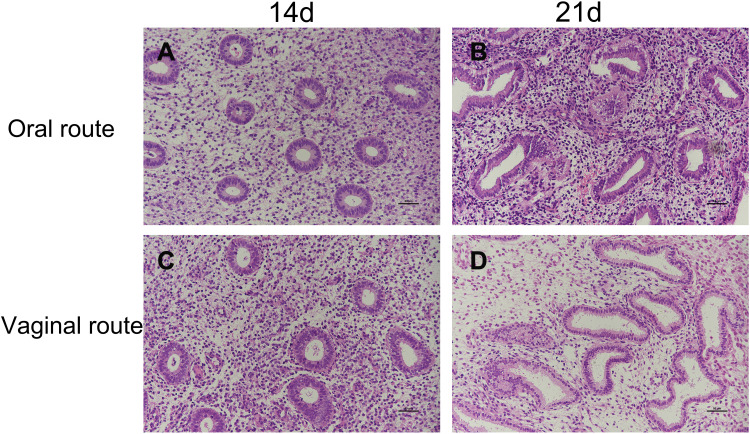
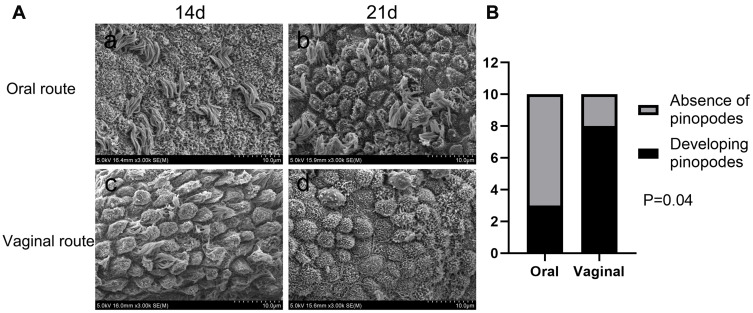
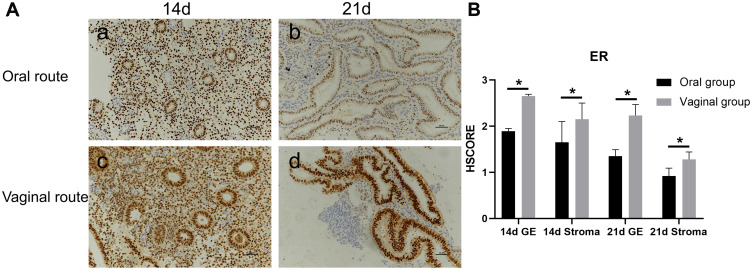
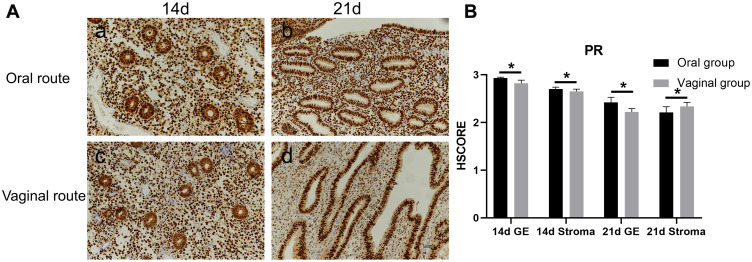
Twenty patients with POF who were awaiting oocyte donation were included in the study; they were randomly assigned to two groups to receive E and DG either orally or vaginally. Treatment efficacy was compared between the two groups regarding blood E concentrations, endometrial thickness, histology using hematoxylin and eosin staining, immunohistochemical analysis of ER expression, and PR and pinopodes morphology using scanning electron microscopy.
E concentrations differed significantly between oral and vaginal E and DG administration for 14 days (82.3 vs 1015.6 pg/mL; P < 0.001) and 21 days (85.0 vs 809.8 pg/mL; P < 0.001). Endometrial thickening was more pronounced in the vaginal treatment group, and also ER staining was stronger on days 14 and 21 in the vaginal treatment group. PR staining in the endometrium appeared more intense in the oral treatment group, which was, however, not significant. The abundance of developing pinopodes was higher in the vaginal treatment group (P = 0.04).
Vaginal administration of E and DG is more effective than oral administration regarding proliferative and secretory transformation of the endometrium in POF patients and preparing for assisted reproductive technology.
本研究旨在评估阴道与口服给予雌二醇(E)和地屈孕酮(DG)对卵巢早衰(POF)患者准备接受辅助生殖技术时子宫内膜增生和分泌转化的疗效。
本研究纳入了 20 名等待捐卵的 POF 患者,将其随机分为两组,分别给予口服或阴道途径 E 和 DG 治疗。比较两组患者的血 E 浓度、子宫内膜厚度、苏木精-伊红染色的组织学变化、ER 表达的免疫组化分析,以及采用扫描电子显微镜观察 PR 和微绒毛形态。
E 和 DG 阴道给药 14 天(82.3 与 1015.6 pg/mL;P < 0.001)和 21 天(85.0 与 809.8 pg/mL;P < 0.001)的血 E 浓度差异有统计学意义。阴道治疗组的子宫内膜增厚更明显,且在第 14 天和第 21 天阴道治疗组的 ER 染色也更强。子宫内膜 PR 染色在口服治疗组更明显,但差异无统计学意义。阴道治疗组中正在发育的微绒毛数量更多(P = 0.04)。
与口服途径相比,阴道给予 E 和 DG 更能有效促进 POF 患者子宫内膜的增生和分泌转化,为辅助生殖技术做准备。