Division of Cell Matrix Biology & Regenerative Medicine, School of Biological Sciences, The University of Manchester, Manchester, UK.
Division of Medical Education, School of Medical Sciences, The University of Manchester, Manchester, UK.
Cartilage. 2021 Dec;13(1_suppl):132S-146S. doi: 10.1177/19476035211007903. Epub 2021 Apr 22.
This systematic review aimed to determine whether coronal angular corrections correlate with patient reported outcomes following valgus-producing high tibial osteotomy (HTO).
Ovid MEDLINE, Embase, and Web of Science were systematically searched. Studies that reported hip-knee-ankle angles (HKA) or femorotibial angles (FTA), and the Oxford Knee Score (OKS), visual analogue scale (VAS) score, Knee Injury and Osteoarthritis Outcome Score (KOOS), or EQ-5D before and after valgus-producing HTO were eligible. Correlation analyses were performed where appropriate to investigate the relationships between variables. PROSPERO ID: CRD42019135467.
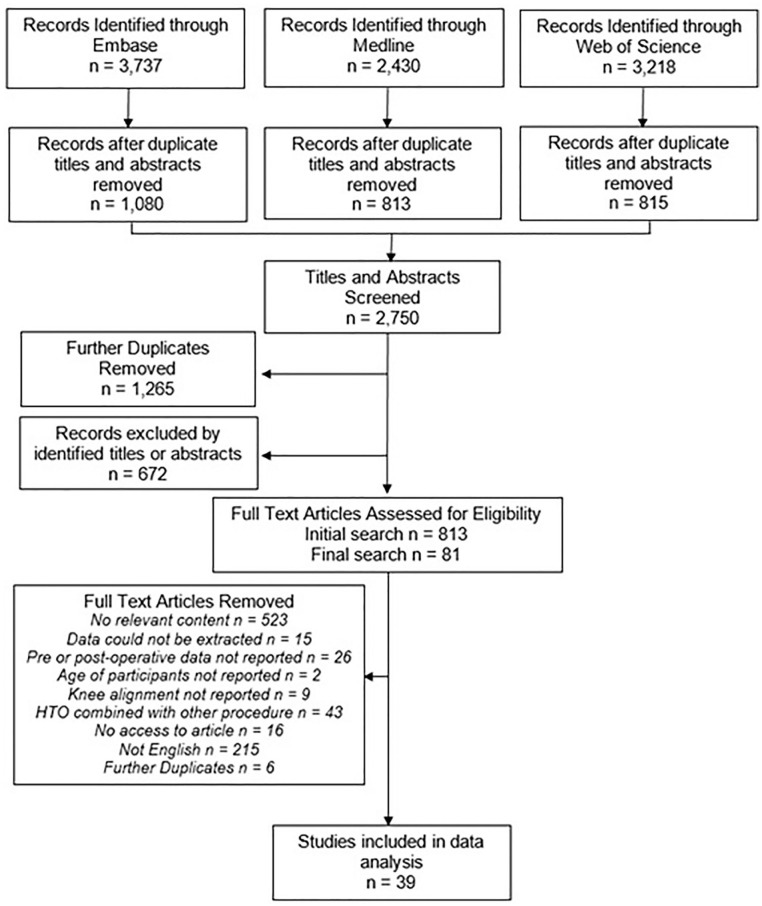
This study included 39 articles including 50 cohorts. VAS was reported in 22 studies, OKS in 9, KOOS in 12 and EQ-5D in 2. The HKA angle was corrected from 7.1° ± 1.7° varus to 2.3° ± 1.7° valgus at final follow-up. The FTA changed from 3.0° ± 2.0° varus to 7.7° ± 1.3° valgus. Outcome scores improved with clinical and statistical significance postoperatively. Spearman correlations for nonparametric data revealed greater changes in knee alignment were moderately associated with larger improvements in VAS scores ( = 0.50). Furthermore, those who experienced greater changes in alignment showed larger improvements in the KOOS Activity and Quality of Life domains ( = 0.72 and = 0.51, respectively).
On average, patients did not achieve the "ideal correction" of 3° to 6° valgus postoperatively. Nevertheless, statistical and clinical improvements in patient-reported outcome measure scores were consistently reported. This suggests that the "ideal correction" may be more flexible than 3° to 6°.
本系统评价旨在确定在产生外翻的胫骨高位截骨术(HTO)后,冠状角校正与患者报告的结果是否相关。
系统检索了 Ovid MEDLINE、Embase 和 Web of Science。符合条件的研究报告了髋膝踝角(HKA)或股胫角(FTA)以及牛津膝关节评分(OKS)、视觉模拟评分(VAS)、膝关节损伤与骨关节炎结果评分(KOOS)或 EQ-5D 在产生外翻的 HTO 前后。适当进行了相关性分析,以研究变量之间的关系。PROSPERO ID:CRD42019135467。
本研究纳入了 39 篇文章,共 50 个队列。22 项研究报告了 VAS,9 项研究报告了 OKS,12 项研究报告了 KOOS,2 项研究报告了 EQ-5D。最终随访时,HKA 角从 7.1°±1.7°内翻校正至 2.3°±1.7°外翻。FTA 从 3.0°±2.0°内翻变为 7.7°±1.3°外翻。术后临床和统计学上均有显著改善。非参数数据的斯皮尔曼相关性显示,膝关节对线的较大变化与 VAS 评分的较大改善呈中度相关( = 0.50)。此外,对线变化较大的患者在 KOOS 活动和生活质量领域的改善也更大( = 0.72 和 = 0.51)。
平均而言,患者术后并未达到 3°至 6°外翻的“理想矫正”。然而,患者报告的测量结果评分的统计学和临床改善仍有一致的报道。这表明“理想矫正”可能比 3°至 6°更灵活。