Centre for Neuroscience and Regenerative Medicine, Faculty of Science, University of Technology Sydney, Sydney, New South Wales 2007, Australia.
St Vincent's Centre for Applied Medical Research, Sydney, New South Wales 2011, Australia.
J Neurosci. 2021 May 5;41(18):4120-4130. doi: 10.1523/JNEUROSCI.2786-20.2021. Epub 2021 Apr 22.
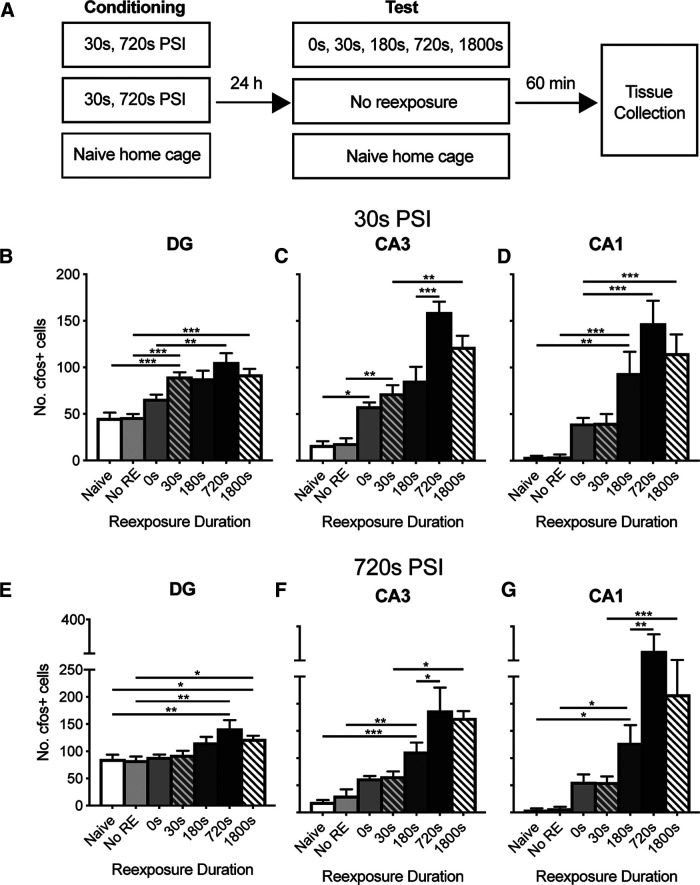
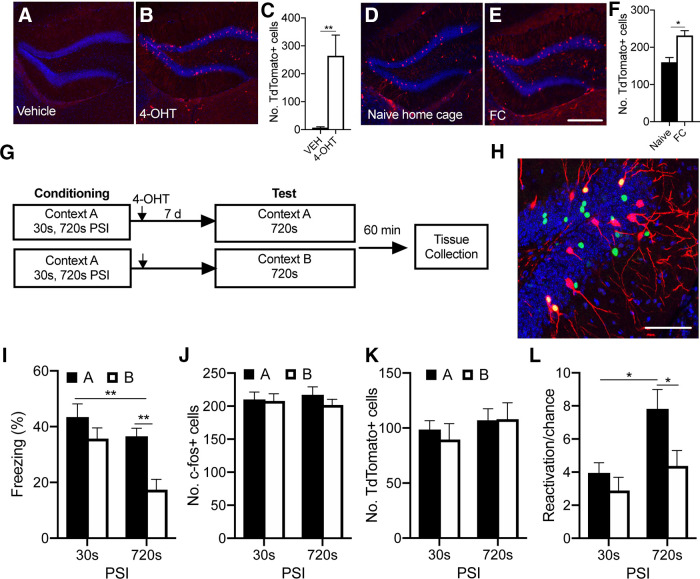
Memories are rarely acquired under ideal conditions, rendering them vulnerable to profound omissions, errors, and ambiguities. Consistent with this, recent work using context fear conditioning has shown that memories formed after inadequate learning time display a variety of maladaptive properties, including overgeneralization to similar contexts. However, the neuronal basis of such poor learning and memory imprecision remains unknown. Using c-fos to track neuronal activity in male mice, we examined how these learning-dependent changes in context fear memory precision are encoded in hippocampal ensembles. We found that the total number of c-fos-encoding cells did not correspond with learning history but instead more closely reflected the length of the session immediately preceding c-fos measurement. However, using a c-fos-driven tagging method ( mouse line), we found that the degree of learning and memory specificity corresponded with neuronal activity in a subset of dentate gyrus cells that were active during both learning and recall. Comprehensive memories acquired after longer learning intervals were associated with more double-labeled cells. These were preferentially reactivated in the conditioning context compared with a similar context, paralleling behavioral discrimination. Conversely, impoverished memories acquired after shorter learning intervals were associated with fewer double-labeled cells. These were reactivated equally in both contexts, corresponding with overgeneralization. Together, these findings provide two surprising conclusions. First, engram size varies with learning. Second, larger engrams support better neuronal and behavioral discrimination. These findings are incorporated into a model that describes how neuronal activity is influenced by previous learning and present experience, thus driving behavior. Memories are not always formed under ideal circumstances. This is especially true in traumatic situations, such as car accidents, where individuals have insufficient time to process what happened around them. Such memories have the potential to overgeneralize to irrelevant situations, producing inappropriate fear and contributing to disorders, such as post-traumatic stress disorder. However, it is unknown how such poorly formed fear memories are encoded within the brain. We find that restricting learning time results in fear memories that are encoded by fewer hippocampal cells. Moreover, these fewer cells are inappropriately reactivated in both dangerous and safe contexts. These findings suggest that fear memories formed at brief periods overgeneralize because they lack the detail-rich information necessary to support neuronal discrimination.
记忆很少是在理想条件下获得的,这使得它们容易出现严重的遗漏、错误和模糊。最近使用情景恐惧条件反射的研究工作表明,在学习时间不足的情况下形成的记忆表现出多种适应不良的特性,包括对相似情景的过度泛化。然而,这种不良学习和记忆不精确的神经基础仍然未知。我们使用 c-fos 追踪雄性小鼠海马体中的神经元活动,研究了情景恐惧记忆精度的这些学习依赖性变化是如何在海马体集合中编码的。我们发现,c-fos 编码细胞的总数与学习历史无关,而是更紧密地反映了 c-fos 测量之前的会话长度。然而,使用 c-fos 驱动的标记方法(mouse line),我们发现,学习和记忆特异性的程度与在学习和回忆过程中都活跃的齿状回细胞中的一小部分神经元活动相对应。在较长的学习间隔后获得的综合记忆与更多的双标记细胞相关。这些细胞在条件性情境中比在相似情境中更优先被重新激活,与行为辨别相对应。相反,在较短的学习间隔后获得的贫瘠记忆与较少的双标记细胞相关。这些细胞在两个情境中被同等激活,对应于过度泛化。总之,这些发现提供了两个令人惊讶的结论。首先,记忆痕迹的大小随学习而变化。其次,更大的记忆痕迹支持更好的神经元和行为辨别。这些发现被纳入一个模型,该模型描述了神经元活动如何受到先前学习和当前经验的影响,从而驱动行为。记忆并不总是在理想条件下形成。在创伤性情况下更是如此,例如车祸,个体没有足够的时间来处理周围发生的事情。这些记忆有可能泛化到不相关的情况,产生不适当的恐惧,并导致创伤后应激障碍等障碍。然而,目前尚不清楚大脑中是如何对这些形成不良的恐惧记忆进行编码的。我们发现,限制学习时间会导致由较少的海马体细胞编码的恐惧记忆。此外,这些较少的细胞在危险和安全的环境中都会被不恰当地重新激活。这些发现表明,在短时间内形成的恐惧记忆会过度泛化,因为它们缺乏支持神经元辨别所需的详细信息。