Department of Medicine and Nutrition, University of Guanajuato, León, Guanajuato, Mexico.
Department of Medical Sciences, University of Guanajuato, León, Guanajuato, Mexico.
Sci Rep. 2021 Apr 22;11(1):8750. doi: 10.1038/s41598-021-88108-8.
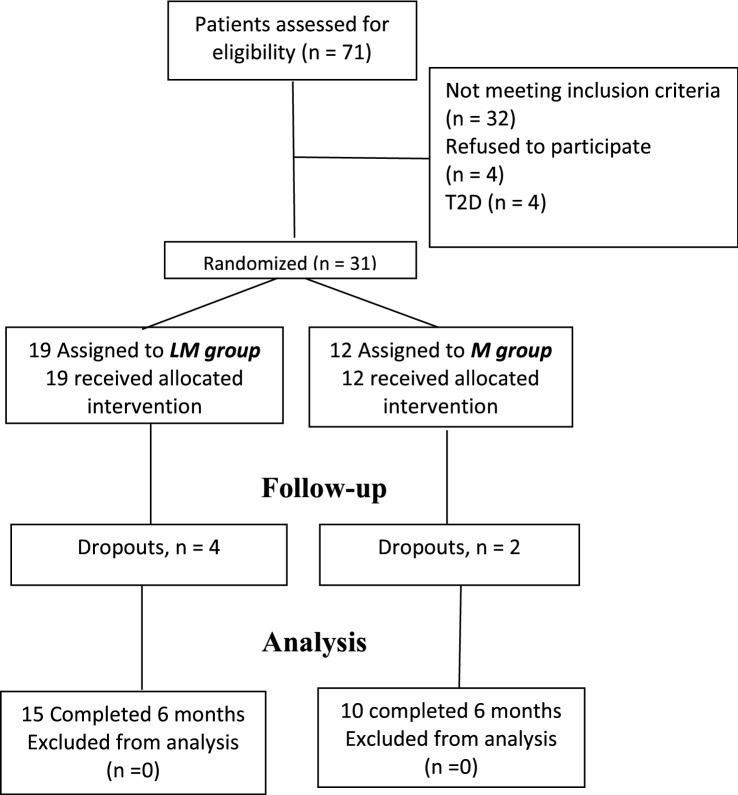
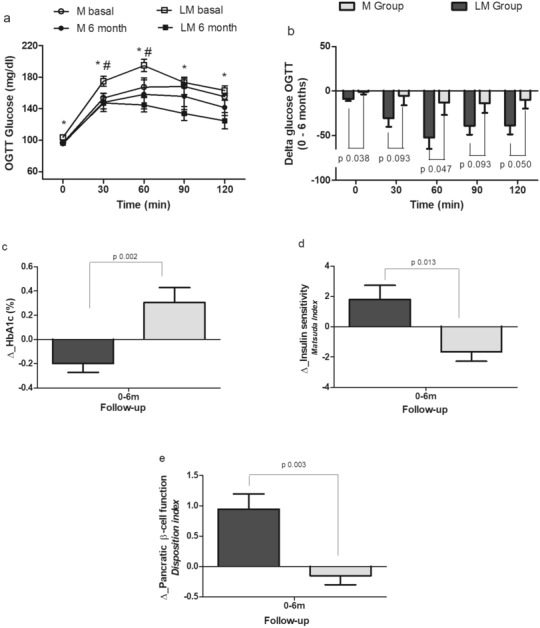
The goal of the study was to evaluate the effect of adding linagliptin to metformin and lifestyle on glucose levels and pancreatic β-cell function in patients with persistent impaired glucose tolerance (IGT) after 12 months of metformin and lifestyle. A single center parallel double-blind randomized clinical trial with 6 months of follow-up was performed in patients with persistent IGT after 12 months of treatment with metformin and lifestyle; patients were randomized to continue with metformin 850 mg twice daily (M group, n = 12) or linagliptin/metformin 2.5/850 mg twice daily (LM group, n = 19). Anthropometric measurements were obtained by standard methods and by bioelectrical impedance; glucose was measured by dry chemistry, insulin by chemiluminescence, and pancreatic β-cell function was calculated with the disposition index using glucose and insulin values during oral glucose tolerance test (OGTT) and adjusting by insulin sensitivity. The main outcomes were glucose levels during OGTT and pancreatic β-cell function. Patients in the LM group had a reduction in weight (-1.7 ± 0.6, p < 0.05) and body mass index (BMI, -0.67 ± 0.2, p < 0.05). Glucose levels significantly improved in LM group with a greater reduction in the area under the glucose curve during OGTT (AUCGluc) as compared to the M group (-4425 ± 871 vs -1116 ± 1104 mg/dl/120 min, p < 0.001). Pancreatic β-cell function measured with the disposition index, improved only in LM group (2.3 ± 0.23 vs 1.7 ± 0.27, p 0.001); these improvements persisted after controlling for OGTT glucose levels. The differences in pancreatic β-cell function persisted also after pairing groups for basal AUCGluc. The addition of linagliptin to patients with persistent IGT after 12 months of treatment with metformin and lifestyle, improved glucose levels during OGTT and pancreatic β-cell function after 6 months of treatment.Trial registration: Clinicaltrials.gov with the ID number NCT04088461.
该研究的目的是评估在二甲双胍和生活方式治疗 12 个月后仍存在糖耐量受损(IGT)的患者中,加用利拉利汀对二甲双胍和生活方式治疗的血糖水平和胰岛β细胞功能的影响。在二甲双胍和生活方式治疗 12 个月后仍存在 IGT 的患者中进行了一项为期 6 个月随访的单中心平行双盲随机临床试验;患者被随机分为继续服用二甲双胍 850mg 每日 2 次(M 组,n=12)或利拉利汀/二甲双胍 2.5/850mg 每日 2 次(LM 组,n=19)。通过标准方法和生物电阻抗测量人体测量学指标;通过干化学法测量血糖,通过化学发光法测量胰岛素,通过口服葡萄糖耐量试验(OGTT)期间的血糖和胰岛素值计算胰岛β细胞功能,并通过胰岛素敏感性进行调整。主要结局为 OGTT 时的血糖水平和胰岛β细胞功能。LM 组患者体重(-1.7±0.6,p<0.05)和体重指数(BMI,-0.67±0.2,p<0.05)降低。与 M 组相比,LM 组患者 OGTT 时血糖水平显著改善,OGTT 时血糖曲线下面积(AUCGluc)降低更明显(-4425±871 与-1116±1104mg/dl/120min,p<0.001)。仅 LM 组的胰岛β细胞功能通过处置指数测量有所改善(2.3±0.23 与 1.7±0.27,p<0.001);这些改善在控制 OGTT 血糖水平后仍然存在。配对基础 AUCGluc 后,胰岛β细胞功能的差异仍然存在。在二甲双胍和生活方式治疗 12 个月后仍存在 IGT 的患者中加用利拉利汀,可改善 OGTT 时的血糖水平和治疗 6 个月后的胰岛β细胞功能。试验注册:Clinicaltrials.gov 登记号 NCT04088461。