Joseph Adedayo O, Li Ya-Huei, Salako Omolola, Doi Suhail, Balogun Onyinye D, Awofeso Opeyemi M, Abdulkareem Fatimah, Onitilo Adedayo A
NSIA-LUTH Cancer Treatment Center, Lagos University Teaching Hospital, Lagos, Nigeria.
Cancer Care and Research Center, Marshfield Clinic Research Institute, Marshfield, Wisconsin 54449, USA.
Ecancermedicalscience. 2021 Feb 23;15:1190. doi: 10.3332/ecancer.2021.1190. eCollection 2021.
Diagnosis and treatment of cancer rely heavily on imaging, histopathology and molecular information. Incomplete or missing tumour information can hinder the delivery of high-quality care in oncology practice, especially in resource-limited countries. To evaluate the completeness of histopathology reporting in a real-world setting and identify areas for future cancer care delivery research efforts, we retrospectively analysed reports from patients diagnosed with breast cancer who received care at a high-volume oncology department at a hospital in Lagos, Nigeria.
Demographic, institutional and histopathology characteristics were retrospectively obtained from 1,001 patient records from 2007 to 2016. Completeness was defined as reporting five tumour features (tumour histology, tumour grade, laterality, oestrogen receptor (ER) or progesterone receptor (PR) and human epidermal growth factor receptor 2 (HER2)) for biopsy specimens and seven tumour features (tumour size, tumour histology, tumour grade, laterality, ER/PR, HER2 and lymph node involvement) for surgical specimens.
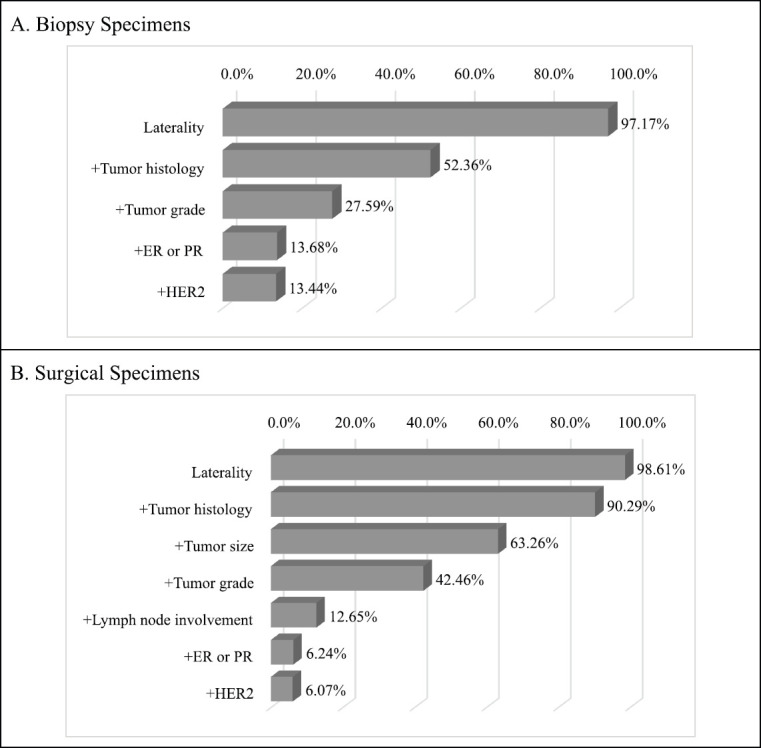
The mean age of patients was 48.6 ± 11.7 years with a predominantly female population (99.3%). A majority of pathologic reports were produced after 2011, and two-thirds of the reports originated from centres or labs within Lagos, Nigeria (67.7%). Most reports documented primary site (98.0%) and specimen type (85.0%) while other characteristics were less often recorded. This led to substantial variation in reporting between biopsy (13.4%) and surgical (6.1%) specimens for an overall low pathology report completeness <10%.
The majority of patient records analysed lacked complete documentation of breast cancer histopathological characteristics commonly used in oncology practice. Our study highlights a need to identify and address the contributing factors for incomplete histopathological reporting in Nigeria and will guide future clinical programmatic developments.
癌症的诊断和治疗在很大程度上依赖于影像学、组织病理学和分子信息。肿瘤信息不完整或缺失会阻碍肿瘤学实践中高质量护理的提供,尤其是在资源有限的国家。为了评估实际环境中组织病理学报告的完整性,并确定未来癌症护理研究工作的重点领域,我们回顾性分析了在尼日利亚拉各斯一家医院的高容量肿瘤科室接受治疗的乳腺癌患者的报告。
回顾性收集了2007年至2016年1001例患者记录中的人口统计学、机构和组织病理学特征。完整性定义为活检标本报告五个肿瘤特征(肿瘤组织学、肿瘤分级、侧别、雌激素受体(ER)或孕激素受体(PR)以及人表皮生长因子受体2(HER2)),手术标本报告七个肿瘤特征(肿瘤大小、肿瘤组织学、肿瘤分级、侧别、ER/PR、HER2和淋巴结受累情况)。
患者的平均年龄为48.6±11.7岁,以女性为主(99.3%)。大多数病理报告产生于2011年之后,三分之二的报告来自尼日利亚拉各斯市内的中心或实验室(67.7%)。大多数报告记录了原发部位(98.0%)和标本类型(85.0%),而其他特征的记录较少。这导致活检标本(13.4%)和手术标本(6.1%)报告的完整性存在很大差异,总体病理报告完整性较低,<10%。
分析的大多数患者记录缺乏肿瘤学实践中常用的乳腺癌组织病理学特征的完整记录。我们的研究强调需要识别和解决尼日利亚组织病理学报告不完整的影响因素,并将指导未来的临床项目发展。