Adebiyi Janet Adeyinka, Njobeh Patrick Berka, Adebo Oluwafemi Ayodeji, Kayitesi Eugenie
Department of Biotechnology and Food Technology, Faculty of Science, University of Johannesburg, PO Box 17011, Doornfontein Campus, Gauteng, South Africa.
Department of Consumer and Food Sciences, Faculty of Natural and Agricultural Sciences, University of Pretoria, Private Bag X20, Hatfield 0028, Pretoria, South Africa.
Heliyon. 2021 Apr 3;7(4):e06666. doi: 10.1016/j.heliyon.2021.e06666. eCollection 2021 Apr.
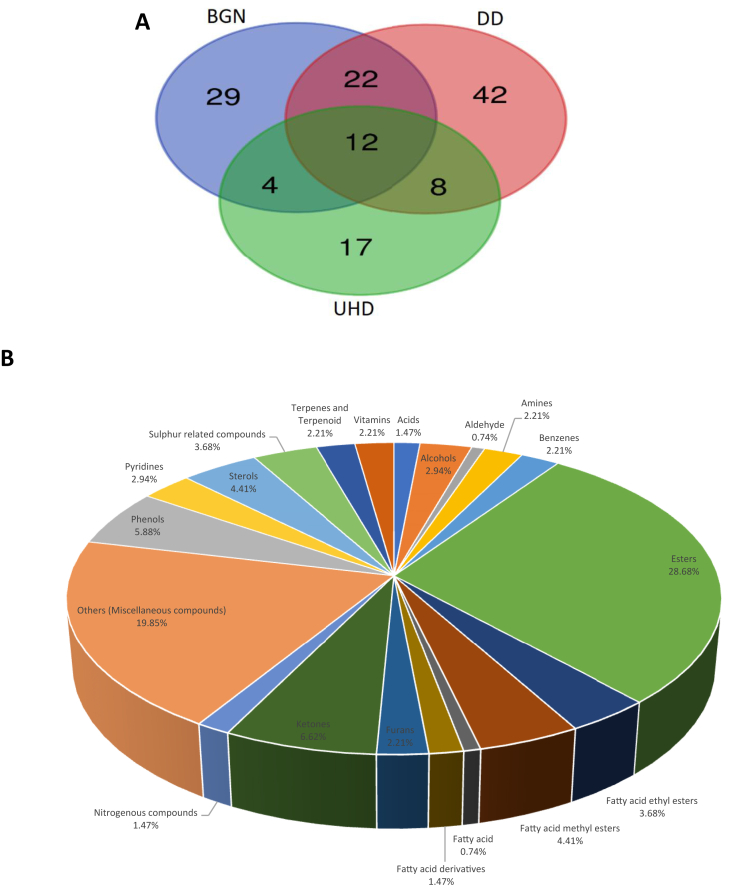
Metabolite profile provides an overview and avenue for the detection of a vast number of metabolites in food sample at a particular time. Gas chromatography high resolution time-of-flight mass spectrometry (GC-HRTOF-MS) is one of such techniques that can be utilized for profiling known and unknown compounds in a food sample. In this study, the metabolite profiles of Bambara groundnut and (unhulled and dehulled) were investigated using GC-HRTOF-MS. The presence of varying groups of metabolites, including aldehydes, sterols, ketones, alcohols, nitrogen-containing compounds, furans, pyridines, acids, vitamins, fatty acids, sulphur-related compounds, esters, terpenes and terpenoids were reported. Bambara groundnut fermented into derived products induced either an increase or decrease as well as the formation of some metabolites. The major compounds (with their peak area percentages) identified in Bambara groundnut were furfuryl ether (9.31%), bis (2-(dimethylamino)ethyl) ether (7.95%), 2-monopalmitin (7.88%), hexadecanoic acid, methyl ester (6.98%), 9,12-octadecadienoic acid (Z,Z) and 2-hydroxy-1-(hydroxymethyl)ethyl ester (5.82%). For dehulled , the significant compounds were palmitic acid, ethyl ester (17.7%), lauric acid, ethyl ester (10.2%), carbonic acid, 2-dimethylaminoethyl 2-methoxyethyl ester (7.3%), 9,12-octadecadienoic acid (Z,Z)-, 2-hydroxy-1-(hydroxymethyl)ethyl ester (5.13%) and maltol (4%), while for undehulled , it was indoline, 2-(hydroxydiphenylmethyl) (26.1%), benzoic acid, 4-amino-4-hydroximino-2,2,6,6-tetramethyl-1-piperidinyl ester (8.2%), 2-undecen-4-ol (4.7%), 2-methylbutyl propanoate (4.7%) and ë-tocopherol (4.3%). These observed metabolites reported herein provides an overview of the metabolites in these investigated foods, some of which could be related to nutrition, bioactivity as well as sensory properties. It is important to emphasize that based on some of the metabolites detected, it could be suggested that Bambara groundnut and derived might serve as functional foods that are beneficial to health.
代谢物谱为在特定时间检测食品样品中的大量代谢物提供了一个总体情况和途径。气相色谱高分辨率飞行时间质谱法(GC-HRTOF-MS)就是可用于分析食品样品中已知和未知化合物的此类技术之一。在本研究中,使用GC-HRTOF-MS对 Bambara 花生(带壳和去壳)的代谢物谱进行了研究。报告了不同种类代谢物的存在,包括醛类、甾醇类、酮类、醇类、含氮化合物、呋喃类、吡啶类、酸类、维生素、脂肪酸、硫相关化合物、酯类、萜类和萜类化合物。发酵成衍生产品的 Bambara 花生会导致某些代谢物的增加、减少以及形成。在 Bambara 花生中鉴定出的主要化合物(及其峰面积百分比)为糠基醚(9.31%)、双(2-(二甲基氨基)乙基)醚(7.95%)、2-单棕榈酸甘油酯(7.88%)、十六烷酸甲酯(6.98%)、9,12-十八碳二烯酸(Z,Z)和 2-羟基-1-(羟甲基)乙酯(5.82%)。对于去壳的[具体名称未给出],显著化合物为棕榈酸乙酯(17.7%)、月桂酸乙酯(10.2%)、碳酸 2-二甲基氨基乙基 2-甲氧基乙酯(7.3%)、9,12-十八碳二烯酸(Z,Z)-2-羟基-1-(羟甲基)乙酯(5.13%)和麦芽酚(4%),而对于带壳的[具体名称未给出],则是吲哚啉,2-(羟基二苯基甲基)(26.1%)、苯甲酸,4-氨基-4-羟亚氨基-2,2,6,6-四甲基-1-哌啶酯(8.2%)、2-十一碳烯-4-醇(4.7%)、2-甲基丁基丙酸酯(4.7%)和γ-生育酚(4.3%)。本文报道的这些观察到的代谢物提供了这些被研究食品中代谢物的总体情况,其中一些可能与营养、生物活性以及感官特性有关。需要强调的是,基于检测到的一些代谢物,可以认为 Bambara 花生及其衍生产品可能作为对健康有益的功能性食品。