Her Qoua, Kent Thomas, Samizo Yuji, Slavkovic Aleksandra, Vilk Yury, Toh Sengwee
Department of Population Medicine, Harvard Medical School, Boston, MA, United States.
Harvard Pilgrim Health Care Institute, Boston, MA, United States.
JMIR Med Inform. 2021 Apr 23;9(4):e21459. doi: 10.2196/21459.
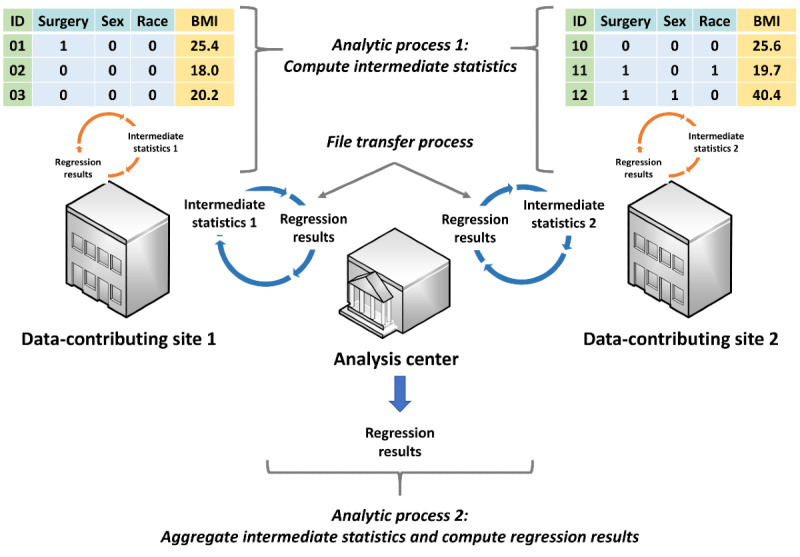
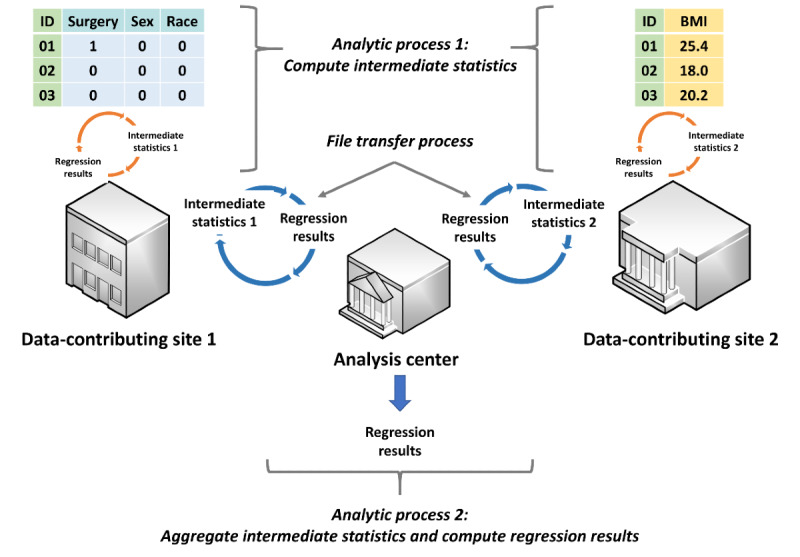
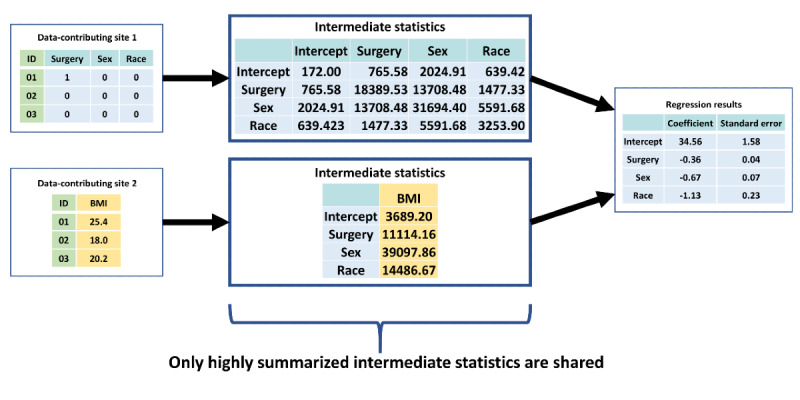
In clinical research, important variables may be collected from multiple data sources. Physical pooling of patient-level data from multiple sources often raises several challenges, including proper protection of patient privacy and proprietary interests. We previously developed an SAS-based package to perform distributed regression-a suite of privacy-protecting methods that perform multivariable-adjusted regression analysis using only summary-level information-with horizontally partitioned data, a setting where distinct cohorts of patients are available from different data sources. We integrated the package with PopMedNet, an open-source file transfer software, to facilitate secure file transfer between the analysis center and the data-contributing sites. The feasibility of using PopMedNet to facilitate distributed regression analysis (DRA) with vertically partitioned data, a setting where the data attributes from a cohort of patients are available from different data sources, was unknown.
The objective of the study was to describe the feasibility of using PopMedNet and enhancements to PopMedNet to facilitate automatable vertical DRA (vDRA) in real-world settings.
We gathered the statistical and informatic requirements of using PopMedNet to facilitate automatable vDRA. We enhanced PopMedNet based on these requirements to improve its technical capability to support vDRA.
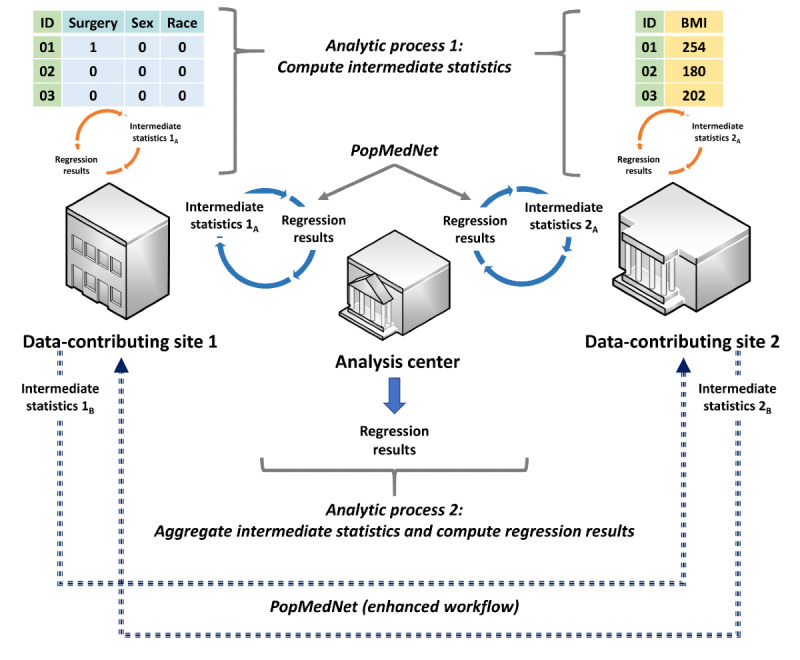
PopMedNet can enable automatable vDRA. We identified and implemented two enhancements to PopMedNet that improved its technical capability to perform automatable vDRA in real-world settings. The first was the ability to simultaneously upload and download multiple files, and the second was the ability to directly transfer summary-level information between the data-contributing sites without a third-party analysis center.
PopMedNet can be used to facilitate automatable vDRA to protect patient privacy and support clinical research in real-world settings.
在临床研究中,重要变量可能从多个数据源收集。从多个来源对患者层面的数据进行物理合并通常会带来若干挑战,包括对患者隐私和专有利益的妥善保护。我们之前开发了一个基于SAS的软件包来执行分布式回归——这是一套隐私保护方法,使用仅汇总级信息对水平分区数据进行多变量调整回归分析,在这种情况下,不同队列的患者可从不同数据源获得。我们将该软件包与开源文件传输软件PopMedNet集成,以促进分析中心与数据提供站点之间的安全文件传输。使用PopMedNet促进对垂直分区数据进行分布式回归分析(DRA)的可行性尚不清楚,在这种情况下,一组患者的数据属性可从不同数据源获得。
本研究的目的是描述在现实环境中使用PopMedNet及其增强功能来促进可自动化的垂直DRA(vDRA)的可行性。
我们收集了使用PopMedNet促进可自动化vDRA的统计和信息学要求。我们根据这些要求对PopMedNet进行了增强,以提高其支持vDRA的技术能力。
PopMedNet可以实现可自动化的vDRA。我们确定并实施了对PopMedNet的两项增强功能,提高了其在现实环境中执行可自动化vDRA的技术能力。第一项是同时上传和下载多个文件的能力,第二项是在无需第三方分析中心的情况下在数据提供站点之间直接传输汇总级信息的能力。
PopMedNet可用于促进可自动化的vDRA,以保护患者隐私并支持现实环境中的临床研究。