Berne Cardiovascular Research Center USA; Department of Cardiology USA; Hematovascular Biology Center, University of Virginia, School of Medicine, Charlottesville, VA, 22908 USA.
Berne Cardiovascular Research Center USA; Department of Cardiology USA; Hematovascular Biology Center, University of Virginia, School of Medicine, Charlottesville, VA, 22908 USA.
Trends Cardiovasc Med. 2022 May;32(4):198-203. doi: 10.1016/j.tcm.2021.04.005. Epub 2021 Apr 20.
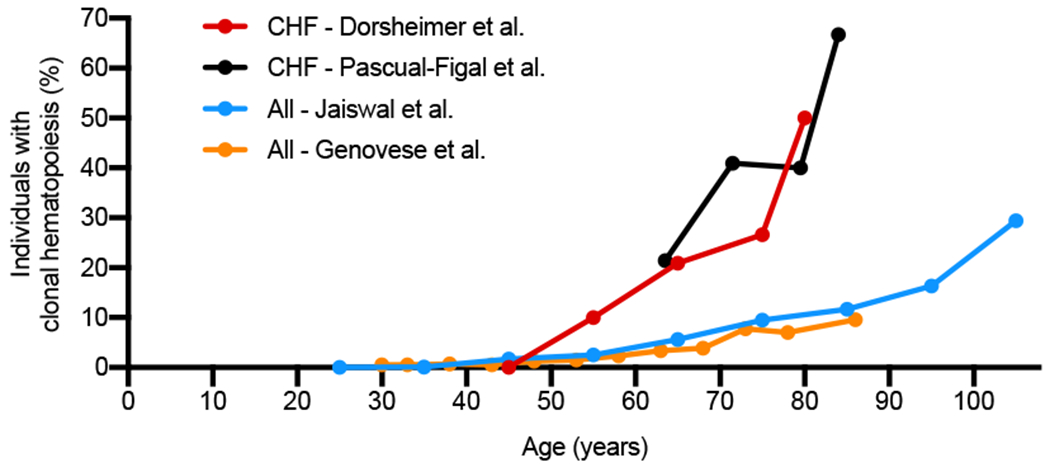
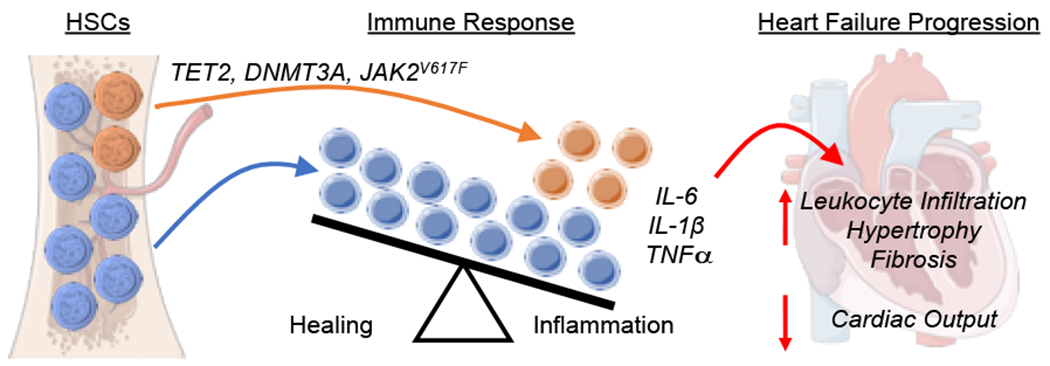
Heart failure is prevalent in the elderly population. Inflammatory processes can contribute to the progression of heart failure by altering the balance of tissue healing and pathological remodeling during the injury response. New findings show that aging can alter immune cell phenotypes through the process of clonal hematopoiesis. This condition results from acquired somatic DNA mutations in specific driver genes that give rise to clonal expansions of mutant hematopoietic cells with overactive inflammatory properties. Recent clinical and experimental studies have shown that clonal hematopoiesis is prevalent in heart failure patients and associated with poor prognosis. In this review, we summarize current evidence that associates clonal hematopoiesis with the progression of heart failure. We further describe the mechanistic links between clonal hematopoiesis and the pro-inflammatory responses that can contribute to pathological outcomes in the heart. Finally, we provide perspectives on future research directions in the area of clonal hematopoiesis and heart failure.
心力衰竭在老年人群中较为普遍。炎症过程可通过改变损伤反应过程中组织修复和病理性重塑之间的平衡,从而促进心力衰竭的进展。新的研究结果表明,衰老可通过克隆性造血过程改变免疫细胞表型。这种情况是由于特定驱动基因获得性体细胞 DNA 突变引起的,导致具有过度活跃炎症特性的突变造血细胞的克隆性扩增。最近的临床和实验研究表明,克隆性造血在心力衰竭患者中较为普遍,并与预后不良相关。在这篇综述中,我们总结了将克隆性造血与心力衰竭进展相关联的现有证据。我们进一步描述了克隆性造血与促炎反应之间的机制联系,这些反应可能导致心脏的病理性结局。最后,我们对克隆性造血和心力衰竭领域的未来研究方向提供了一些观点。