School of Biosciences, University of Birmingham, Edgbaston, Birmingham, B15 2TT, UK.
Department of Pharmacology and Toxicology, College of Pharmacy, Qassim University, 51 452, Qassim, Kingdom of Saudi Arabia.
BMC Psychiatry. 2021 Apr 23;21(1):209. doi: 10.1186/s12888-021-03188-0.
It is estimated that up to 75% of patients with severe mental illness (SMI) also have substance use disorder (SUD). The aim of this systematic review was to explore the scope, quality and inclusivity of international clinical guidelines on mental health and/or substance abuse in relation to diagnosis and treatment of co-existing disorders and considerations for wider social and contextual factors in treatment recommendations.
A protocol (PROSPERO CRD42020187094) driven systematic review was conducted. A systematic search was undertaken using six databases including MEDLINE, Cochrane Library, EMBASE, PsychInfo from 2010 till June 2020; and webpages of guideline bodies and professional societies. Guideline quality was assessed based on 'Appraisal of Guidelines for Research & Evaluation II' (AGREE II) tool. Data was extracted using a pre-piloted structured data extraction form and synthesized narratively. Reporting was based on PRISMA guideline.
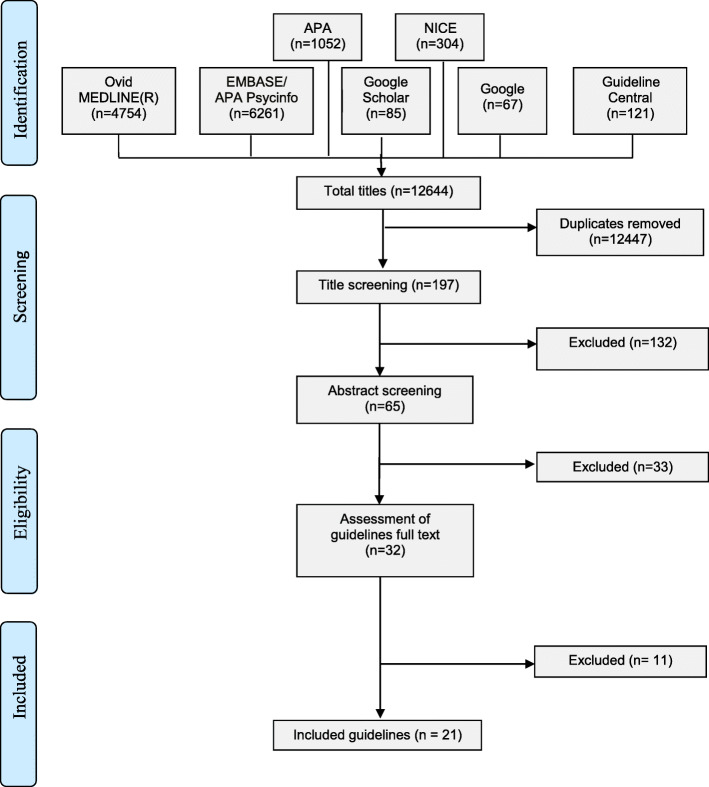
A total of 12,644 records were identified. Of these, 21 guidelines were included in this review. Three of the included guidelines were related to coexisting disorders, 11 related to SMI, and 7 guidelines were related to SUD. Seven (out of 18) single disorder guidelines did not adequately recommend the importance of diagnosis or treatment of concurrent disorders despite their high co-prevalence. The majority of the guidelines (n = 15) lacked recommendations for medicines optimisation in accordance with concurrent disorders (SMI or SUD) such as in the context of drug interactions. Social cause and consequence of dual diagnosis such as homelessness and safeguarding and associated referral pathways were sparsely mentioned.
Despite very high co-prevalence, clinical guidelines for SUD or SMI tend to have limited considerations for coexisting disorders in diagnosis, treatment and management. There is a need to improve the scope, quality and inclusivity of guidelines to offer person-centred and integrated care.
据估计,多达 75%的严重精神疾病(SMI)患者也存在物质使用障碍(SUD)。本系统评价的目的是探讨国际精神健康和/或物质滥用临床指南在诊断和治疗共病以及治疗建议中更广泛的社会和背景因素方面的范围、质量和包容性。
采用议定书(PROSPERO CRD42020187094)驱动的系统评价。从 2010 年到 2020 年 6 月,使用包括 MEDLINE、Cochrane 图书馆、EMBASE、PsychInfo 在内的六个数据库,以及指南制定机构和专业协会的网页,进行了系统搜索。根据“评估研究和评价 II”(AGREE II)工具评估指南质量。使用预先制定的结构化数据提取表格提取数据,并进行叙述性综合。报告基于 PRISMA 指南。
共确定了 12644 条记录。其中,21 条指南被纳入本研究。纳入的指南中有 3 条与共病有关,11 条与 SMI 有关,7 条与 SUD 有关。尽管共病的高共病率,7 条单病种指南中有 7 条(占 18 条)没有充分建议诊断或治疗共病。尽管存在药物相互作用等情况下药物优化的问题,但大多数指南(n=15)缺乏针对共病(SMI 或 SUD)的建议。双重诊断的社会原因和后果,如无家可归和保障以及相关的转诊途径,很少被提及。
尽管共病的共病率非常高,但 SUD 或 SMI 的临床指南在诊断、治疗和管理方面往往对共病考虑有限。需要提高指南的范围、质量和包容性,以提供以患者为中心和综合的护理。