Ntari Lydia, Nikolaou Christoforos, Kranidioti Ksanthi, Papadopoulou Dimitra, Christodoulou-Vafeiadou Eleni, Chouvardas Panagiotis, Meier Florian, Geka Christina, Denis Maria C, Karagianni Niki, Kollias George
Biomedcode Hellas SA, Vari, Greece.
Institute for Bioinnovation, Biomedical Sciences Research Center (BSRC), Alexander Fleming, 34 Alexander Fleming Street, 16672, Vari, Greece.
J Transl Med. 2021 Apr 23;19(1):165. doi: 10.1186/s12967-021-02764-y.
New medications for Rheumatoid Arthritis (RA) have emerged in the last decades, including Disease Modifying Antirheumatic Drugs (DMARDs) and biologics. However, there is no known cure, since a significant proportion of patients remain or become non-responders to current therapies. The development of new mode-of-action treatment schemes involving combination therapies could prove successful for the treatment of a greater number of RA patients.
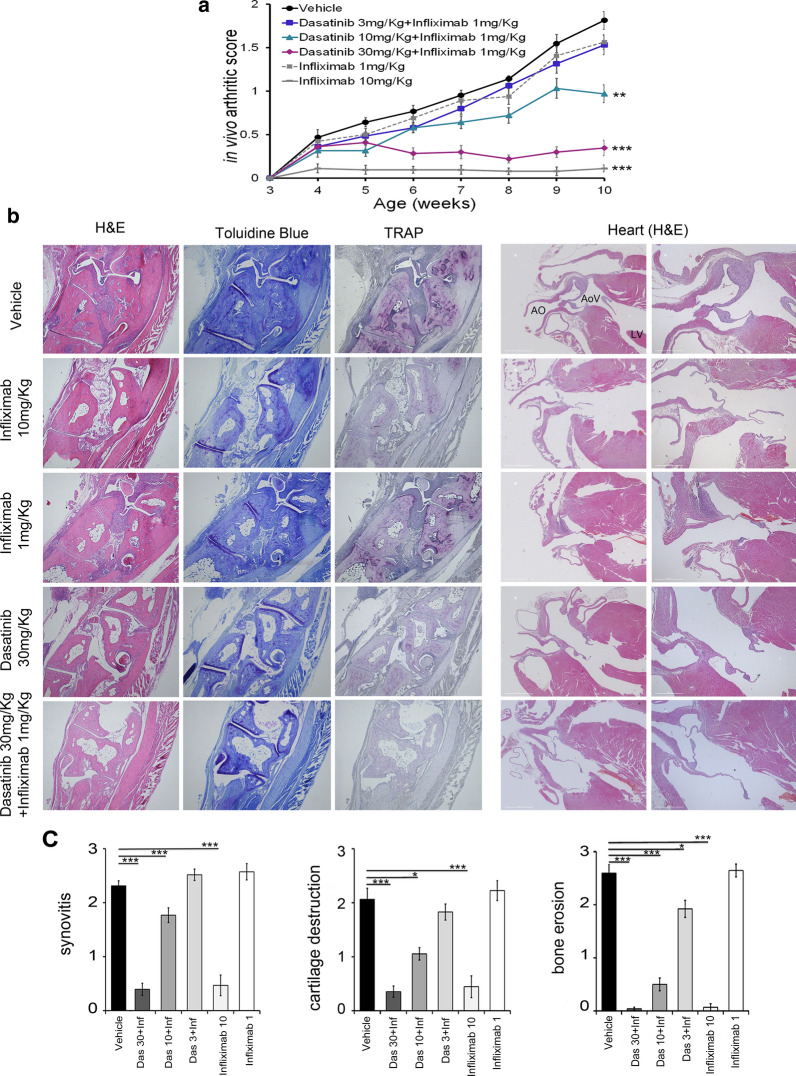
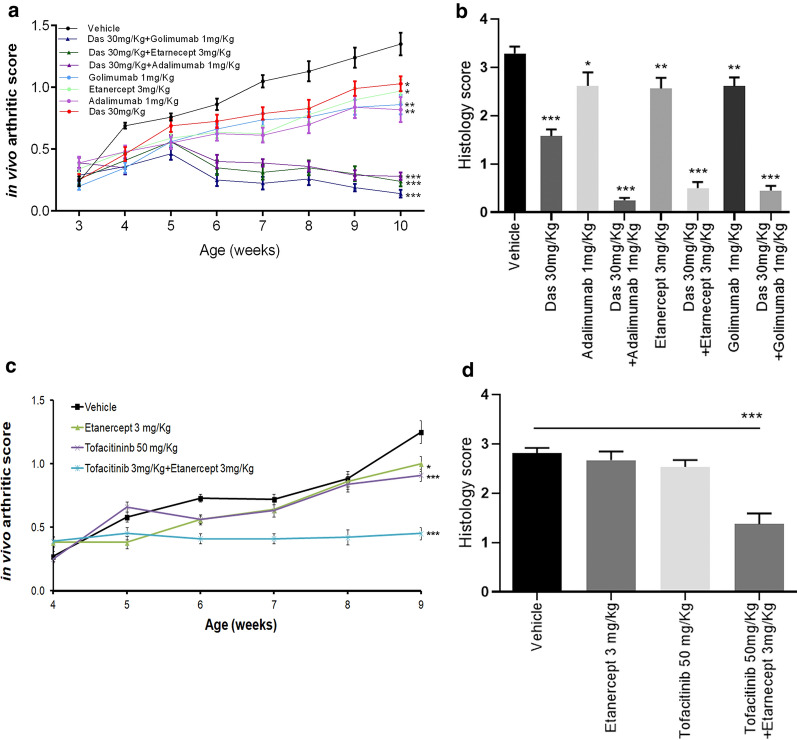
We investigated the effect of the Tyrosine Kinase inhibitors (TKIs) dasatinib and bosutinib, on the human TNF-dependent Tg197 arthritis mouse model. The inhibitors were administered either as a monotherapy or in combination with a subtherapeutic dose of anti-hTNF biologics and their therapeutic effect was assessed clinically, histopathologically as well as via gene expression analysis and was compared to that of an efficient TNF monotherapy.
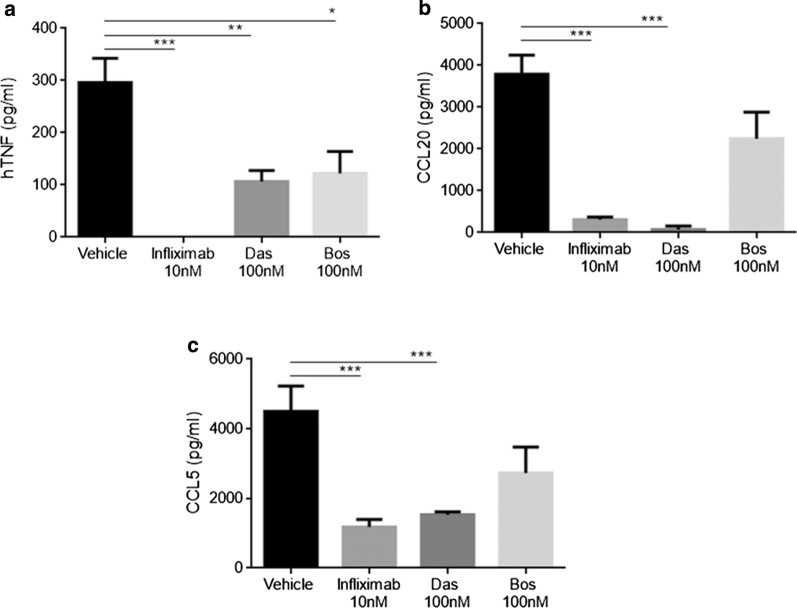
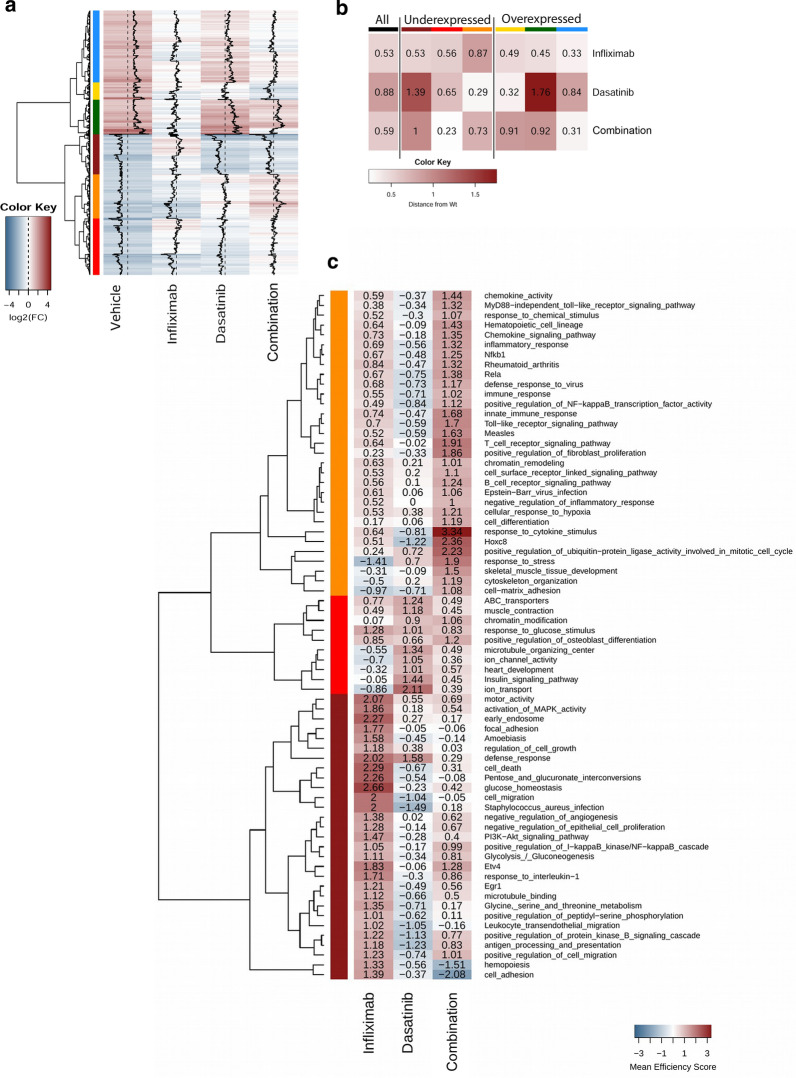
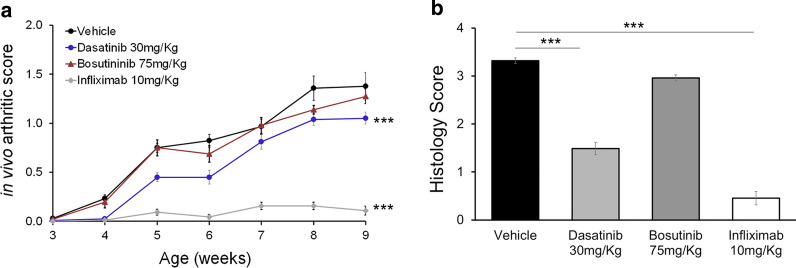
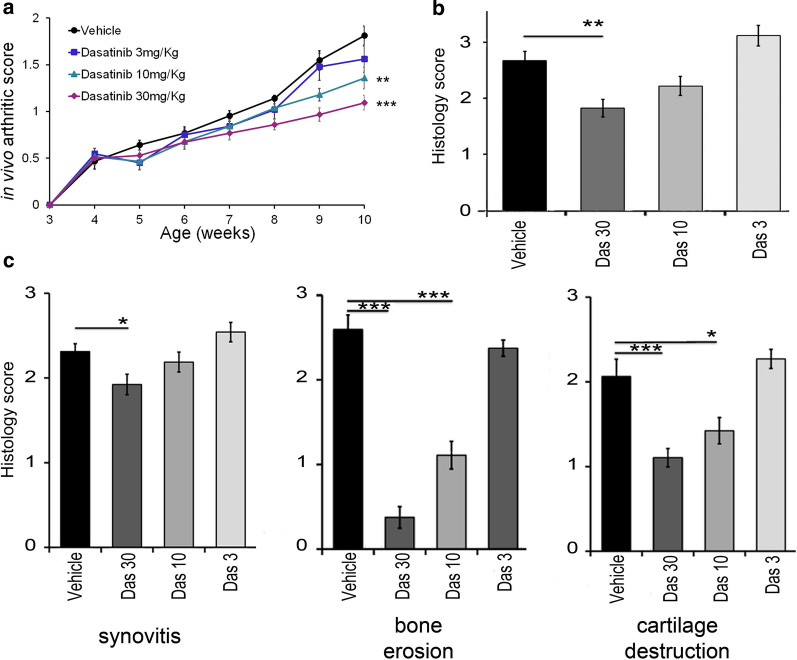
Dasatinib and, to a lesser extent, bosutinib inhibited the production of TNF and proinflammatory chemokines from arthritogenic synovial fibroblasts. Dasatinib, but not bosutinib, also ameliorated significantly and in a dose-dependent manner both the clinical and histopathological signs of Tg197 arthritis. Combination of dasatinib with a subtherapeutic dose of anti-hTNF biologic agents, resulted in a synergistic inhibitory effect abolishing all arthritis symptoms. Gene expression analysis of whole joint tissue of Tg197 mice revealed that the combination of dasatinib with a low subtherapeutic dose of Infliximab most efficiently restores the pathogenic gene expression profile to that of the healthy state compared to either treatment administered as a monotherapy.
Our findings show that dasatinib exhibits a therapeutic effect in TNF-driven arthritis and can act in synergy with a subtherapeutic anti-hTNF dose to effectively treat the clinical and histopathological signs of the pathology. The combination of dasatinib and anti-hTNF exhibits a distinct mode of action in restoring the arthritogenic gene signature to that of a healthy profile. Potential clinical applications of combination therapies with kinase inhibitors and anti-TNF agents may provide an interesting alternative to high-dose anti-hTNF monotherapy and increase the number of patients responding to treatment.
在过去几十年中出现了用于治疗类风湿性关节炎(RA)的新药物,包括改善病情抗风湿药(DMARDs)和生物制剂。然而,由于相当一部分患者对当前治疗仍无反应或变得无反应,因此尚无已知的治愈方法。涉及联合疗法的新作用方式治疗方案的开发可能被证明对更多类风湿性关节炎患者的治疗是成功的。
我们研究了酪氨酸激酶抑制剂(TKIs)达沙替尼和博舒替尼对人肿瘤坏死因子(TNF)依赖性Tg197关节炎小鼠模型的影响。这些抑制剂以单一疗法或与亚治疗剂量的抗hTNF生物制剂联合给药,并通过临床、组织病理学以及基因表达分析评估其治疗效果,并与有效的TNF单一疗法进行比较。
达沙替尼以及在较小程度上博舒替尼抑制了致关节炎滑膜成纤维细胞产生TNF和促炎趋化因子。达沙替尼而非博舒替尼还以剂量依赖性方式显著改善了Tg197关节炎的临床和组织病理学症状。达沙替尼与亚治疗剂量的抗hTNF生物制剂联合使用,产生了协同抑制作用,消除了所有关节炎症状。对Tg197小鼠全关节组织的基因表达分析表明,与单一疗法相比,达沙替尼与低亚治疗剂量的英夫利昔单抗联合使用最有效地将致病基因表达谱恢复到健康状态。
我们的研究结果表明,达沙替尼在TNF驱动的关节炎中具有治疗作用,并且可以与亚治疗剂量的抗hTNF协同作用,有效治疗该病理的临床和组织病理学症状。达沙替尼和抗hTNF的联合使用在将致关节炎基因特征恢复到健康状态方面表现出独特的作用方式。激酶抑制剂和抗TNF药物联合疗法的潜在临床应用可能为高剂量抗hTNF单一疗法提供有趣的替代方案,并增加对治疗有反应的患者数量。