Department of Assisted Reproduction, Shanghai Ninth People's Hospital, Shanghai Jiaotong University School of Medicine, Shanghai, People's Republic of China.
Centre of Assisted Reproduction, Shanghai East Hospital, Tongji University, Shanghai, People's Republic of China.
Reprod Biol Endocrinol. 2021 Apr 23;19(1):60. doi: 10.1186/s12958-021-00747-8.
Low serum progesterone on the day of frozen embryo transfer (FET) is associated with diminished pregnancy rates in artificial endometrium preparation cycles, but there is no consensus on whether strengthened luteal phase support (LPS) benefits patients with low progesterone on the FET day in artificial cycles. This single-centre, large-sample retrospective trial was designed to investigate the contribution of strengthened LPS to pregnancy outcomes for groups with low progesterone levels on the FET day in artificial endometrium preparation cycles.
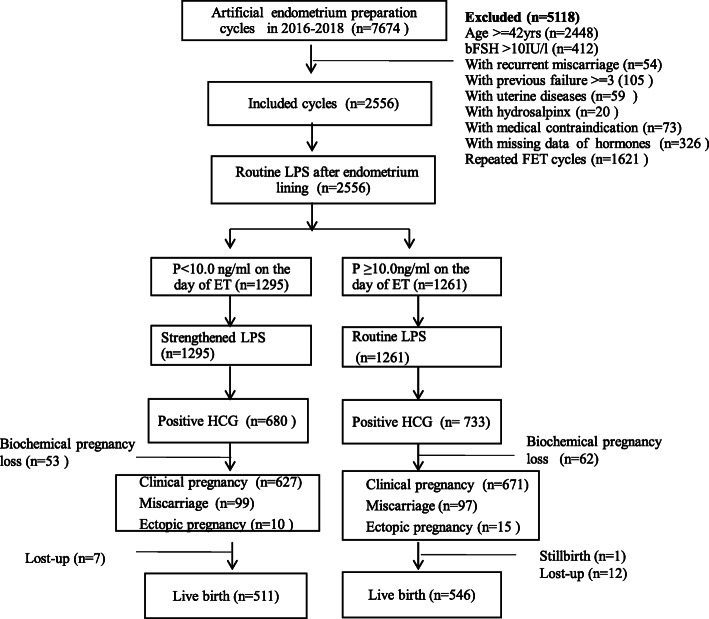
Women who had undergone the first artificial endometrium preparation cycle after a freeze-all protocol in our clinic from 2016 to 2018 were classified into two groups depending on their serum progesterone levels on the FET day. Routine LPS was administered to group B (P ≥ 10.0 ng/ml on the FET day, n = 1261), and strengthened LPS (routine LPS+ im P 40 mg daily) was administered to group A (P < 10.0 ng/ml on the FET day, n = 1295). The primary endpoint was the live birth rate, and the secondary endpoints were clinical pregnancy, miscarriage and neonatal outcomes.
The results showed that the clinical pregnancy rate was significantly lower in group A than in group B (48.4% vs 53.2%, adjusted risk ratio (aRR) 0.81, 95% confidence interval (CI) 0.68, 0.96), whereas miscarriage rates were similar between the two groups (16.0% vs 14.7%, aRR 1.09, 95% CI 0.77, 1.54). The live birth rate was slightly lower in group A than in group B (39.5% vs 43.3%, aRR 0.84, 95% CI 0.70, 1.0). Birthweights and other neonatal outcomes were similar between the two groups (P > 0.05).
The results indicated that the serum progesterone level on the FET day was one of the risk factors predicting the chances of pregnancy in artificial endometrium preparation cycles, and strengthened LPS in patients with low progesterone on the FET day might help to provide a reasonable pregnancy outcome in artificial cycles, although further prospective evidence is needed to confirm this possibility.
在冻融胚胎移植(FET)日血清孕酮水平低与人工子宫内膜准备周期妊娠率降低有关,但对于在人工周期中 FET 日孕酮水平低的患者是否需要强化黄体支持(LPS),目前尚无共识。本单中心、大样本回顾性试验旨在探讨在人工子宫内膜准备周期中,FET 日孕酮水平低的患者强化 LPS 是否对妊娠结局有贡献。
本研究将 2016 年至 2018 年在我院行首次冻融全部方案的患者根据 FET 日血清孕酮水平分为两组。B 组(FET 日孕酮≥10.0ng/ml,n=1261)给予常规 LPS,A 组(FET 日孕酮<10.0ng/ml,n=1295)给予强化 LPS(常规 LPS+每日 im P 40mg)。主要结局为活产率,次要结局为临床妊娠、流产和新生儿结局。
结果显示,A 组临床妊娠率明显低于 B 组(48.4% vs 53.2%,调整风险比(aRR)0.81,95%置信区间(CI)0.68,0.96),但两组流产率相似(16.0% vs 14.7%,aRR 1.09,95% CI 0.77,1.54)。A 组活产率略低于 B 组(39.5% vs 43.3%,aRR 0.84,95% CI 0.70,1.0)。两组新生儿体重和其他结局相似(P>0.05)。
FET 日血清孕酮水平是预测人工子宫内膜准备周期妊娠机会的危险因素之一,在 FET 日孕酮水平低的患者中强化 LPS 可能有助于提供合理的人工周期妊娠结局,但需要进一步的前瞻性证据来证实这一可能性。