Department of Hepatobiliary Surgery and Liver Transplantation, University Medical Center Groningen, Hanzeplein 1, PO Box 30001, 9700 RB, Groningen, the Netherlands.
Department of Surgery, Medisch Spectrum Twente, Koningsplein 1, 7512 KZ, Enschede, the Netherlands.
Eur J Med Res. 2021 Apr 23;26(1):36. doi: 10.1186/s40001-021-00507-9.
Surgery-related loss of muscle quantity negatively affects postoperative outcomes. However, changes of muscle quality have not been fully investigated. A perioperative intervention targeting identified risk factors could improve postoperative outcome. This study investigated risk factors for surgery-related loss of muscle quantity and quality and outcomes after liver resection for colorectal liver metastasis (CRLM).
Data of patients diagnosed with CRLM who underwent liver resection between 2006 and 2016 were analysed. Muscle quantity (psoas muscle index [PMI]), and muscle quality, (average muscle radiation attenuation [AMA] of the psoas), were measured using computed tomography. Changes in PMI and AMA of psoas after surgery were assessed.
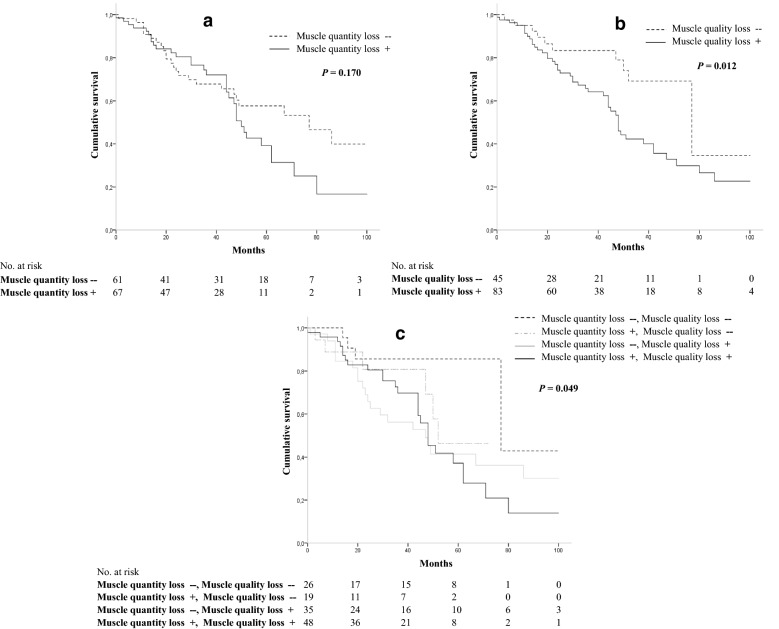
A total of 128 patients were analysed; 67 (52%) had surgery-related loss of muscle quantity and 83 (65%) muscle quality loss. Chronic obstructive pulmonary disease (COPD) (P = 0.045) and diabetes (P = 0.003) were risk factors for surgery-related loss of muscle quantity. A higher age (P = 0.002), open resection (P = 0.003) and longer operation time (P = 0.033) were associated with muscle quality loss. Overall survival was lower in patients with both muscle quantity and quality loss compared to other categories (P = 0.049). The rate of postoperative complications was significantly higher in the group with surgery-related loss of muscle quality.
Risk factors for surgery-related muscle loss were identified. Overall survival was lowest in patients with both muscle quantity and quality loss. Complication rate was higher in patients with surgery-related loss of muscle quality.
与手术相关的肌肉量损失会对术后结果产生负面影响。然而,肌肉质量的变化尚未得到充分研究。针对已确定的危险因素进行围手术期干预可能会改善术后结果。本研究调查了与结直肠癌肝转移(CRLM)肝切除相关的肌肉量和质量损失的危险因素以及术后结果。
分析了 2006 年至 2016 年间诊断为 CRLM 并接受肝切除术的患者的数据。使用计算机断层扫描测量肌肉量(腰大肌指数 [PMI])和肌肉质量(腰大肌的平均肌肉辐射衰减 [AMA])。评估手术后 PMI 和腰大肌 AMA 的变化。
共分析了 128 例患者;67 例(52%)有与手术相关的肌肉量损失,83 例(65%)有肌肉质量损失。慢性阻塞性肺疾病(COPD)(P=0.045)和糖尿病(P=0.003)是与手术相关的肌肉量损失的危险因素。较高的年龄(P=0.002)、开放性切除术(P=0.003)和较长的手术时间(P=0.033)与肌肉质量损失相关。与其他类别相比,肌肉量和质量均损失的患者总生存率较低(P=0.049)。与手术相关的肌肉质量损失组的术后并发症发生率明显更高。
确定了与手术相关的肌肉损失的危险因素。肌肉量和质量均损失的患者总生存率最低。与手术相关的肌肉质量损失的患者并发症发生率更高。