BAOMS Project Manager, British Association of Oral and Maxillofacial Surgery, Royal College of Surgeons of England, 35/43 Lincoln's Inn Fields, London WC2A 3PE.
Northwick Park Hospital, Watford, HA1 3UJ.
Br J Oral Maxillofac Surg. 2021 Oct;59(8):875-880. doi: 10.1016/j.bjoms.2020.12.017. Epub 2021 Jan 8.
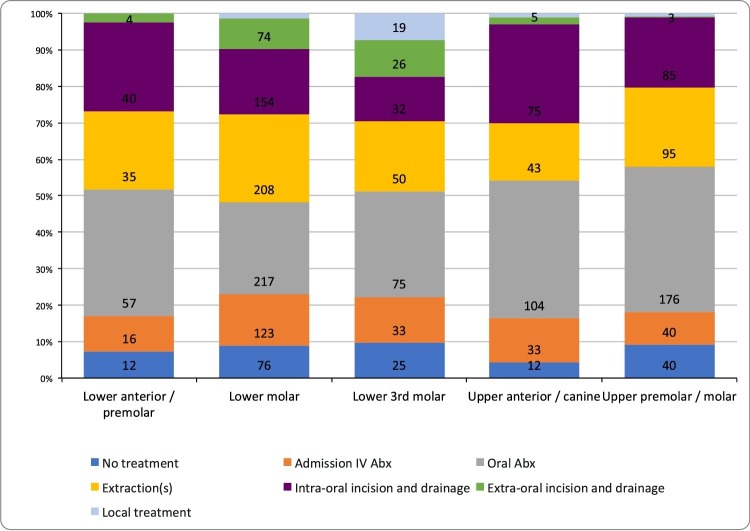
On 25 March 2020, the Chief Dental Officer issued national guidance restricting the provision of all routine, non-urgent dental services in response to the spread of COVID-19. We analysed odontogenic cervicofacial infections (CFI) presenting to oral and maxillofacial surgery (OMFS) departments during the first wave of COVID-19 in the United Kingdom. From 1 April 2020 until 31 July 2020 a database was used to prospectively collect records for all patients with CFI who presented to oral and maxillofacial teams. Information gathered included clinical presentation, location/origin of infection, and how this was managed. The OMFS units were asked to compare the patient's care with the treatment that would usually have been given prior to the crisis. A total of 32 OMFS units recorded 1381 cases of CFI in the UK. Most of the infections were referred via the emergency department (74%). Lower first or second molars were the most common origin, contributing 40% of CFI. Collaborators reported that patients' treatments were modified as a response to COVID in 20% of cases, the most frequently cited reason being the application of COVID-19 hospital policy (85%). The impact of the first wave of COVID modified the management of a significant number of patients presenting with CFI, and there was a proactive move to avoid general anaesthetics where possible. Some patients who presented to secondary care were given no treatment, suggesting they could have been managed in primary dental care if this had been available. We recommend that OMFS units and urgent dental care centres (UDCCs) build strong communication links not only to provide the best possible patient care, but to minimise COVID exposure and the strain on emergency departments during the pandemic.
2020 年 3 月 25 日,首席牙科官员发布了全国性指导意见,限制提供所有常规的非紧急牙科服务,以应对 COVID-19 的传播。我们分析了在英国 COVID-19 第一波期间,口腔颌面外科(OMFS)部门就诊的牙源性颈面部感染(CFI)。从 2020 年 4 月 1 日至 7 月 31 日,使用数据库前瞻性收集所有 CFI 患者的记录,这些患者就诊于口腔颌面团队。收集的信息包括临床表现、感染部位/起源以及如何处理。OMFS 部门被要求将患者的护理与危机前通常给予的治疗进行比较。共有 32 个 OMFS 部门记录了英国 1381 例 CFI。大多数感染是通过急诊室转介的(74%)。下第一或第二磨牙是最常见的感染源,占 CFI 的 40%。合作者报告说,在 20%的病例中,患者的治疗因 COVID 而发生了改变,最常提到的原因是 COVID-19 医院政策的应用(85%)。第一波 COVID 的影响改变了大量 CFI 患者的管理方式,并积极采取措施避免在可能的情况下使用全身麻醉。一些就诊于二级护理的患者未接受治疗,这表明如果初级牙科护理可用,他们本可以在那里得到治疗。我们建议 OMFS 部门和紧急牙科护理中心(UDCC)建立强大的沟通联系,不仅为患者提供尽可能好的护理,而且在大流行期间尽量减少 COVID 暴露和对急诊部门的压力。