Department of Synthetic Biology and Immunology, National Institute of Chemistry, SI-1000 Ljubljana, Slovenia.
Department of Physical Chemistry, Faculty of Chemistry and Chemical Technology, University of Ljubljana, SI-1000 Ljubljana, Slovenia.
Proc Natl Acad Sci U S A. 2021 Apr 27;118(17). doi: 10.1073/pnas.2021899118.
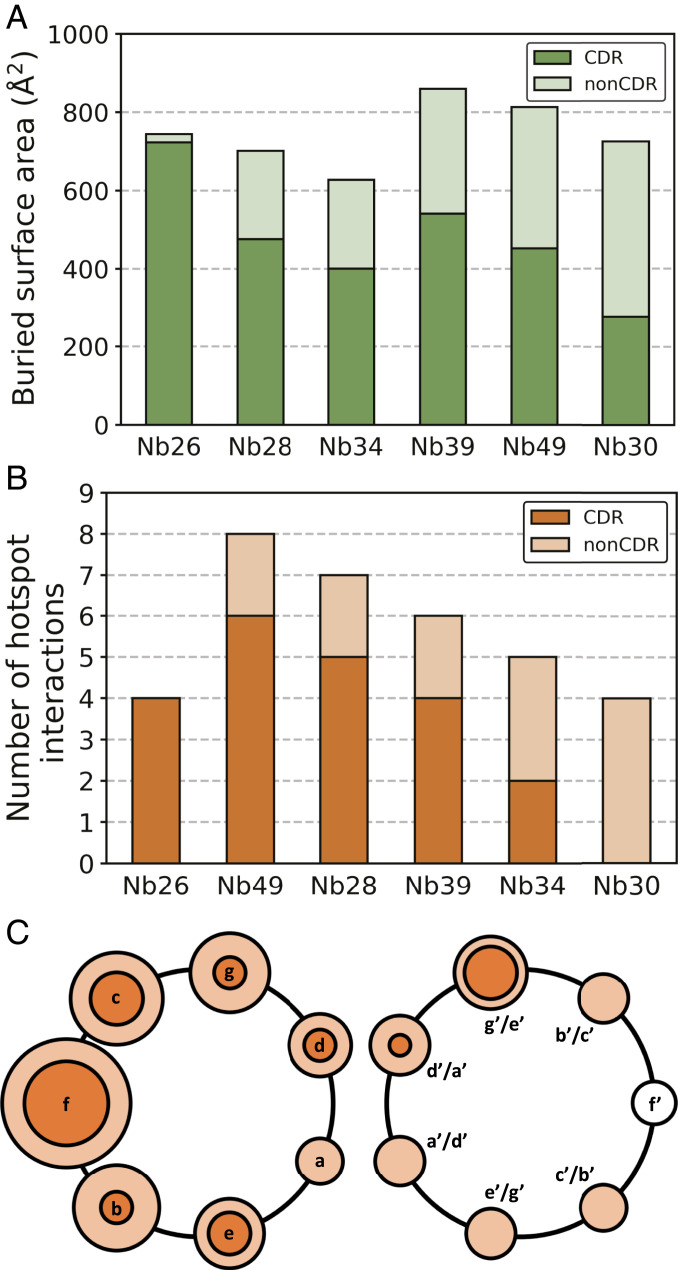
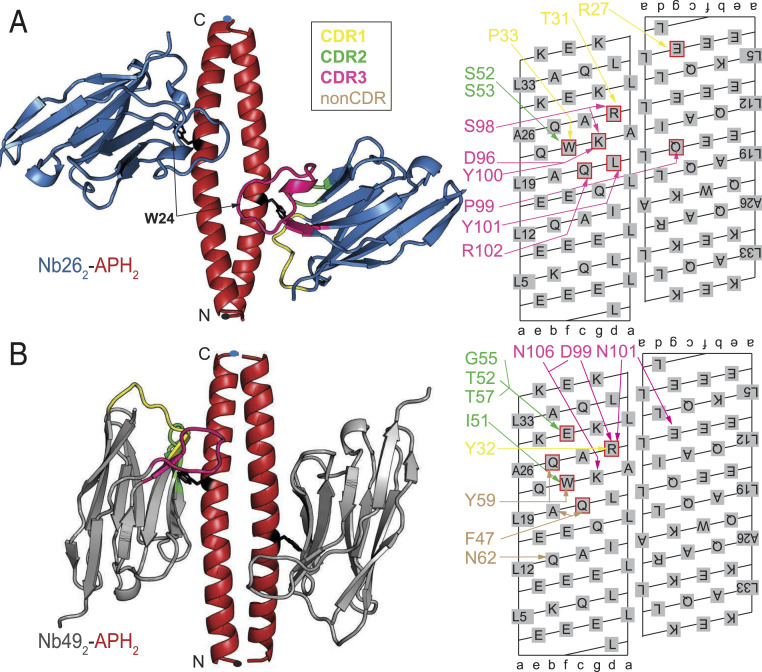
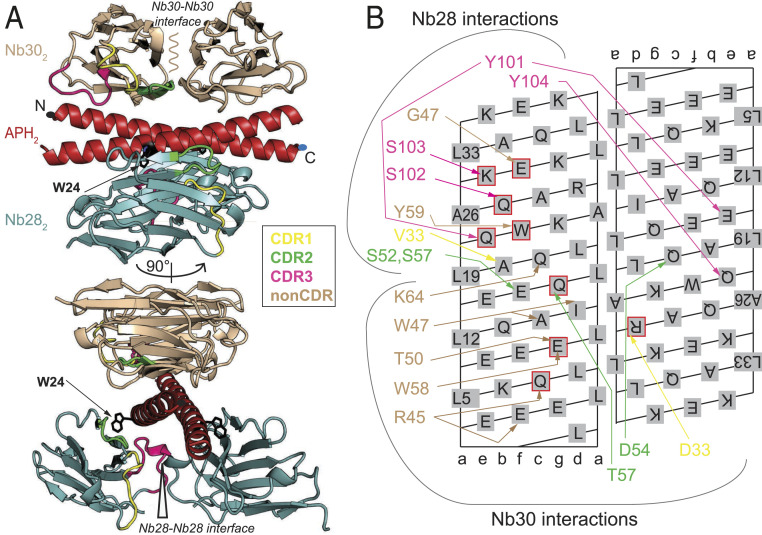
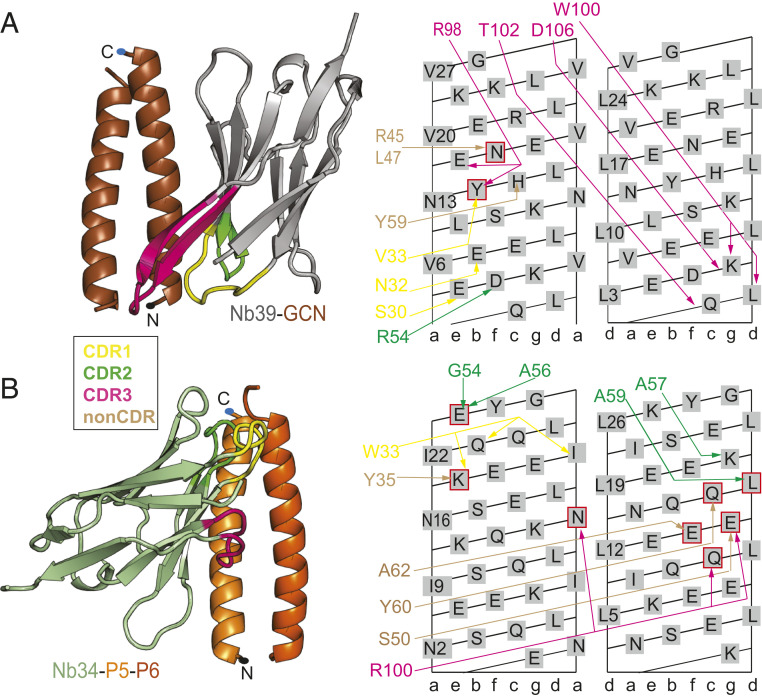
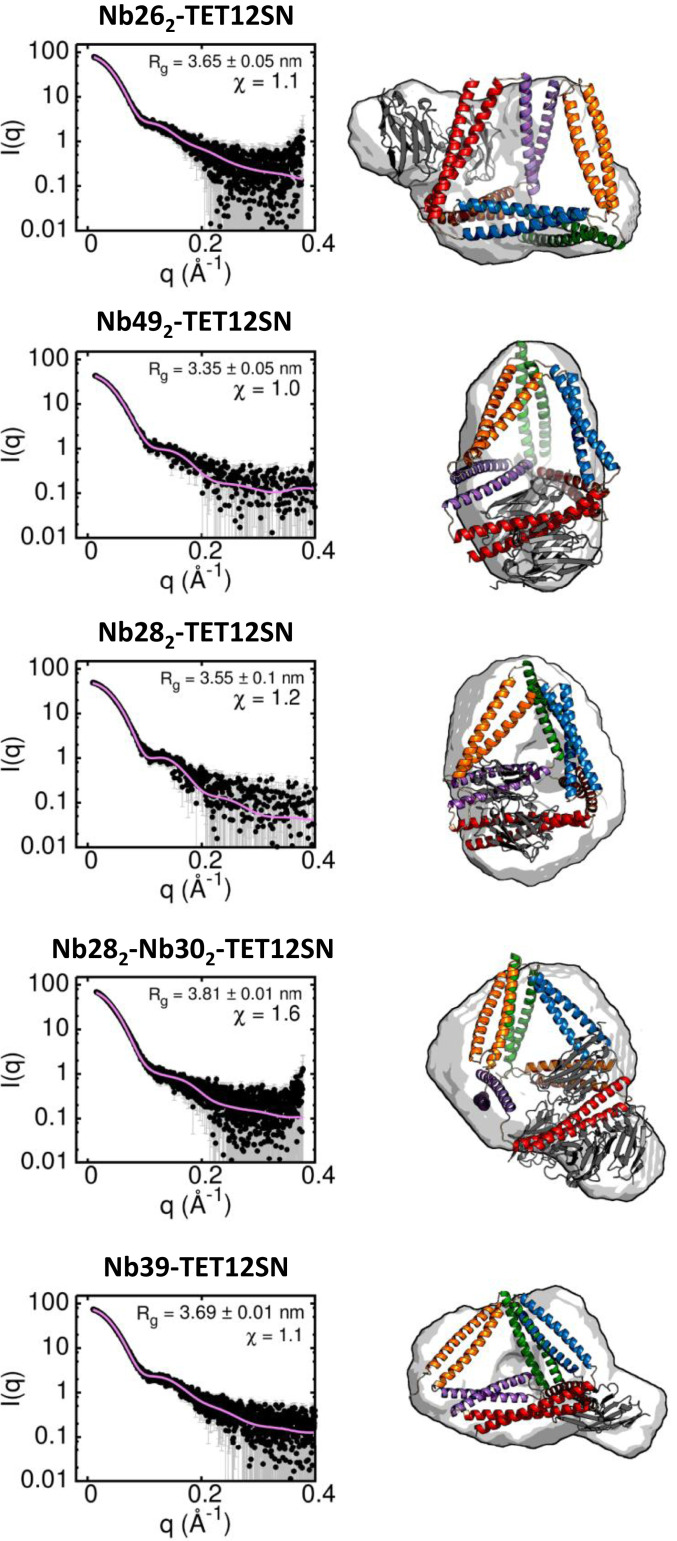
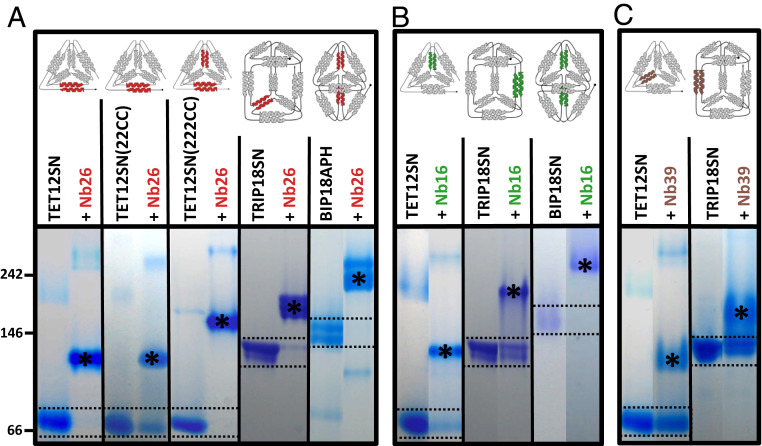
Coiled-coil (CC) dimers are widely used in protein design because of their modularity and well-understood sequence-structure relationship. In CC protein origami design, a polypeptide chain is assembled from a defined sequence of CC building segments that determine the self-assembly of protein cages into polyhedral shapes, such as the tetrahedron, triangular prism, or four-sided pyramid. However, a targeted functionalization of the CC modules could significantly expand the versatility of protein origami scaffolds. Here, we describe a panel of single-chain camelid antibodies (nanobodies) directed against different CC modules of a de novo designed protein origami tetrahedron. We show that these nanobodies are able to recognize the same CC modules in different polyhedral contexts, such as isolated CC dimers, tetrahedra, triangular prisms, or trigonal bipyramids, thereby extending the ability to functionalize polyhedra with nanobodies in a desired stoichiometry. Crystal structures of five nanobody-CC complexes in combination with small-angle X-ray scattering show binding interactions between nanobodies and CC dimers forming the edges of a tetrahedron with the nanobody entering the tetrahedral cavity. Furthermore, we identified a pair of allosteric nanobodies in which the binding to the distant epitopes on the antiparallel homodimeric APH CC is coupled via a strong positive cooperativity. A toolbox of well-characterized nanobodies specific for CC modules provides a unique tool to target defined sites in the designed protein structures, thus opening numerous opportunities for the functionalization of CC protein origami polyhedra or CC-based bionanomaterials.
螺旋-螺旋(CC)二聚体因其模块化和对序列-结构关系的深入了解而被广泛用于蛋白质设计。在 CC 蛋白折纸设计中,多肽链由 CC 构建片段的明确定义序列组装而成,这些片段决定了蛋白笼自组装成多面体形状,如四面体、三棱柱或四面金字塔。然而,对 CC 模块的靶向功能化可以显著扩展蛋白折纸支架的多功能性。在这里,我们描述了一组针对从头设计的蛋白折纸四面体的不同 CC 模块的单链骆驼抗体(纳米抗体)。我们表明,这些纳米抗体能够识别不同多面体环境中的相同 CC 模块,例如孤立的 CC 二聚体、四面体、三棱柱或三角双锥,从而能够以所需的化学计量比用纳米抗体对多面体进行功能化。五个纳米抗体-CC 复合物的晶体结构与小角度 X 射线散射相结合,显示了纳米抗体与形成四面体边缘的 CC 二聚体之间的结合相互作用,纳米抗体进入四面体腔。此外,我们鉴定了一对别构纳米抗体,其中与平行同源二聚体 APH CC 上的远位表位的结合通过强正协同作用偶联。一组针对 CC 模块的特征良好的纳米抗体为靶向设计蛋白结构中的特定位点提供了独特的工具,从而为 CC 蛋白折纸多面体或基于 CC 的仿生纳米材料的功能化开辟了众多机会。