Department of Pediatrics, University of Minnesota, Minneapolis, MN, USA.
Masonic Cancer Center, University of Minnesota, Minneapolis, MN, USA.
Nat Commun. 2021 Apr 23;12(1):2437. doi: 10.1038/s41467-021-22009-2.
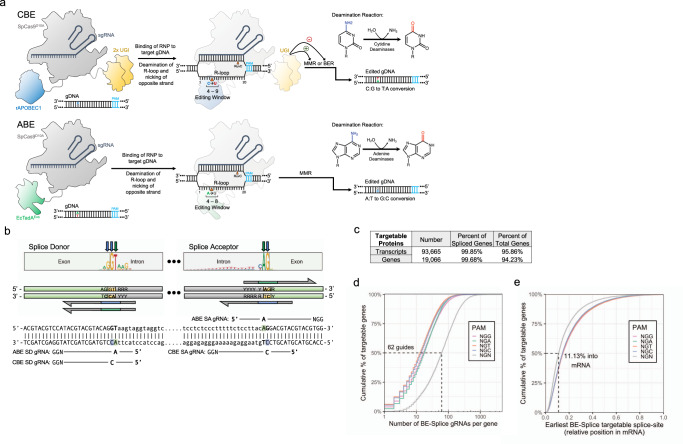
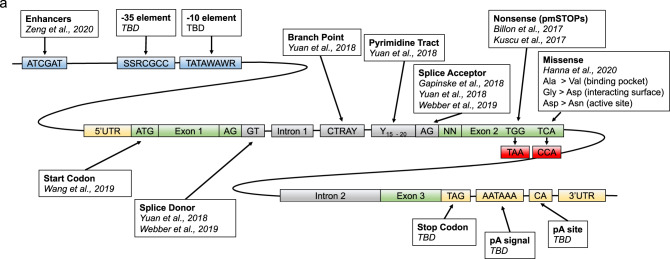
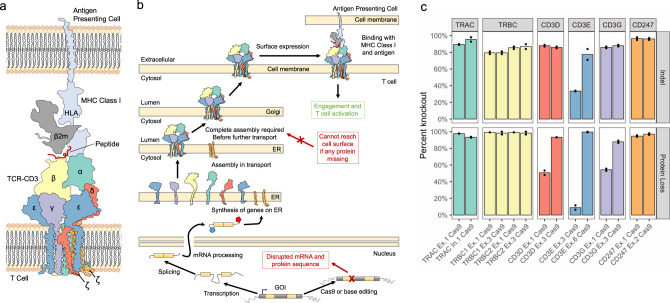
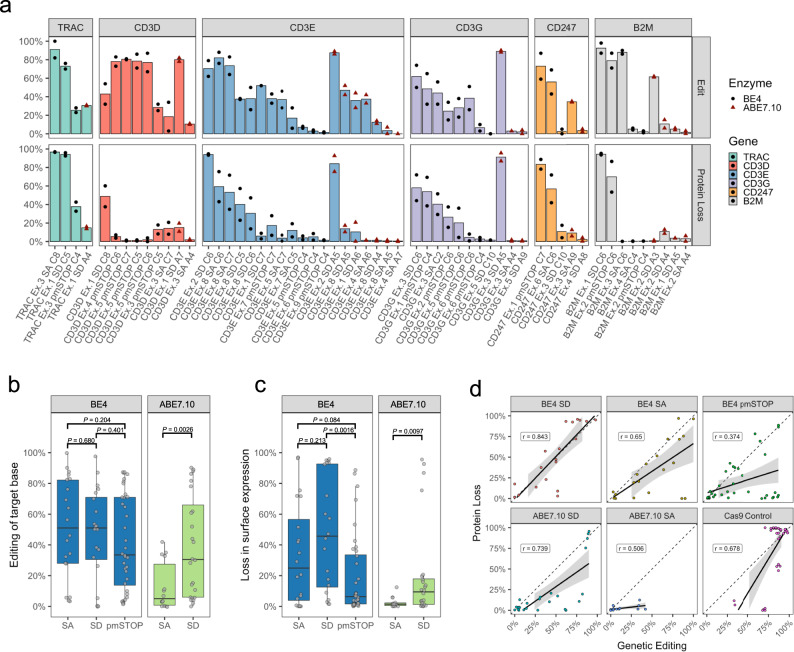
CRISPR-Cas9 cytidine and adenosine base editors (CBEs and ABEs) can disrupt genes without introducing double-stranded breaks by inactivating splice sites (BE-splice) or by introducing premature stop (pmSTOP) codons. However, no in-depth comparison of these methods or a modular tool for designing BE-splice sgRNAs exists. To address these needs, we develop SpliceR ( http://z.umn.edu/spliceR ) to design and rank BE-splice sgRNAs for any Ensembl annotated genome, and compared disruption approaches in T cells using a screen against the TCR-CD3 MHC Class I immune synapse. Among the targeted genes, we find that targeting splice-donors is the most reliable disruption method, followed by targeting splice-acceptors, and introducing pmSTOPs. Further, the CBE BE4 is more effective for disruption than the ABE ABE7.10, however this disparity is eliminated by employing ABE8e. Collectively, we demonstrate a robust method for gene disruption, accompanied by a modular design tool that is of use to basic and translational researchers alike.
CRISPR-Cas9 胞嘧啶和腺嘌呤碱基编辑器(CBEs 和 ABEs)可以通过失活剪接位点(BE-splice)或引入过早终止(pmSTOP)密码子来破坏基因,而无需引入双链断裂。然而,目前还没有对这些方法进行深入比较,也没有用于设计 BE-splice sgRNA 的模块化工具。为了解决这些需求,我们开发了 SpliceR(http://z.umn.edu/spliceR),用于设计和对任何 Ensembl 注释基因组进行排名 BE-splice sgRNA,并在针对 TCR-CD3 MHC 类 I 免疫突触的筛选中比较 T 细胞中的破坏方法。在靶向基因中,我们发现靶向剪接供体是最可靠的破坏方法,其次是靶向剪接受体,然后是引入 pmSTOP。此外,CBE BE4 比 ABE ABE7.10 更有效,但通过使用 ABE8e 可以消除这种差异。总的来说,我们展示了一种强大的基因破坏方法,同时还提供了一个模块化的设计工具,这对基础和转化研究人员都很有用。