Cheong Yeonju, Uehara Izumi
Department of Psychology, Ochanomizu University, Tokyo, Japan.
Institute for Education and Human Development, Ochanomizu University, Tokyo, Japan.
Front Psychol. 2021 Apr 9;12:626662. doi: 10.3389/fpsyg.2021.626662. eCollection 2021.
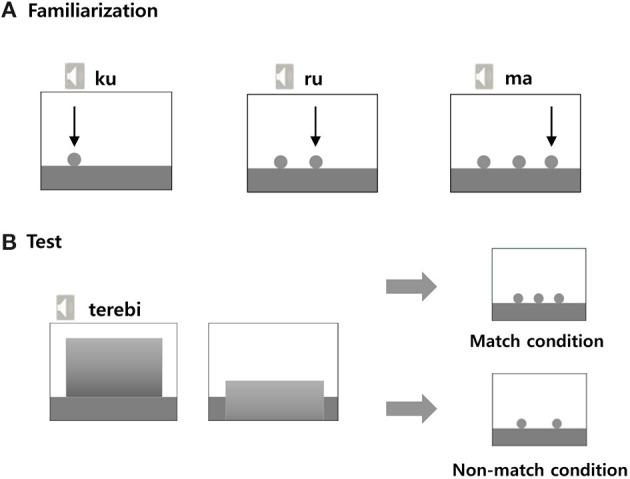
When infants and toddlers are confronted with sequences of sounds, they are required to segment the sounds into meaningful units to achieve sufficient understanding. Rhythm has been regarded as a crucial cue for segmentation of speech sounds. Although previous intermodal methods indicated that infants and toddlers could detect differences in speech sounds based on stress-timed and syllable-timed units, these methods could not clearly indicate how infants and toddlers perform sound segmentation. Thus, the present study examined whether Japanese infants and toddlers could segment word speech sounds comprising basic morae (i.e., rhythm units similar to syllables), on the basis of concurrent basic mora units within syllable units, using the new intermodal matching procedure. The results indicated that, regardless of their ages and linguistic abilities, Japanese infants and toddlers aged 6-25 months tended to segment Japanese words comprising basic morae sounds on the basis of concurrent basic mora units within syllable units. This implies that infants' and toddlers' use of syllable units for segmentation of speech sounds at an early age could be evident among many infants and toddlers learning various languages. Although this finding should be interpreted carefully, the present study demonstrated the utility of the new intermodal matching procedure for examining segmentation of speech sounds and word sounds by infants and toddlers, on the basis of specific rhythm units.
当婴幼儿面对一连串声音时,他们需要将这些声音分割成有意义的单元,以实现充分理解。节奏被视为语音分割的关键线索。尽管先前的多模态方法表明,婴幼儿能够根据重音计时和音节计时单元检测语音差异,但这些方法无法明确指出婴幼儿是如何进行声音分割的。因此,本研究使用新的多模态匹配程序,考察了日本婴幼儿是否能够基于音节单元内同时出现的基本拍节单元,对由基本拍节(即类似于音节的节奏单元)组成的单词语音进行分割。结果表明,6至25个月大的日本婴幼儿,无论其年龄和语言能力如何,都倾向于基于音节单元内同时出现的基本拍节单元,对由基本拍节声音组成的日语单词进行分割。这意味着,在许多学习各种语言的婴幼儿中,早期就能明显看出他们使用音节单元进行语音分割。尽管这一发现应谨慎解读,但本研究证明了新的多模态匹配程序在基于特定节奏单元考察婴幼儿语音和单词声音分割方面的实用性。