Department of Small Animal Clinical Sciences, College of Veterinary Medicine, University of Florida, Gainesville, FL 32610, USA.
Open Vet J. 2021 Jan-Mar;11(1):89-95. doi: 10.4314/ovj.v11i1.13. Epub 2021 Feb 2.
Fractures of the distal femoral physis are the most common physeal fracture sustained by skeletally immature dogs. Reduction and stabilization of these fractures can sometimes be achieved through closed reduction, primarily in fractures that are nominally displaced. Circular external fixator constructs have been used to assist in indirect, closed reduction of fractures at other anatomic locations in dogs and this report describes application of this method to reduce a displaced Salter-Harris type II fracture of the distal femur in a 1-year-old dog.
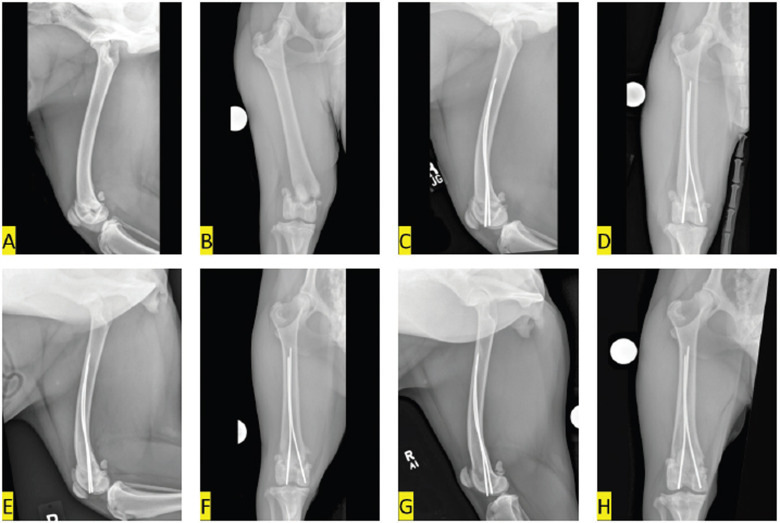
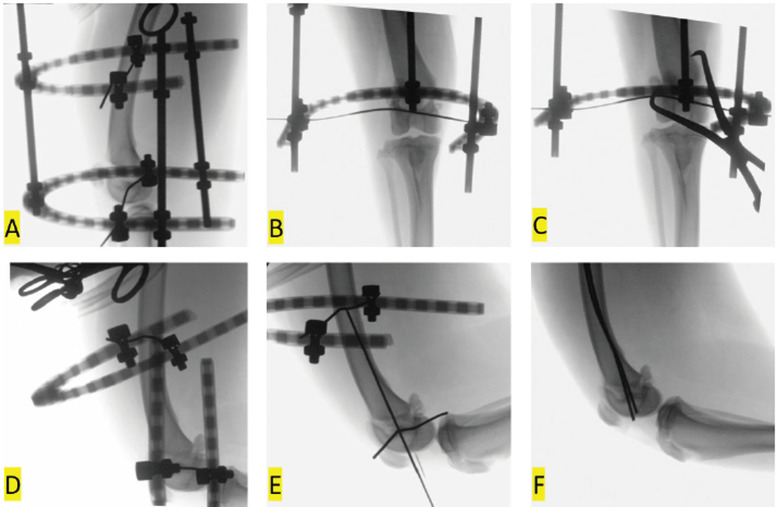
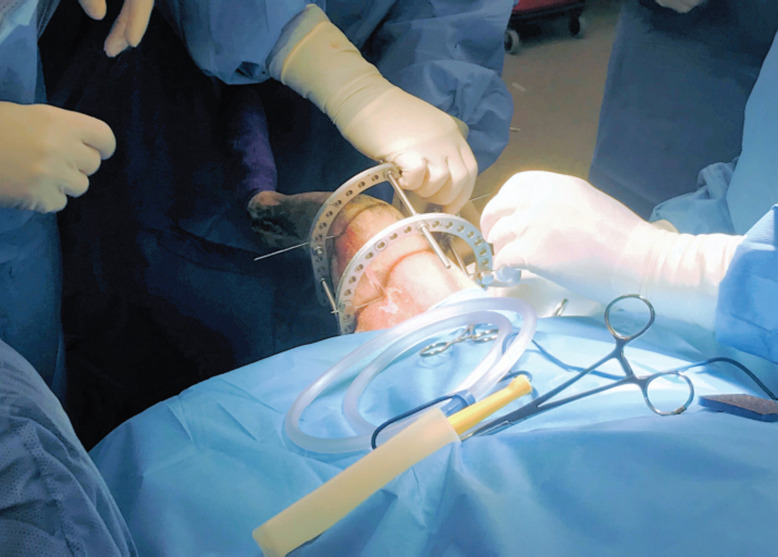
A 1-year-old female spayed Akita was referred for treatment of a Salter-Harris type II fracture of the right distal femur. The epiphyseal segment was laterally and slightly caudally displaced. Multiple attempts to manually reduce the fracture during surgery were unsuccessful, so a two-ring circular external fixator construct was applied to facilitate distraction and reduction. The construct was applied by placing a medial-to-lateral Kirschner wire in both the mid-femoral diaphysis and in the distal femoral epiphysis. Distraction of the construct provided sufficient separation of the fracture segments to facilitate near anatomic reduction. The fracture was stabilized with two percutaneously placed Steinmann pins placed in Rush fashion. Radiographic union was confirmed 5 weeks after surgery. The dog was not lame and was bearing more weight on the right pelvic limb, as assessed using force plate analysis, 9 months following surgery. Goniometric measurements of stifle range of motion and thigh muscle circumference were similar between the pelvic limbs.
Application of a two-ring circular construct would appear to be useful to facilitate closed reduction and percutaneous stabilization of distal femoral physeal fractures.
骺板下股骨骨折是未成熟犬中最常见的骺板骨折。这些骨折有时可以通过闭合复位来实现复位和固定,主要是在名义上移位的骨折。环形外固定器结构已被用于辅助犬其他解剖部位骨折的间接闭合复位,本报告介绍了在 1 岁犬的骺板下移位型 II 型 Salter-Harris 股骨骨折中应用该方法的情况。
一只 1 岁的雌性去势秋田犬因右侧股骨远端骺板下 II 型骨折而被转诊治疗。骺板段向外侧和略向尾侧移位。手术中多次尝试手动复位骨折均未成功,因此应用了双环环形外固定器结构来促进分离和复位。该结构通过在股骨中段和股骨远端骺板中分别放置一根内侧到外侧的克氏针来应用。构建物的分离提供了足够的骨折段分离,以促进近乎解剖复位。骨折采用两根经皮放置的斯氏针以 Rush 方式稳定。术后 5 周确认骨折愈合。术后 9 个月,使用测力板分析评估,患犬无跛行,且右后肢负重更多。后肢膝关节运动范围和大腿肌肉周长的测角测量在两条后肢之间相似。
应用双环环形结构似乎有助于促进股骨远端骺板骨折的闭合复位和经皮固定。