Serrano-Lorenzo Pablo, Coya Olga N, López-Jimenez Ana, Blázquez Alberto, Delmiro Aitor, Lucia Alejandro, Arenas Joaquín, Martín Miguel A
Mitochondrial Diseases Laboratory, '12 de Octubre' University Hospital. Instituto de Investigación Sanitaria Hospital 12 de Octubre (imas12), Av. de Córdoba S/n 28041, Madrid, Spain.
Emergency Laboratory, Clinical Biochemistry Department. 12 de Octubre' University Hospital, Av. de Córdoba S/n 28041, Madrid, Spain.
Pract Lab Med. 2021 May;25:e00226. doi: 10.1016/j.plabm.2021.e00226. Epub 2021 Apr 21.
We aimed to determine whether the plasma profile of lactate dehydrogenase (LDH) isoenzymes is altered in patients with COVID-19, and whether this is attributable to a specific release of LDH-3, the main LDH isoenzyme expressed in lungs.
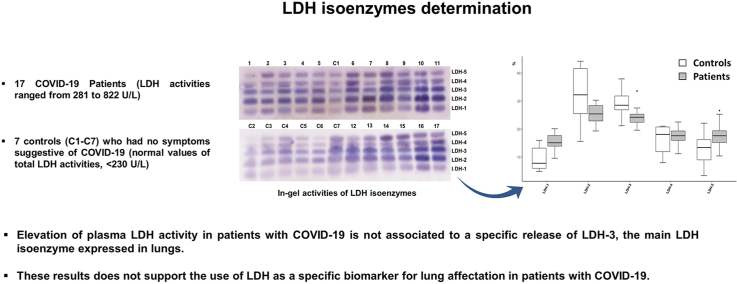
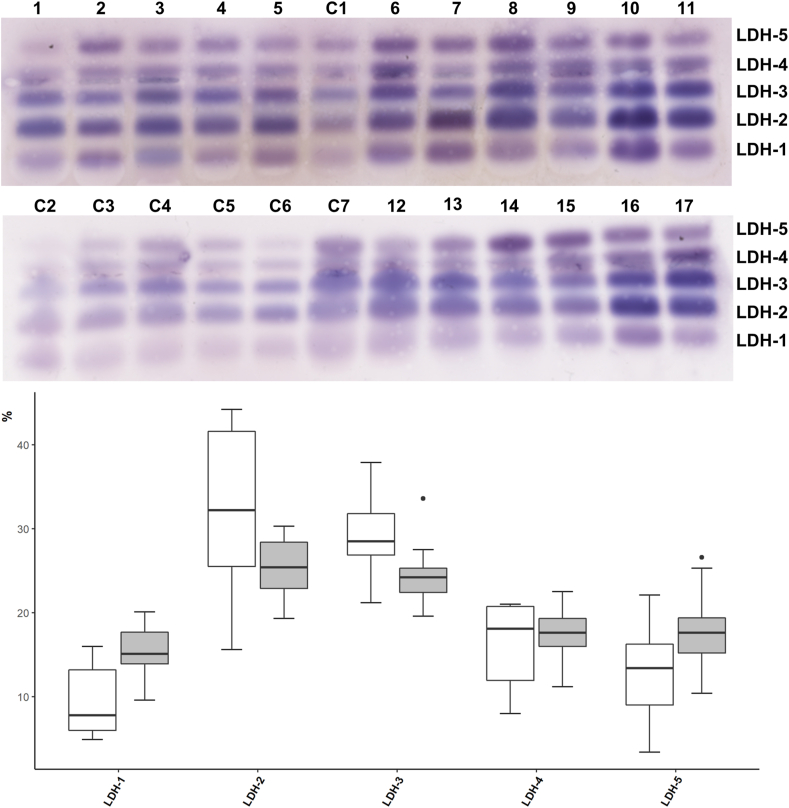
We collected fresh plasma aliquots from 17 patients (LDH range, 281-822 U/L) and seven controls (LDH < 230 U/L). In-gel relative activity of the different LDH isoenzymes was determined by electrophoresis and densitometric analysis.
Despite the expected higher total LDH activity levels in patients (p < 0.001), the in-gel relative activities of LDH isoenzymes did not differ between patients and controls (all p > 0.05). We found no correlation between total plasma LDH activity and the in-gel relative activities of the different LDH isoenzymes, including LDH-3. Likewise, there was no correlation between LDH-3 and various routine haematological and serum parameters that have been previously reported to be altered in COVID-19 (such as lymphocyte count, albumin, alanine and aspartate aminotransferase, creatinine, C-reactive protein, or ferritin).
Our findings suggest that elevation of plasma LDH activity in patients with COVID-19 is not associated to a specific release of LDH-3 into the bloodstream, and do not support the use of LDH as a specific biomarker for lung affectation in patients with COVID-19.
我们旨在确定新型冠状病毒肺炎(COVID-19)患者的乳酸脱氢酶(LDH)同工酶血浆谱是否发生改变,以及这是否归因于肺中主要表达的LDH同工酶LDH-3的特异性释放。
我们从17例患者(LDH范围为281 - 822 U/L)和7例对照(LDH < 230 U/L)中收集新鲜血浆样本。通过电泳和光密度分析测定不同LDH同工酶的凝胶内相对活性。
尽管患者的总LDH活性水平预期较高(p < 0.001),但患者和对照之间LDH同工酶的凝胶内相对活性并无差异(所有p > 0.05)。我们发现血浆总LDH活性与不同LDH同工酶(包括LDH-3)的凝胶内相对活性之间无相关性。同样,LDH-3与先前报道在COVID-19中发生改变的各种常规血液学和血清参数(如淋巴细胞计数、白蛋白、丙氨酸和天冬氨酸转氨酶、肌酐、C反应蛋白或铁蛋白)之间也无相关性。
我们的研究结果表明,COVID-19患者血浆LDH活性升高与LDH-3特异性释放到血液中无关,不支持将LDH用作COVID-19患者肺部受累的特异性生物标志物。