Department of Clinical Microbiology and Immunology, Faculty of Medicine, Tel Aviv University, Tel Aviv 6997801, Israel.
Center for Combatting Pandemics, Tel Aviv University, Tel Aviv 6997801, Israel.
Cell Rep Med. 2021 May 18;2(5):100264. doi: 10.1016/j.xcrm.2021.100264. Epub 2021 Apr 18.
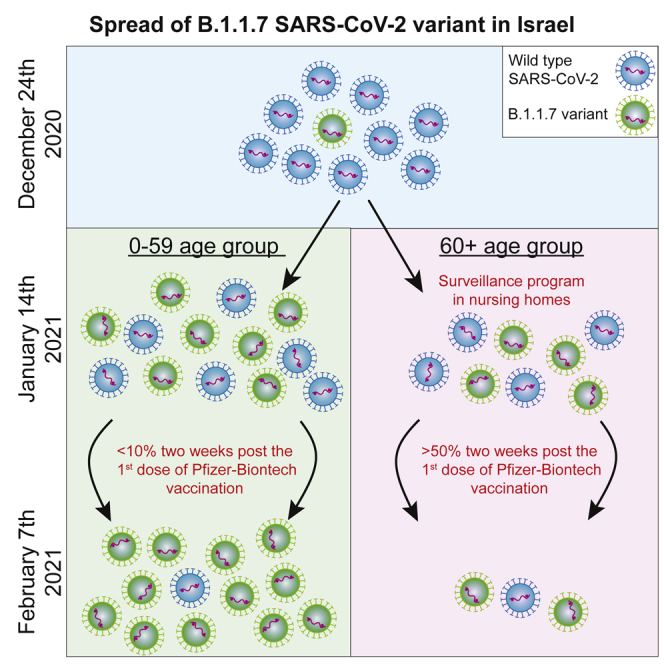
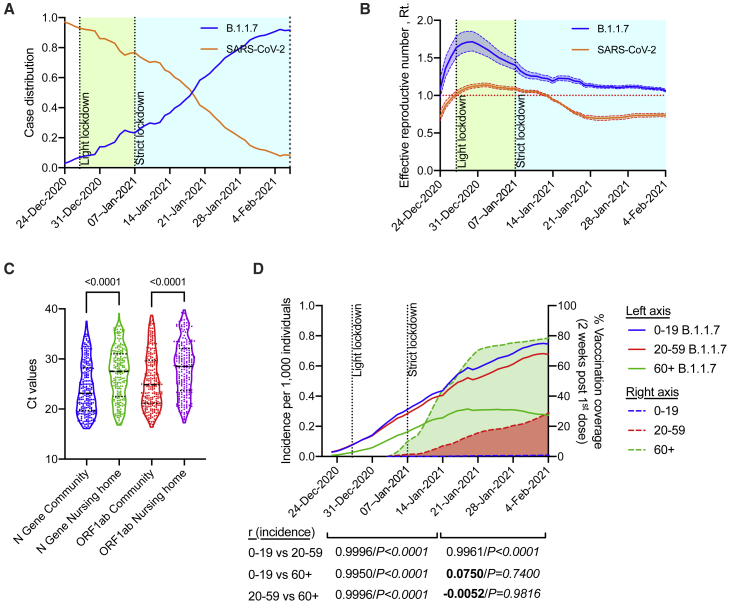
Since the emergence of the SARS-CoV-2 pandemic, various genetic variants have been described. The B.1.1.7 variant, which emerged in England during December 2020, is associated with increased infectivity. Therefore, its pattern of spread is of great importance. The Israeli government established three national programs: massive RT-PCR testing, focused surveillance in nursing homes, and robust prioritized vaccination with BNT162b2. To define the impact of the aforementioned programs, we analyze data from ∼300,000 RT-PCR samples collected from December 6, 2020, to February 10, 2021. We reveal that the B.1.1.7 is 45% (95% confidence interval [CI]: 20%-60%) more transmissible than the wild-type strain and has become the dominant strain in Israel within 3.5 weeks. Despite the rapid increase in viral spread, focused RT-PCR testing and prioritized vaccination programs are capable of preventing the spread of the B.1.1.7 variant in the elderly. Therefore, proactive surveillance programs, combined with prioritized vaccination, are achievable and can reduce severe illness and subsequent death.
自 SARS-CoV-2 大流行出现以来,已经描述了各种遗传变异。2020 年 12 月在英国出现的 B.1.1.7 变异株与传染性增加有关。因此,其传播模式非常重要。以色列政府建立了三个国家计划:大规模 RT-PCR 检测、养老院重点监测以及使用 BNT162b2 进行强化优先疫苗接种。为了确定上述计划的影响,我们分析了 2020 年 12 月 6 日至 2021 年 2 月 10 日期间收集的约 30 万份 RT-PCR 样本的数据。我们发现,B.1.1.7 比野生型菌株的传染性高出 45%(95%置信区间:20%-60%),并且在 3.5 周内成为以色列的主要菌株。尽管病毒传播迅速增加,但集中 RT-PCR 检测和优先疫苗接种计划能够防止 B.1.1.7 变异株在老年人中的传播。因此,积极的监测计划加上优先疫苗接种是可行的,可以减少严重疾病和随后的死亡。