Kahn Sagol Maccabi (KSM) Research & Innovation Center, Maccabi Healthcare Services, Tel Aviv, Israel.
Pediatric Gastroenterology Unit, Dana-Dwek Children's Hospital, Tel-Aviv Sourasky Medical Center, Tel Aviv, Israel.
Eur J Pediatr. 2022 Sep;181(9):3309-3318. doi: 10.1007/s00431-022-04531-7. Epub 2022 Jul 1.
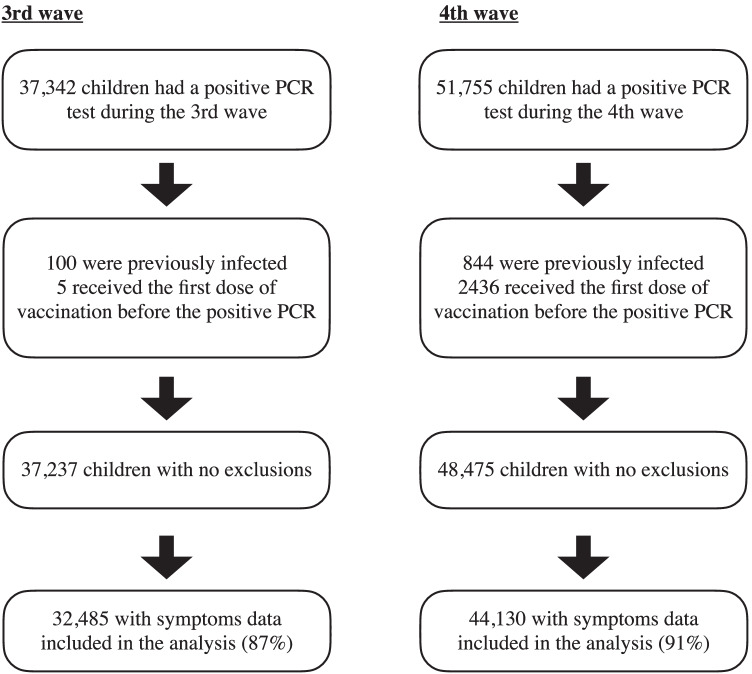
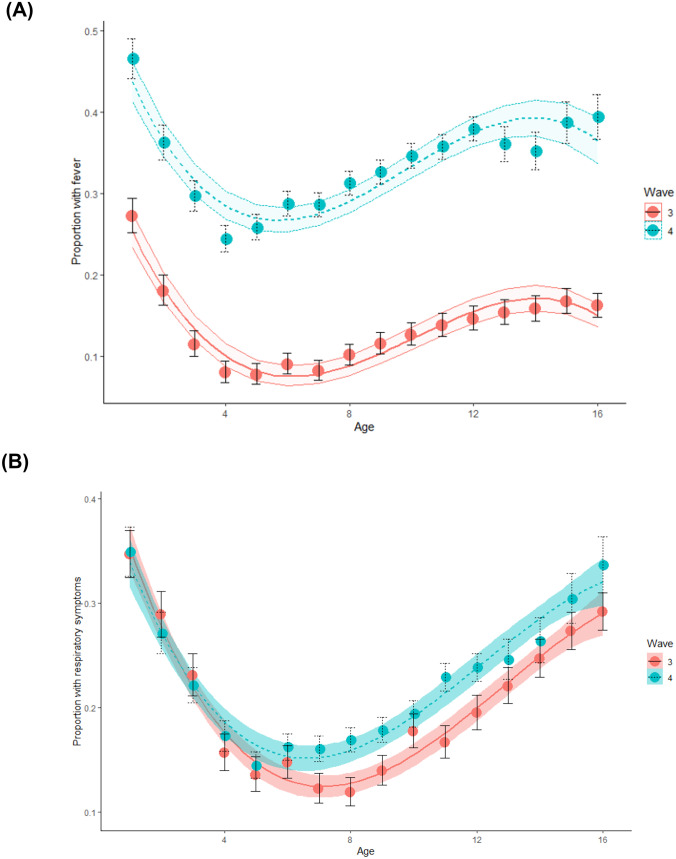
The aim of this real-life, big data population-based study was to evaluate differences in symptomatic presentation of children infected with severe acute respiratory syndrome coronavirus-2 (SARS-CoV-2) between the third and fourth waves of the pandemic in Israel, dominated by the Alpha and Delta variants, respectively. Our cohort included all children and adolescents, members of the second-largest Health Maintenance Organization in Israel that had positive real-time polymerase chain reaction (RT-PCR) test during the third and fourth waves of the pandemic (December 1, 2020, to April 30, 2021, and June 1, 2021, to October 10, 2021, respectively). A total of 32,485 and 44,130 children and adolescents in the third and fourth waves were included in the final analysis. The rate of children with symptomatic disease among patients with documented SARS-CoV-2 infection was higher in the fourth wave compared to the third wave (49.9% vs. 37.5%). The most commonly reported symptom and the only symptom that substantially differed between waves was fever, with 33% of SARS-CoV-2 infected children in the fourth wave vs. 13.6% in the third wave. Preschool children had the lowest prevalence of febrile illness compared to other age groups.
Children and adolescents infected during the fourth wave of the pandemic in Israel, a Delta-dominant period, had a significantly higher rate of symptomatic febrile illness than the Alpha-dominant period. This phenomenon occurred across all age groups.
• There are differences in COVID-19 severity among adults and children during different waves of the pandemic. • There is a paucity of data regarding symptomatic characteristics in children in large-scale cohorts aside from hospital settings.
• In a time period dominated by the Delta variant, there were substantially more children with symptomatic disease and febrile illness compared to a period dominated by the alpha variant. • Preschool children had the lowest rate of febrile illness among all age groups.
本真实数据、基于人群的研究旨在评估在分别由阿尔法和德尔塔变体主导的以色列大流行第三波和第四波期间,感染严重急性呼吸综合征冠状病毒 2(SARS-CoV-2)的儿童的症状表现差异。我们的队列包括在以色列第二大健康维护组织(HMO)成员中,在大流行的第三波和第四波期间(分别为 2020 年 12 月 1 日至 2021 年 4 月 30 日和 2021 年 6 月 1 日至 2021 年 10 月 10 日)进行过实时聚合酶链反应(RT-PCR)检测呈阳性的所有儿童和青少年。第三波和第四波中分别有 32485 名和 44130 名儿童和青少年被纳入最终分析。与第三波相比,第四波中记录的 SARS-CoV-2 感染患者中有症状疾病的儿童比例更高(49.9%比 37.5%)。最常见的报告症状和波与波之间唯一显著不同的症状是发热,第四波中 33%的 SARS-CoV-2 感染儿童和第三波中 13.6%的儿童有发热。与其他年龄组相比,学龄前儿童发热性疾病的患病率最低。
与阿尔法主导期相比,在以色列大流行第四波期间(德尔塔主导期)感染的儿童和青少年有症状性发热的发生率显著更高。这种现象发生在所有年龄组。
• 在不同的大流行波次期间,成人和儿童的 COVID-19 严重程度存在差异。• 除医院环境外,关于大流行期间儿童症状特征的大规模队列数据很少。
• 在以德尔塔变体为主导的时期,与以阿尔法变体为主导的时期相比,有症状疾病和发热的儿童数量显著增加。• 与所有年龄组相比,学龄前儿童的发热率最低。