Division of Critical Care Medicine, The Children's Hospital of Philadelphia, University of Pennsylvania Perelman School of Medicine, Philadelphia, PA.
The Leonard Davis Institute of Health Economics, University of Pennsylvania, Philadelphia, PA.
Pediatr Crit Care Med. 2021 Sep 1;22(9):774-784. doi: 10.1097/PCC.0000000000002749.
Blood cultures are fundamental in evaluating for sepsis, but excessive cultures can lead to false-positive results and unnecessary antibiotics. Our objective was to create consensus recommendations focusing on when to safely avoid blood cultures in PICU patients.
A panel of 29 multidisciplinary experts engaged in a two-part modified Delphi process. Round 1 consisted of a literature summary and an electronic survey sent to invited participants. In the survey, participants rated a series of recommendations about when to avoid blood cultures on five-point Likert scale. Consensus was achieved for the recommendation(s) if 75% of respondents chose a score of 4 or 5, and these were included in the final recommendations. Any recommendations that did not meet these a priori criteria for consensus were discussed during the in-person expert panel review (Round 2). Round 2 was facilitated by an independent expert in consensus methodology. After a review of the survey results, comments from round 1, and group discussion, the panelists voted on these recommendations in real-time.
Experts' institutions; in-person discussion in Baltimore, MD.
Experts in pediatric critical care, infectious diseases, nephrology, oncology, and laboratory medicine.
None.
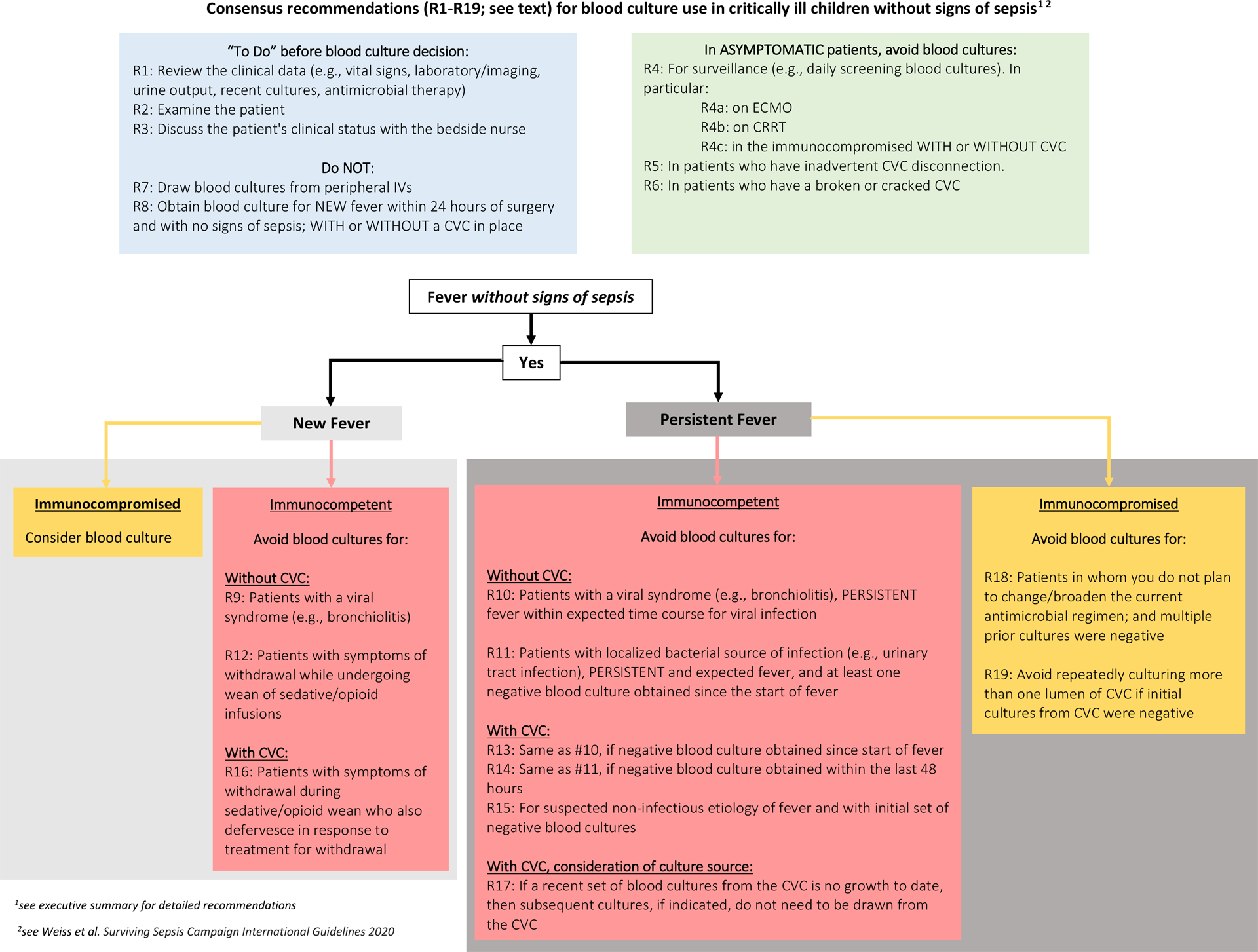
Of the 27 original recommendations, 18 met criteria for achieving consensus in Round 1; some were modified for clarity or condensed from multiple into single recommendations during Round 2. The remaining nine recommendations were discussed and modified until consensus was achieved during Round 2, which had 26 real-time voting participants. The final document contains 19 recommendations.
Using a modified Delphi process, we created consensus recommendations on when to avoid blood cultures and prevent overuse in the PICU. These recommendations are a critical step in disseminating diagnostic stewardship on a wider scale in critically ill children.
血液培养对于评估败血症至关重要,但过多的培养可能导致假阳性结果和不必要的抗生素使用。我们的目标是制定共识建议,重点关注在儿科重症监护病房(PICU)患者中何时可以安全避免进行血液培养。
一个由 29 名多学科专家组成的小组参与了两轮改良 Delphi 过程。第一轮包括文献总结和向受邀参与者发送的电子调查。在调查中,参与者根据五点 Likert 量表对一系列关于何时避免进行血液培养的建议进行评分。如果 75%的受访者选择 4 或 5 分,则达成共识,这些建议将被纳入最终建议。任何未达到共识的建议将在面对面的专家小组审查(第 2 轮)中进行讨论。第 2 轮由共识方法方面的独立专家协助进行。在审查了调查结果、第 1 轮的意见以及小组讨论后,小组成员实时对这些建议进行了投票。
专家机构;马里兰州巴尔的摩市的现场讨论。
儿科重症监护、传染病、肾脏病学、肿瘤学和实验室医学方面的专家。
无。
在最初的 27 条建议中,有 18 条在第 1 轮中达到了达成共识的标准;在第 2 轮中,为了清晰起见或从多条建议中浓缩为单条建议,对其中一些建议进行了修改。其余的 9 条建议在第 2 轮中进行了讨论和修改,直到达成共识,第 2 轮有 26 名实时投票参与者。最终文件包含 19 条建议。
使用改良 Delphi 过程,我们就何时避免血液培养和防止在 PICU 中过度使用达成了共识建议。这些建议是在危重病儿童中更广泛地传播诊断管理方面的重要一步。