Department of Nephrology, Shanghai East Hospital, Tongji University School of Medicine, Shanghai, China.
Department of Medicine, Rhode Island Hospital and Alpert Medical School, Brown University, Providence, Rhode Island.
Am J Physiol Renal Physiol. 2021 Jun 1;320(6):F1030-F1044. doi: 10.1152/ajprenal.00022.2021. Epub 2021 Apr 26.
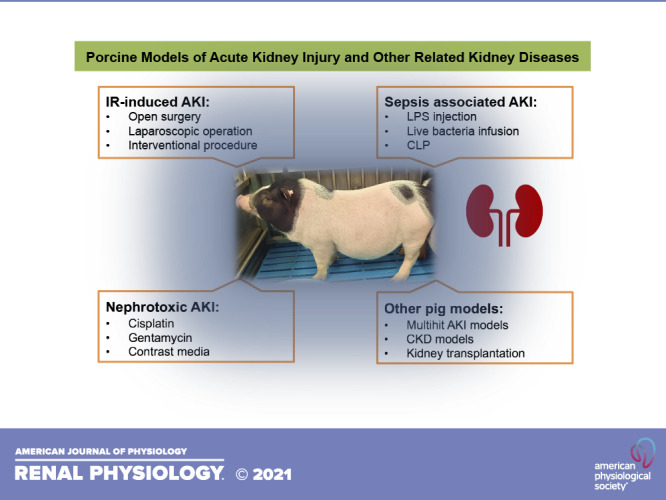
Pigs represent a potentially attractive model for medical research. Similar body size and physiological patterns of kidney injury that more closely mimic those described in humans make larger animals attractive for experimentation. Using larger animals, including pigs, to investigate the pathogenesis of acute kidney injury (AKI) also serves as an experimental bridge, narrowing the gap between clinical disease and preclinical discoveries. This article compares the advantages and disadvantages of large versus small AKI animal models and provides a comprehensive overview of the development and application of porcine models of AKI induced by clinically relevant insults, including ischemia-reperfusion, sepsis, and nephrotoxin exposure. The primary focus of this review is to evaluate the use of pigs for AKI studies by current investigators, including areas where more information is needed.
猪是医学研究中具有吸引力的动物模型。猪的体型和肾脏损伤的生理模式与人类更为相似,因此成为了实验动物的理想选择。使用包括猪在内的大型动物来研究急性肾损伤(AKI)的发病机制,也可以作为实验桥梁,缩小临床疾病和临床前发现之间的差距。本文比较了大动物和小动物 AKI 动物模型的优缺点,并全面综述了临床相关损伤(包括缺血再灌注、脓毒症和肾毒物暴露)诱导的 AKI 猪模型的发展和应用。本综述的主要重点是评估当前研究人员使用猪进行 AKI 研究的情况,包括需要更多信息的领域。