Department of Medical Biotechnologies, Bioengineering Lab, University of Siena, Siena, Italy.
Department of Medical Biotechnologies, Bioengineering Lab, University of Siena, Siena, Italy.
J Biomed Inform. 2021 Jun;118:103793. doi: 10.1016/j.jbi.2021.103793. Epub 2021 Apr 24.
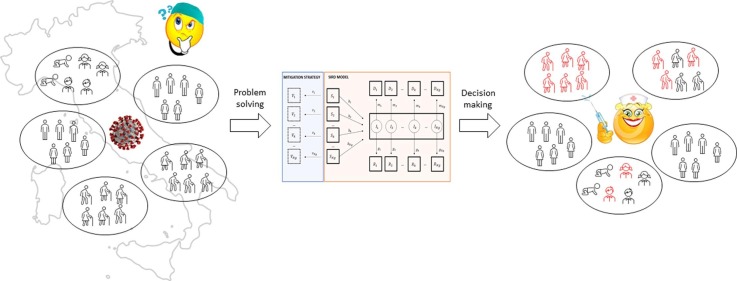
Available national public data are often too incomplete and noisy to be used directly to interpret the evolution of epidemics over time, which is essential for making timely and appropriate decisions. The use of compartment models can be a worthwhile and attractive approach to address this problem. The present study proposes a model compartmentalized by sex and age groups that allows for more complete information on the evolution of the CoViD-19 pandemic in Italy.
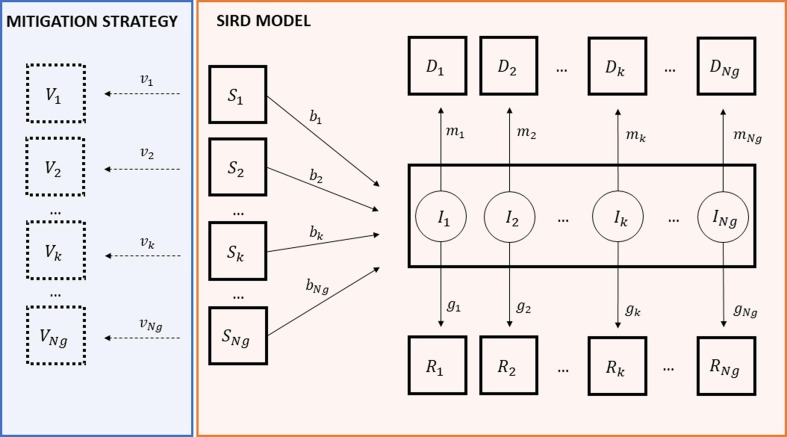
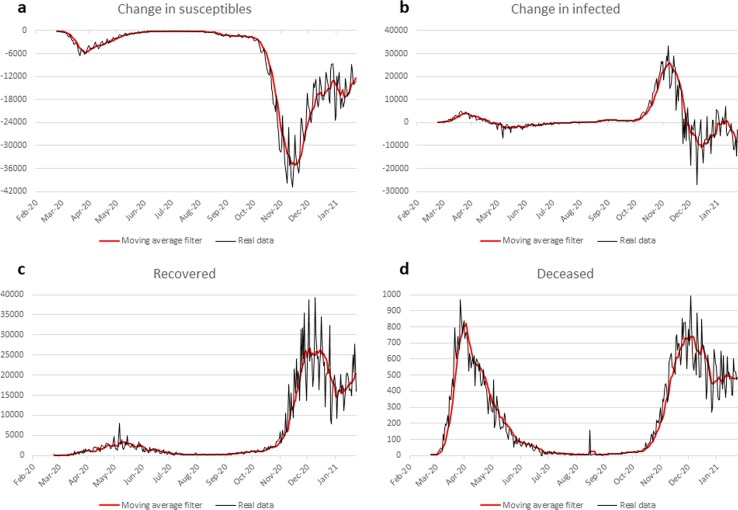
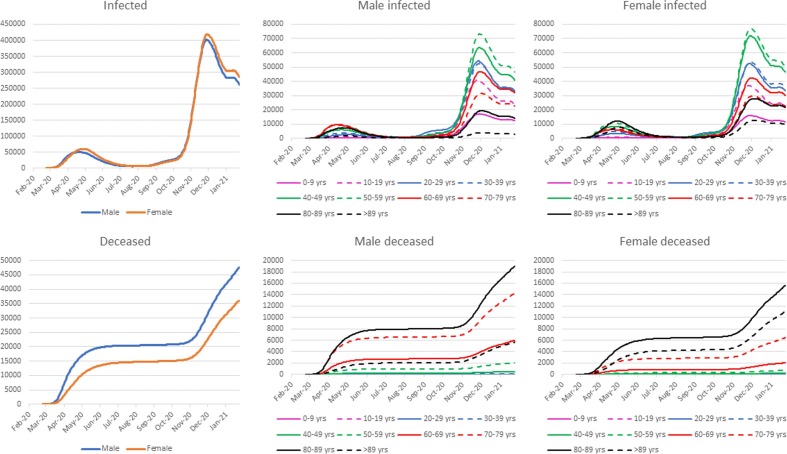
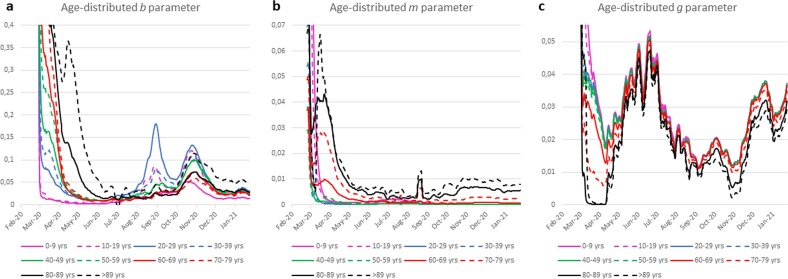
Italian public data on CoViD-19 were pre-treated with a 7-day moving average filter to reduce noise. A time-varying susceptible-infected-recovered-deceased (SIRD) model distributed by age and sex groups was then proposed. Recovered and infected individuals distributed by groups were reconstructed through the SIRD model, which was also used to simulate and identify optimal scenarios of pandemic containment by vaccination. The simulation started from realistic initial conditions based on the SIRD model parameters, estimated from filtered and reconstructed Italian data, at different pandemic times and phases. The following three objective functions, accounting for total infections, total deaths, and total quality-adjusted life years (QALYs) lost, were minimized by optimizing the percentages of vaccinated individuals in five different age groups.
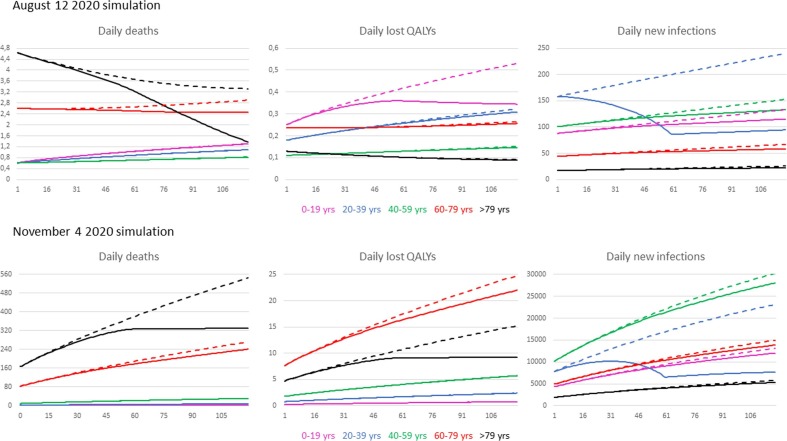
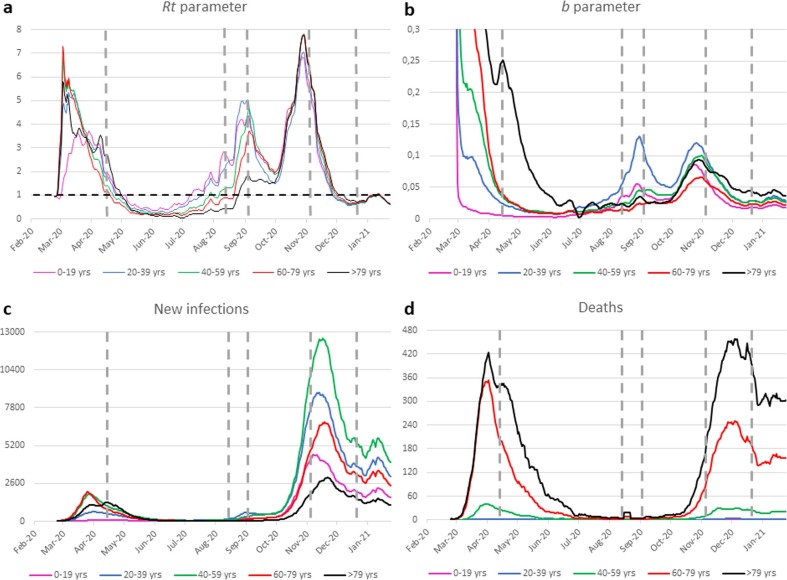
The developed SIRD model clearly highlighted those pandemic phases in which younger people, who had more contacts and lower mortality, infected older people, characterized by a significantly higher mortality, especially in males. Optimizing vaccination strategies yielded different results depending on the cost function used. As expected, to reduce total deaths, the suggested strategy was to vaccinate the older age groups, whatever the baseline scenario. In contrast, for QALYs lost and total infections, the optimal vaccine solutions strongly depended on the initial pandemic conditions: during phases of high virus diffusion, the model suggested to vaccinate mainly younger groups with a higher contact rate.
Because of the poor quality and insufficient availability of stratified public pandemic data, ad hoc information filtering and reconstruction procedures proved essential. The time-varying SIRD model, stratified by age and sex groups, provided insights and additional information on the dynamics of CoViD-19 infection in Italy, also supporting decision making for containment strategies such as vaccination.
可用的国家公共数据通常过于不完整和嘈杂,无法直接用于解释随时间演变的疫情,这对于及时做出适当的决策至关重要。使用隔间模型可以是解决此问题的一种有价值和有吸引力的方法。本研究提出了一种按性别和年龄组划分的隔间模型,可更全面地了解意大利 CoViD-19 大流行的演变。
对意大利 CoViD-19 的公共数据进行了 7 天移动平均滤波器预处理,以减少噪声。然后提出了一个按年龄和性别组分布的时变易感-感染-恢复-死亡(SIRD)模型。通过 SIRD 模型重建了按组分布的恢复和感染个体,该模型还用于模拟和确定通过疫苗接种控制大流行的最佳方案。模拟从基于 SIRD 模型参数的现实初始条件开始,这些参数是从过滤和重建的意大利数据中估计得出的,模拟时间和阶段不同。通过优化五个不同年龄组中接种个体的百分比,最小化了以下三个目标函数,这些函数分别考虑了总感染人数、总死亡人数和总质量调整生命年(QALYs)损失。
开发的 SIRD 模型清楚地突出了那些年轻人接触更多、死亡率更低、感染老年人的大流行阶段,老年人的死亡率明显更高,尤其是男性。优化疫苗接种策略的结果取决于所使用的成本函数。不出所料,为了减少总死亡人数,建议的策略是为老年人接种疫苗,无论基线情况如何。相比之下,对于 QALYs 损失和总感染人数,最佳疫苗解决方案强烈取决于初始大流行条件:在病毒扩散高的阶段,模型建议主要为接触率较高的年轻人群接种疫苗。
由于分层公共大流行病数据的质量差且可用性不足,专门的信息过滤和重建程序证明是必不可少的。按年龄和性别组划分的时变 SIRD 模型提供了有关意大利 CoViD-19 感染动力学的见解和其他信息,也为疫苗接种等控制策略的决策提供了支持。