Department of Neurosurgery, Samsung Medical Center, Sungkyunkwan University School of Medicine, Seoul, Korea.
Department of Otorhinolaryngology, Samsung Medical Center, Sungkyunkwan University School of Medicine, Seoul, Korea.
J Korean Med Sci. 2021 Apr 26;36(16):e102. doi: 10.3346/jkms.2021.36.e102.
Intended subtotal resection (STR) followed by adjuvant gamma knife radiosurgery (GKRS) has emerged as an effective treatment option for facial nerve (FN) preservation in vestibular schwannomas (VSs). This study aimed to identify the optimal cut-off volume of residual VS to predict favorable outcomes in terms of both tumor control and FN preservation.
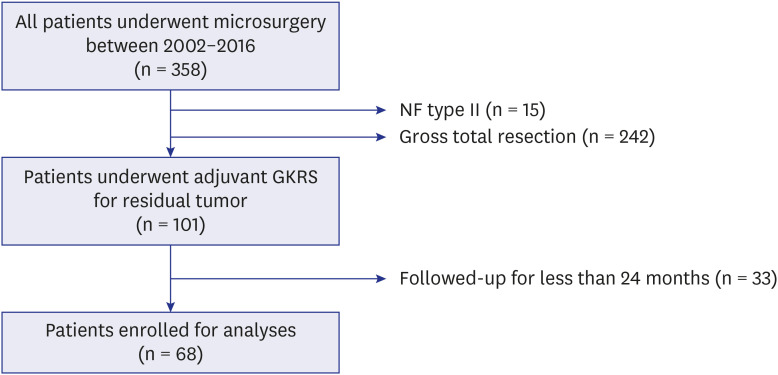
This retrospective study assessed the patients who underwent adjuvant GKRS for residual VS after microsurgery. A total of 68 patients who had been followed up for ≥ 24 months after GKRS were included. Tumor progression was defined as an increase in tumor volume (TV) of ≥ 20%. House-Brackmann grades I and II were considered to indicate good FN function.
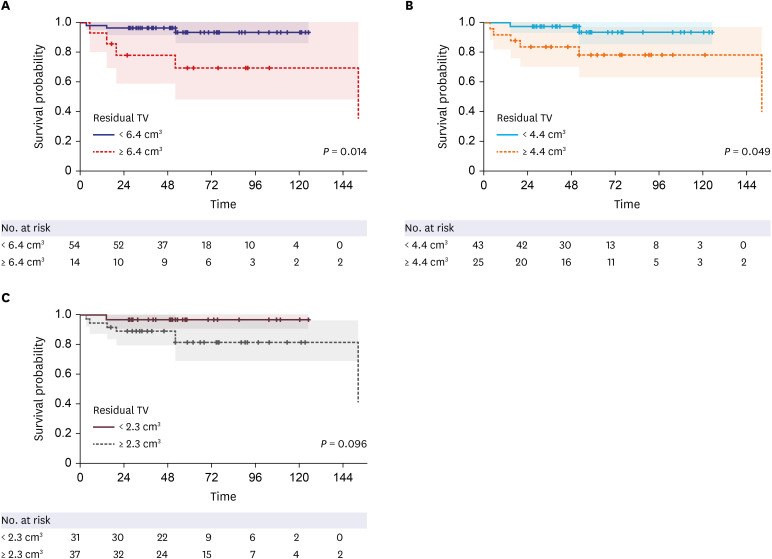
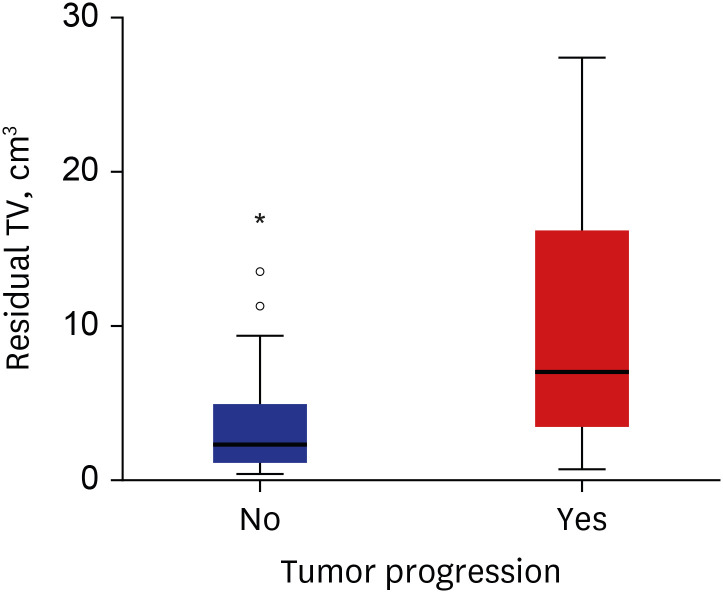
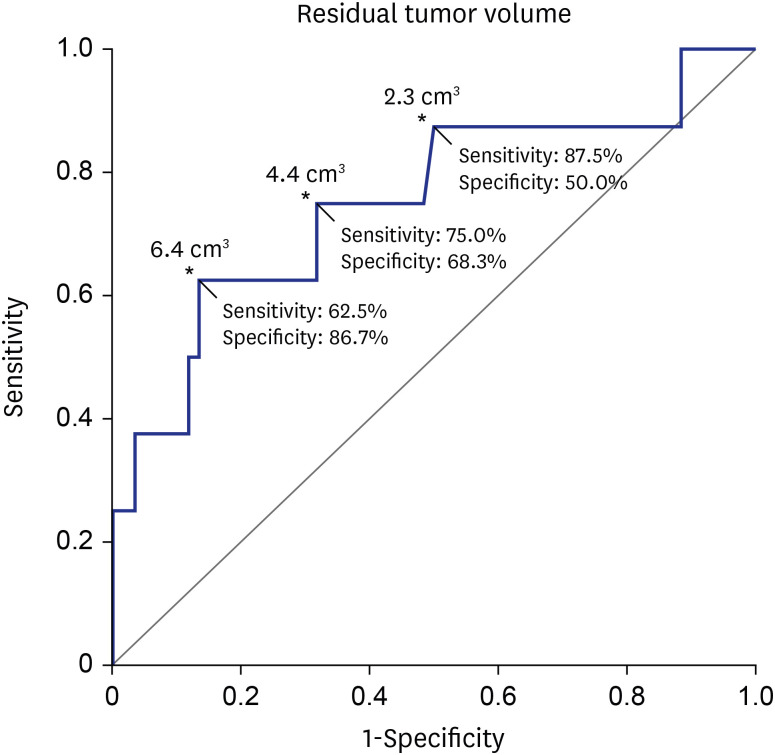
The median residual TV was 2.5 cm³ (range: 0.3-27.4). The median follow-up period after the first adjuvant GKRS was 64 months (range: 25.7-152.4). Eight (12%) patients showed tumor progression. In multivariate analyses, residual TV was associated with tumor progression ( = 0.003; hazard ratio [HR], 1.229; 95% confidence interval [CI], 1.075-1.405). A residual TV of 6.4 cm³ was identified as the cut-off volume for showing the greatest difference in progression-free survival (PFS). The 5-year PFS rates in the group with residual TVs of < 6.4 cm³ (54 patients) and that with residual TVs of ≥ 6.4 cm³ (14 patients) were 93.3% and 69.3%, respectively ( = 0.014). A good FN outcome was achieved in 57 (84%) patients. Residual TV was not associated with good FN function during the immediate postoperative period ( = 0.695; odds ratio [OR], 1.024; 95% CI, 0.908-1.156) or at the last follow-up ( = 0.755; OR, 0.980; 95% CI, 0.866-1.110).
In this study, residual TV was associated with tumor progression in VS after adjuvant GKRS following STR. As preservation of FN function is not correlated with the extent of resection, optimal volume reduction is imperative to achieve long-term tumor control. Our findings will help surgeons predict the prognosis of residual VS after FN-preserving surgery.
对于面神经(FN)保留的前庭神经鞘瘤(VSs),旨在进行次全切除术(STR),然后进行辅助伽玛刀放射外科手术(GKRS),已成为一种有效的治疗选择。本研究旨在确定残余 VS 的最佳残留体积,以预测肿瘤控制和 FN 保留两方面的良好结果。
本回顾性研究评估了接受显微手术后辅助 GKRS 治疗残余 VS 的患者。共纳入了 68 例在 GKRS 后随访≥24 个月的患者。肿瘤进展定义为肿瘤体积(TV)增加≥20%。House-Brackmann 分级 I 和 II 被认为表示 FN 功能良好。
中位残余 TV 为 2.5cm³(范围:0.3-27.4)。首次辅助 GKRS 后中位随访时间为 64 个月(范围:25.7-152.4)。8(12%)例患者出现肿瘤进展。多变量分析显示,残余 TV 与肿瘤进展相关( = 0.003;风险比[HR],1.229;95%置信区间[CI],1.075-1.405)。残余 TV 为 6.4cm³被确定为显示无进展生存期(PFS)差异最大的截止体积。残余 TVs < 6.4cm³(54 例)和残余 TVs ≥ 6.4cm³(14 例)组的 5 年 PFS 率分别为 93.3%和 69.3%( = 0.014)。57(84%)例患者获得良好的 FN 结果。残余 TV 与术后即刻( = 0.695;优势比[OR],1.024;95%CI,0.908-1.156)或末次随访时( = 0.755;OR,0.980;95%CI,0.866-1.110)FN 功能良好无关。
在这项研究中,残余 TV 与 STR 后辅助 GKRS 治疗后 VS 中的肿瘤进展相关。由于 FN 功能的保留与切除范围无关,因此实现最佳体积减少对于实现长期肿瘤控制至关重要。我们的发现将帮助外科医生预测保留 FN 手术后残余 VS 的预后。