Suzuki Miriam F, Almeida Larissa A, Pomin Stephanie A, Silva Felipe D, Freire Renan P, Oliveira João E, Affonso Regina, Soares Carlos R J, Bartolini Paolo
Biotechnology Center, Instituto de Pesquisas Energéticas e Nucleares, IPEN-CNEN/SP, Avenida Prof. Lineu Prestes 2242, São Paulo, SP, 05508-000, Brazil.
AMB Express. 2021 Apr 27;11(1):62. doi: 10.1186/s13568-021-01209-5.
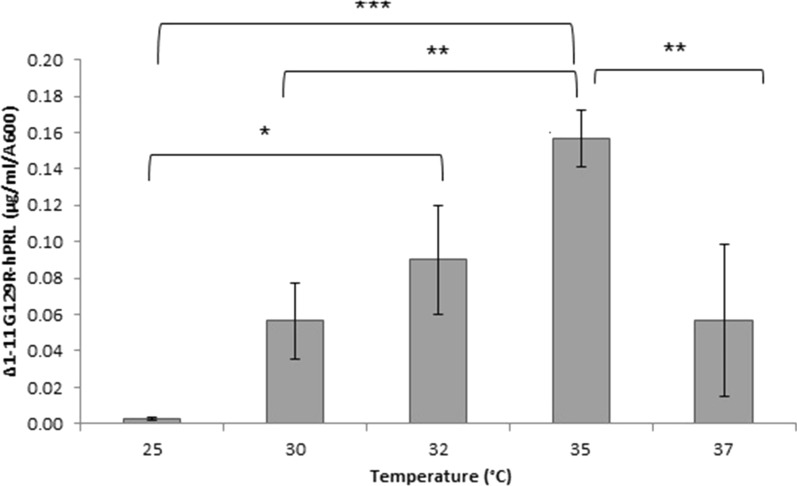
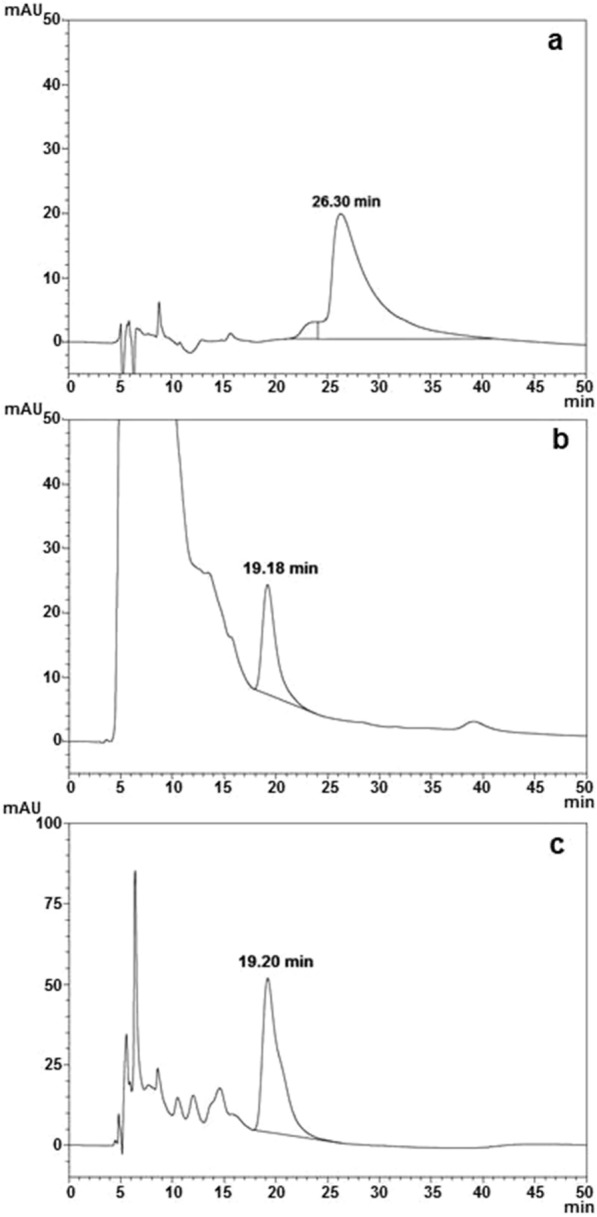
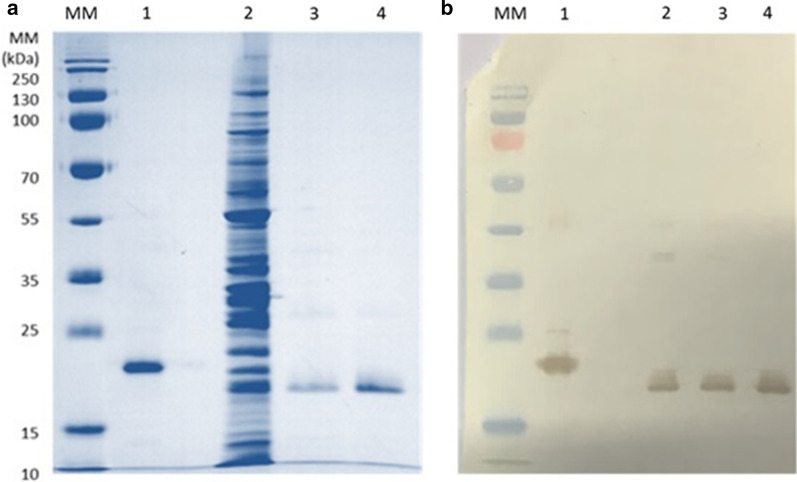
The human prolactin antagonist Δ-G129R-hPRL is a 21.9 kDa recombinant protein with 188 amino acids that downregulates the proliferation of a variety of cells expressing prolactin receptors. Periplasmic expression of recombinant proteins in E. coli has been considered an option for obtaining a soluble and correctly folded protein, as an alternative to cytoplasmic production. The aim of this work was, therefore, to synthesize for the first time, the Δ-G129R-hPRL antagonist, testing different activation temperatures and purifying it by classical chromatographic techniques. E. coli BL21(DE3) strain was transformed with a plasmid based on the pET25b( +) vector, DsbA signal sequence and the antagonist cDNA sequence. Different doses of IPTG were added, activating under different temperatures, and extracting the periplasmic fluid via osmotic shock. The best conditions were achieved by activating at 35 °C for 5 h using 0.4 mM IPTG, which gave a specific expression of 0.157 ± 0.015 μg/mL/A at a final optical density of 3.43 ± 0.13 A. Purification was carried out by nickel-affinity chromatography followed by size-exclusion chromatography, quantification being performed via high-performance size-exclusion chromatography (HPSEC). The prolactin antagonist was characterized by SDS-PAGE, Western blotting, reversed-phase high-performance liquid chromatography (RP-HPLC) and MALDI-TOF-MS. The final product presented > 95% purity and its antagonistic effects were evaluated in vitro in view of potential clinical applications, including inhibition of the proliferation of cancer cells overexpressing the prolactin receptor and specific antidiabetic properties, taking also advantage of the fact that this antagonist was obtained in a soluble and correctly folded form and without an initial methionine.
人催乳素拮抗剂Δ-G129R-hPRL是一种21.9 kDa的重组蛋白,含188个氨基酸,可下调多种表达催乳素受体的细胞的增殖。作为细胞质生产的替代方法,在大肠杆菌中周质表达重组蛋白被认为是获得可溶性且正确折叠蛋白的一种选择。因此,本研究旨在首次合成Δ-G129R-hPRL拮抗剂,测试不同的激活温度,并通过经典色谱技术对其进行纯化。用基于pET25b(+)载体、DsbA信号序列和拮抗剂cDNA序列的质粒转化大肠杆菌BL21(DE3)菌株。加入不同剂量的异丙基-β-D-硫代半乳糖苷(IPTG),在不同温度下激活,并通过渗透压休克提取周质液。最佳条件是使用0.4 mM IPTG在35℃激活5小时,在最终光密度为3.43±0.13 A时,特异性表达为0.157±0.015μg/mL/A。通过镍亲和色谱随后进行尺寸排阻色谱进行纯化,通过高效尺寸排阻色谱(HPSEC)进行定量。通过十二烷基硫酸钠-聚丙烯酰胺凝胶电泳(SDS-PAGE)、蛋白质免疫印迹法(Western blotting)、反相高效液相色谱(RP-HPLC)和基质辅助激光解吸电离飞行时间质谱(MALDI-TOF-MS)对催乳素拮抗剂进行表征。最终产品纯度>95%,鉴于其潜在的临床应用,包括抑制过表达催乳素受体的癌细胞增殖和特定的抗糖尿病特性,对其体外拮抗作用进行了评估,同时还利用了该拮抗剂是以可溶性且正确折叠的形式获得且无初始甲硫氨酸这一事实。