Otago Paleogenetics Laboratory, Department of Zoology, University of Otago, Dunedin, New Zealand.
School of Biological Sciences, The University of Adelaide, Adelaide, South Australia, Australia.
BMC Ecol Evol. 2021 Apr 27;21(1):67. doi: 10.1186/s12862-021-01808-7.
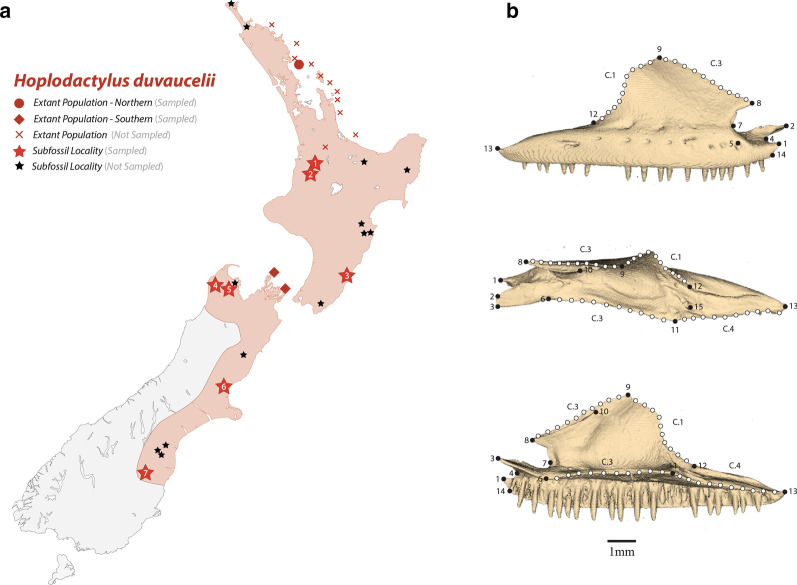
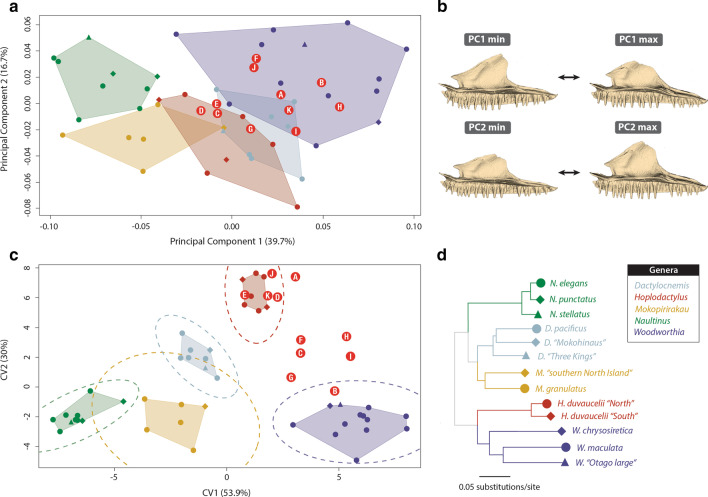
New Zealand's diplodactylid geckos exhibit high species-level diversity, largely independent of discernible osteological changes. Consequently, systematic affinities of isolated skeletal elements (fossils) are primarily determined by comparisons of size, particularly in the identification of Hoplodactylus duvaucelii, New Zealand's largest extant gecko species. Here, three-dimensional geometric morphometrics of maxillae (a common fossilized element) was used to determine whether consistent shape and size differences exist between genera, and if cryptic extinctions have occurred in subfossil 'Hoplodactylus cf. duvaucelii'. Sampling included 13 diplodactylid species from five genera, and 11 Holocene subfossil 'H. cf. duvaucelii' individuals. We found phylogenetic history was the most important predictor of maxilla morphology among extant diplodactylid genera. Size comparisons could only differentiate Hoplodactylus from other genera, with the remaining genera exhibiting variable degrees of overlap. Six subfossils were positively identified as H. duvaucelii, confirming their proposed Holocene distribution throughout New Zealand. Conversely, five subfossils showed no clear affinities with any modern diplodactylid genera, implying either increased morphological diversity in mainland 'H. cf. duvaucelii' or the presence of at least one extinct, large, broad-toed diplodactylid species.
新西兰的蜥趾龙科壁虎表现出高度的种级多样性,在很大程度上独立于明显的骨骼变化。因此,孤立骨骼元素(化石)的系统亲缘关系主要通过大小比较来确定,特别是在鉴定新西兰现存最大的壁虎物种 Hoplodactylus duvaucelii 时。在这里,使用了上颌骨(一种常见的化石元素)的三维几何形态计量学来确定属之间是否存在一致的形状和大小差异,以及是否在亚化石“Hoplodactylus cf. duvaucelii”中发生了隐匿灭绝。采样包括来自五个属的 13 种蜥趾龙科物种,以及 11 个全新世亚化石“H. cf. duvaucelii”个体。我们发现,在现存的蜥趾龙科属中,系统发育历史是上颌骨形态最重要的预测因子。大小比较只能将 Hoplodactylus 与其他属区分开来,而其余属则表现出不同程度的重叠。六块亚化石被确认为 H. duvaucelii,证实了它们在整个新西兰的全新世分布。相反,五块亚化石与任何现代蜥趾龙科属都没有明显的亲缘关系,这表明大陆“H. cf. duvaucelii”的形态多样性增加,或者至少存在一种已灭绝的大型宽趾蜥趾龙科物种。