Department of Cardiology, Institute of Cardiovascular Diseases, First Affiliated Hospital of Dalian Medical University, 193# Lianhe Road, Shahekou District, Dalian, China.
Department of Ultrasonics, Second Affiliated Hospital of Xi'an Jiaotong University, Xi'an, China.
BMC Cardiovasc Disord. 2021 Apr 27;21(1):214. doi: 10.1186/s12872-021-02032-3.
To clarify the appropriate initial dosage of heparin during radiofrequency catheter ablation (RFCA) in patients with atrial fibrillation (AF) receiving uninterrupted nonvitamin K antagonist oral anticoagulant (NOAC) treatment.
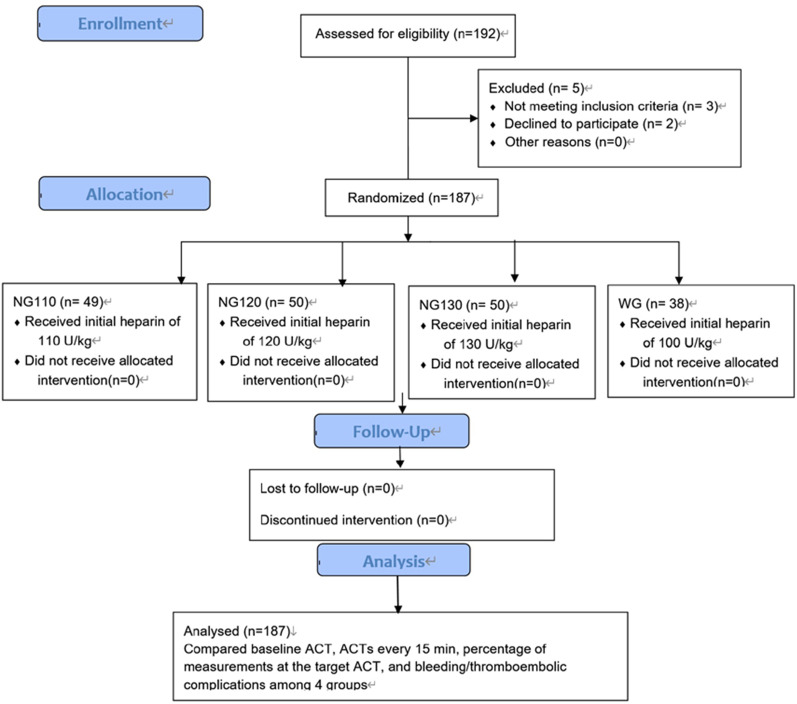
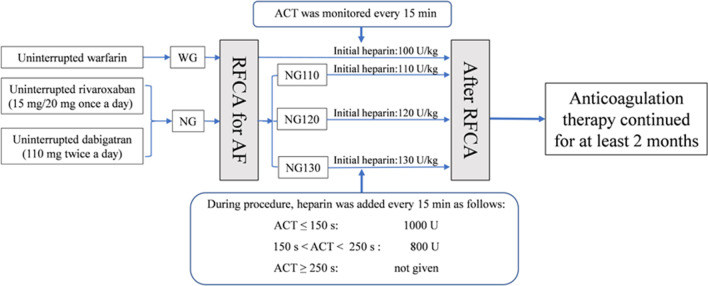
A total of 187 consecutive AF patients who underwent their first RFCA in our center were included. In the warfarin group (WG), an initial heparin dose of 100 U/kg was administered (control group: n = 38). The patients who were on NOACs were randomly divided into 3 NOAC groups (NG: n = 149), NG110, NG120, and NG130, and were administered initial heparin doses of 110 U/kg, 120 U/kg, and 130 U/kg, respectively. During RFCA, the activated clotting time (ACT) was measured every 15 min, and the target ACT was maintained at 250-350 s by intermittent heparin infusion. The baseline ACT and ACTs at each 15-min interval, the average percentage of measurements at the target ACT, and the incidence of periprocedural bleeding and thromboembolic complications were recorded and analyzed.
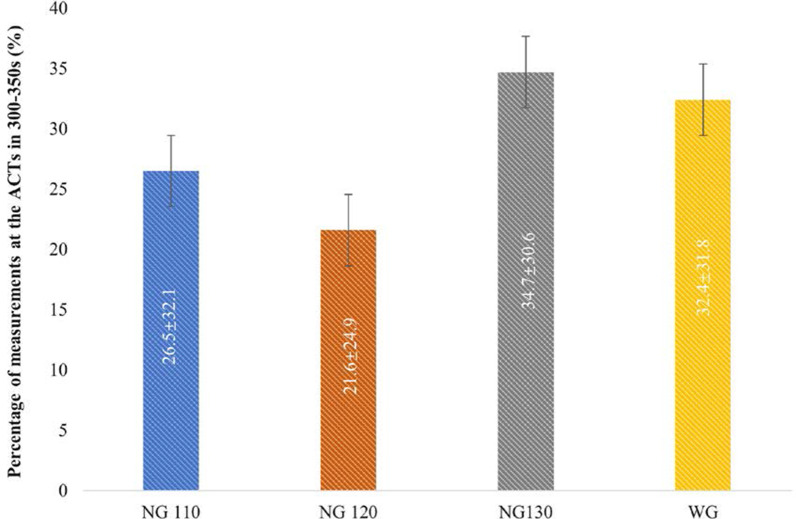
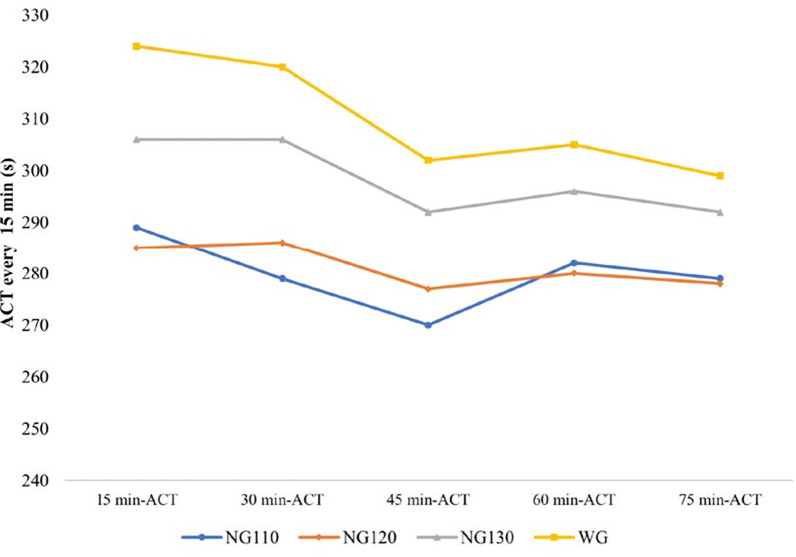
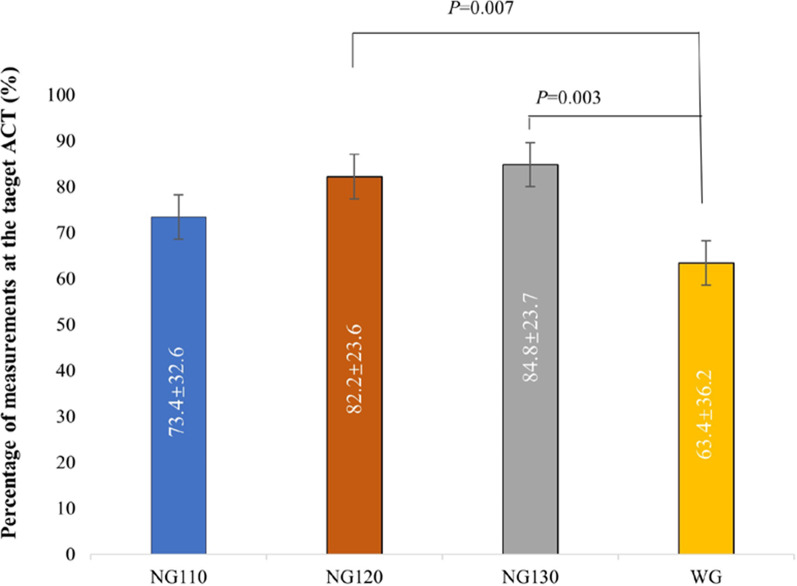
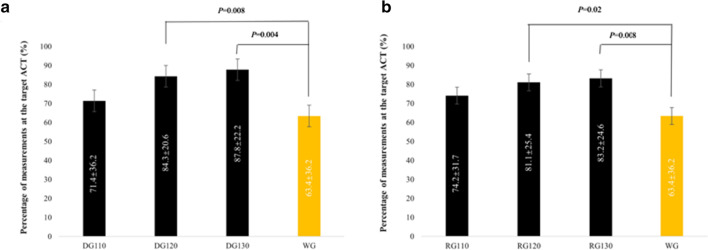
There was no significant difference in sex, age, weight, or baseline ACT among the four groups. The 15 min-ACT, 30 min-ACT, and 45 min-ACT were significantly longer in the WG than in NG110 and NG120. However, no significant difference in 60 min-ACT or 75 min-ACT was detected. The average percentages of measurements at the target ACT in NG120 (82.2 ± 23.6%) and NG130 (84.8 ± 23.7%) were remarkably higher than those in the WG (63.4 ± 36.2%, p = 0.007, 0.003, respectively). These differences were independent of the type of NOAC. The proportion of ACTs in 300-350 s in NG130 was higher than in WG (32.4 ± 31.8 vs. 34.7 ± 30.6, p = 0.735). Severe periprocedural thromboembolic and bleeding complications were not observed.
For patients with AF receiving uninterrupted NOAC treatment who underwent RFCA, an initial heparin dosage of 120 U/kg or 130 U/kg can provide an adequate intraprocedural anticoagulant effect, and 130 U/kg allowed ACT to reach the target earlier.
Registration number: ChiCTR1800016491, First Registration Date: 04/06/2018 (Chinese Clinical Trial Registry http://www.chictr.org.cn/index.aspx ).
为明确房颤(AF)患者在持续接受非维生素 K 拮抗剂口服抗凝剂(NOAC)治疗时行射频导管消融(RFCA)术时肝素的初始适宜剂量。
共纳入 187 例行首次 RFCA 的连续 AF 患者。华法林组(WG)给予 100 U/kg 的初始肝素剂量(对照组:n=38)。NOAC 组患者随机分为 3 个 NOAC 组(NG:n=149),NG110 组、NG120 组和 NG130 组分别给予 110 U/kg、120 U/kg 和 130 U/kg 的初始肝素剂量。在 RFCA 期间,每 15 min 测量 1 次活化凝血时间(ACT),通过间歇性肝素输注将目标 ACT 维持在 250-350 s。记录并分析各组的基线 ACT 和每个 15 min 间隔的 ACT、目标 ACT 测量的平均百分比以及围术期出血和血栓栓塞并发症的发生率。
4 组患者的性别、年龄、体重或基线 ACT 无显著差异。与 NG110 组和 NG120 组相比,WG 的 15 min-ACT、30 min-ACT 和 45 min-ACT 明显更长。然而,60 min-ACT 或 75 min-ACT 无显著差异。NG120 组(82.2±23.6%)和 NG130 组(84.8±23.7%)的目标 ACT 测量的平均百分比显著高于 WG(63.4±36.2%,p=0.007、0.003)。这些差异与 NOAC 的类型无关。NG130 组 300-350 s 时 ACT 比例高于 WG(32.4±31.8 vs. 34.7±30.6,p=0.735)。未观察到严重的围术期血栓栓塞和出血并发症。
对于持续接受 NOAC 治疗并接受 RFCA 的 AF 患者,120 U/kg 或 130 U/kg 的初始肝素剂量可提供充分的术中抗凝效果,且 130 U/kg 可使 ACT 更早达到目标值。
注册号:ChiCTR1800016491,首次注册日期:2018 年 4 月 6 日(中国临床试验注册中心 http://www.chictr.org.cn/index.aspx)。