Department of Biostatistics, National Jewish Health, Denver, CO, USA.
Department of Internal Medicine, University of Michigan Health System, Ann Arbor, MI, USA.
Respir Res. 2021 Apr 27;22(1):127. doi: 10.1186/s12931-021-01686-z.
Soluble receptor for advanced glycation end products (sRAGE) is a proposed emphysema and airflow obstruction biomarker; however, previous publications have shown inconsistent associations and only one study has investigate the association between sRAGE and emphysema. No cohorts have examined the association between sRAGE and progressive decline of lung function. There have also been no evaluation of assay compatibility, receiver operating characteristics, and little examination of the effect of genetic variability in non-white population. This manuscript addresses these deficiencies and introduces novel data from Pittsburgh COPD SCCOR and as well as novel work on airflow obstruction. A meta-analysis is used to quantify sRAGE associations with clinical phenotypes.
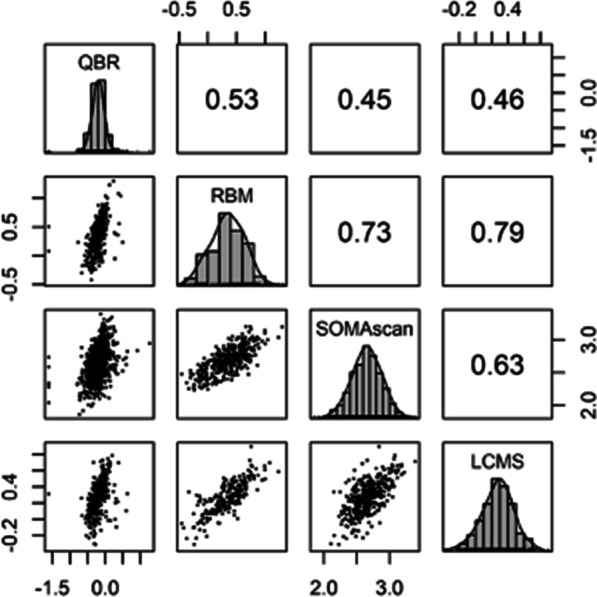
sRAGE was measured in four independent longitudinal cohorts on different analytic assays: COPDGene (n = 1443); SPIROMICS (n = 1623); ECLIPSE (n = 2349); Pittsburgh COPD SCCOR (n = 399). We constructed adjusted linear mixed models to determine associations of sRAGE with baseline and follow up forced expiratory volume at one second (FEV) and emphysema by quantitative high-resolution CT lung density at the 15th percentile (adjusted for total lung capacity).
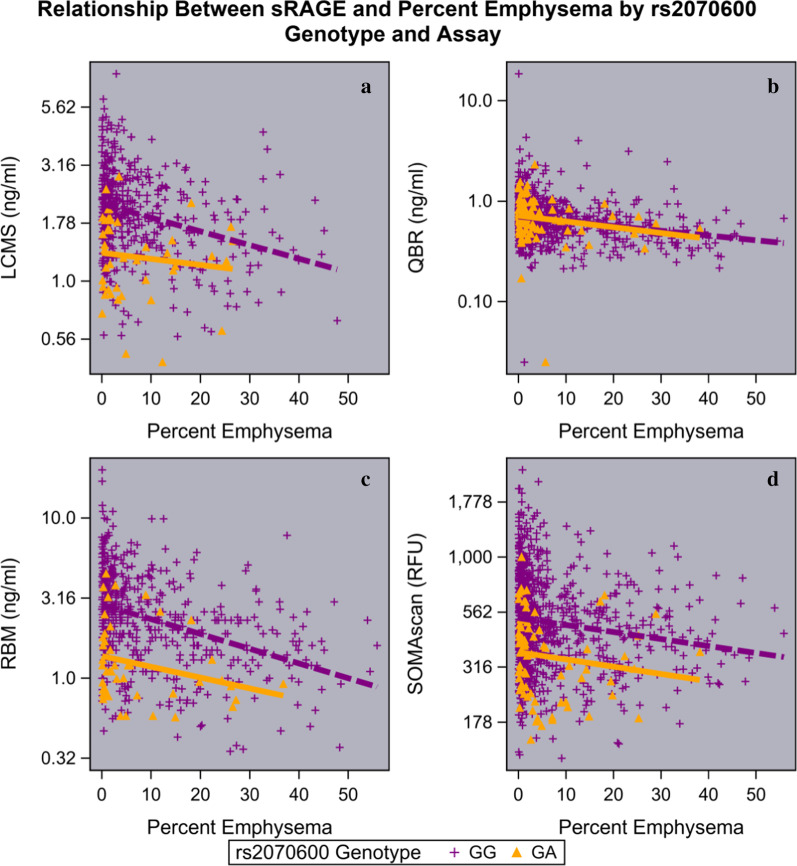
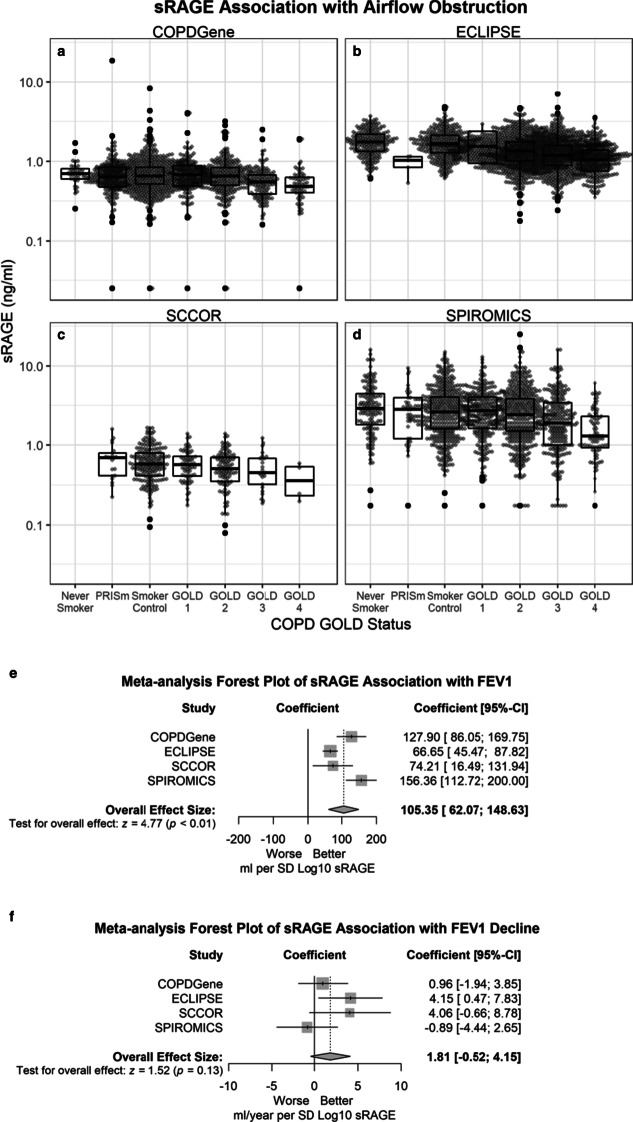
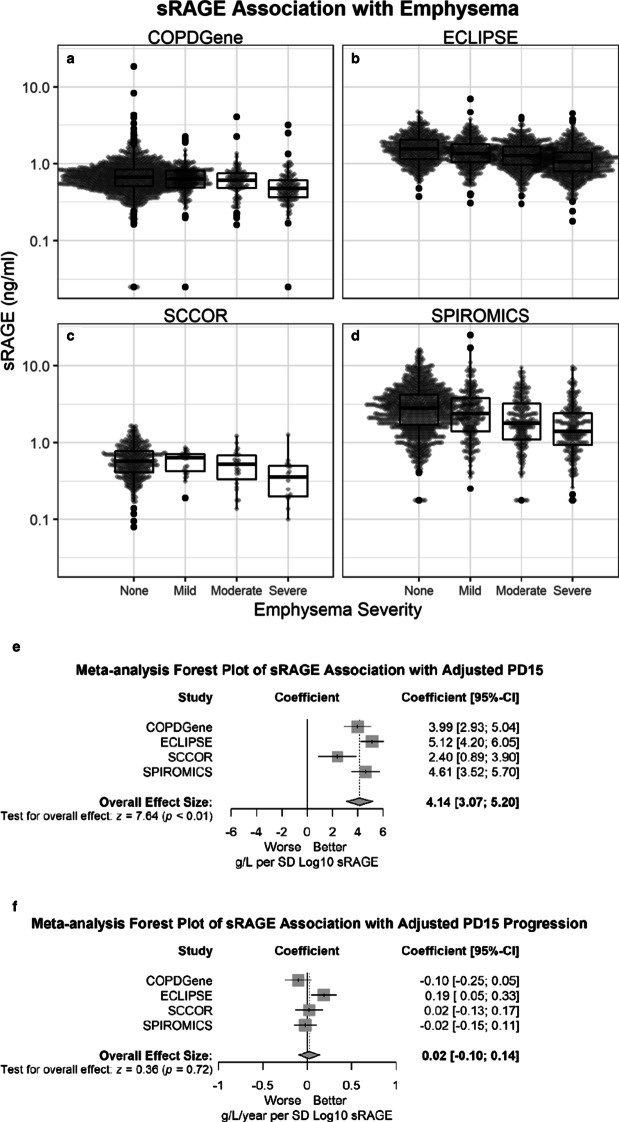
Lower plasma or serum sRAGE values were associated with a COPD diagnosis (P < 0.001), reduced FEV (P < 0.001), and emphysema severity (P < 0.001). In an inverse-variance weighted meta-analysis, one SD lower log-transformed sRAGE was associated with 105 ± 22 mL lower FEV and 4.14 ± 0.55 g/L lower adjusted lung density. After adjusting for covariates, lower sRAGE at baseline was associated with greater FEV decline and emphysema progression only in the ECLIPSE cohort. Non-Hispanic white subjects carrying the rs2070600 minor allele (A) and non-Hispanic African Americans carrying the rs2071288 minor allele (A) had lower sRAGE measurements compare to those with the major allele, but their emphysema-sRAGE regression slopes were similar.
Lower blood sRAGE is associated with more severe airflow obstruction and emphysema, but associations with progression are inconsistent in the cohorts analyzed. In these cohorts, genotype influenced sRAGE measurements and strengthened variance modelling. Thus, genotype should be included in sRAGE evaluations.
可溶性晚期糖基化终产物受体(sRAGE)是一种拟议的肺气肿和气流阻塞生物标志物;然而,先前的出版物显示出不一致的关联,并且只有一项研究调查了 sRAGE 与肺气肿之间的关联。没有队列研究过 sRAGE 与肺功能进行性下降之间的关系。也没有评估分析物兼容性、接收者操作特征的研究,对非白人群体遗传多态性的研究也很少。本文解决了这些缺陷,并介绍了匹兹堡 COPD SCCOR 的新数据以及气流阻塞方面的新工作。Meta 分析用于量化 sRAGE 与临床表型的关联。
在四个独立的纵向队列中,使用不同的分析物检测 sRAGE:COPDGene(n=1443);SPIROMICS(n=1623);ECLIPSE(n=2349);匹兹堡 COPD SCCOR(n=399)。我们构建了调整后的线性混合模型,以确定 sRAGE 与基线和随访时一秒用力呼气量(FEV)以及通过定量高分辨率 CT 肺密度在第 15 百分位数(根据总肺活量调整)测量的肺气肿之间的关联。
较低的血浆或血清 sRAGE 值与 COPD 诊断(P<0.001)、FEV 降低(P<0.001)和肺气肿严重程度(P<0.001)相关。在逆方差加权的荟萃分析中,log 转换后的 sRAGE 降低一个标准差与 FEV 降低 105±22 mL 和调整后的肺密度降低 4.14±0.55 g/L 相关。在校正协变量后,只有在 ECLIPSE 队列中,基线时较低的 sRAGE 与 FEV 下降和肺气肿进展相关。与主要等位基因相比,携带 rs2070600 次要等位基因(A)的非西班牙裔白人和携带 rs2071288 次要等位基因(A)的非西班牙裔非洲裔美国人的 sRAGE 测量值较低,但他们的肺气肿-sRAGE 回归斜率相似。
较低的血液 sRAGE 与更严重的气流阻塞和肺气肿相关,但在分析的队列中,与进展的关联不一致。在这些队列中,基因型影响 sRAGE 测量值并增强方差模型。因此,基因型应纳入 sRAGE 评估。