Department of Oncology.
Department of Oncology, People's Hospital of Jiangdu, Yangzhou 225200, Jiangsu, China.
Medicine (Baltimore). 2021 Apr 30;100(17):e25630. doi: 10.1097/MD.0000000000025630.
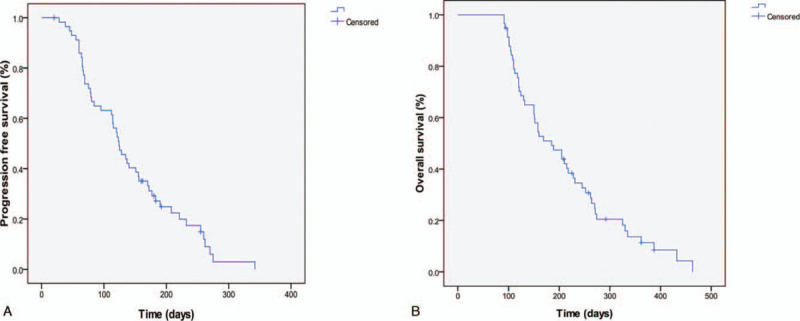
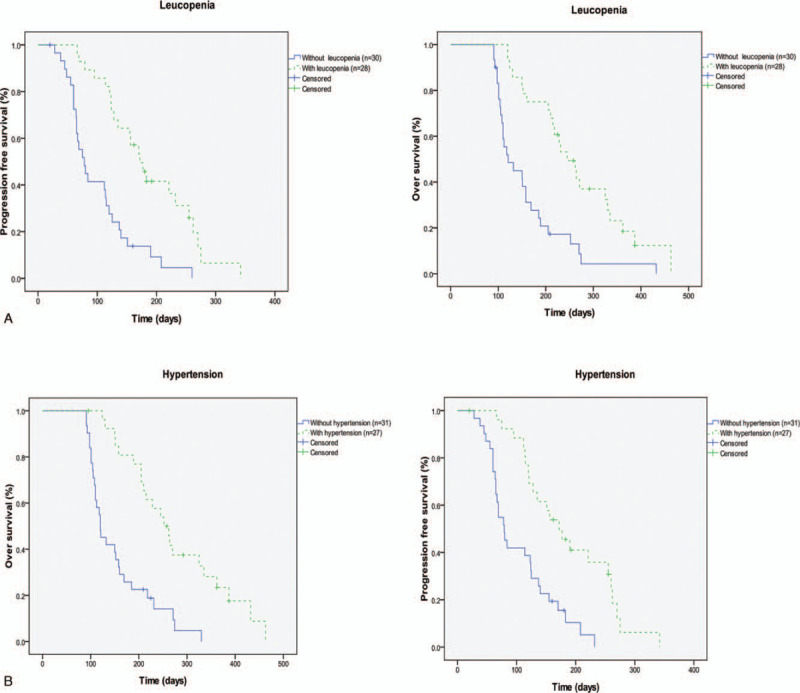
Advanced gastric cancer (AGC) patients are not tolerant to the toxicities of traditional chemotherapy and its second-line therapeutic regimens are limited. The aim of the present study is to evaluate the efficacy and safety of apatinib combined with S-1 as the second-line therapy for AGC patients.Patients with AGC were enrolled in this study. Patients received oral apatinib (250 mg to 500 mg once daily) and S-1(40 mg/m2 twice daily) on days 1-14. Each cycle was 28 days and one course of treatment consisted of 2 cycles. Clinical efficacy and adverse events (AEs) were observed. Kaplan-Meier method was used for survival analysis.From November 2015 to December 2017, 58 AGC patients who failed first-line chemotherapy were enrolled and assessed retrospectively. According to the Response Evaluation Criteria in Solid Tumors (RECIST) standard, all patients were evaluable for response. None achieved CR, and 10 (17.2%) achieved PR (95% CI 7.2%-27.3%). SD was observed in 58.6% (34/58) of patients (95% CI 45.6%-71.7%) and NR in 24.1% (14/58) of patients (95% CI 12.8%-35.5%). The objective response rate (ORR) and the disease control rate (DCR) were 17.2% and 75.8% respectively. The median progression-free survival (PFS) and median overall survival (OS) were 143.1 days (95% CI 121.7-164.5) and 211.6 days (95% CI 162.9-219.7) respectively. The multivariate analysis showed that the ECOG PS was the independent factor of PFS and OS for AGC patients (PFS: HR = 3.565, 95% CI: 2.25-5.65, P < .001; OS: HR = 3.676, 95% CI: 2.29-5.89, P < .001). The main AEs were fatigue (72.4%), hypertension (46.6%), and leukopenia (48.3%).Apatinib combined with S-1 showed promising efficiency and was well tolerated as the second-line therapy for AGC patients. ECOG PS was the independent factor of PFS and OS for AGC patients. AEs were moderate and controllable, and leukopenia or hypertension was predictable factors for the PFS and OS of AGC patients.
晚期胃癌(AGC)患者对传统化疗的毒性不耐受,二线治疗方案有限。本研究旨在评估阿帕替尼联合替吉奥(S-1)二线治疗 AGC 患者的疗效和安全性。
本研究纳入 AGC 患者。患者接受阿帕替尼(250-500mg,每日一次)和 S-1(40mg/m2,每日两次)口服治疗,第 1-14 天用药。每 28 天为一个周期,一个疗程包括 2 个周期。观察临床疗效和不良反应(AE)。采用 Kaplan-Meier 法进行生存分析。
2015 年 11 月至 2017 年 12 月,共纳入 58 例一线化疗失败的 AGC 患者进行回顾性评估。根据实体瘤反应评价标准(RECIST),所有患者均可评价疗效。均未达到完全缓解(CR),10 例(17.2%)患者达到部分缓解(PR)(95%CI7.2%-27.3%)。疾病稳定(SD)占 58.6%(34/58)(95%CI45.6%-71.7%),疾病进展(PD)占 24.1%(14/58)(95%CI12.8%-35.5%)。客观缓解率(ORR)和疾病控制率(DCR)分别为 17.2%和 75.8%。中位无进展生存期(PFS)和中位总生存期(OS)分别为 143.1 天(95%CI121.7-164.5)和 211.6 天(95%CI162.9-219.7)。多因素分析显示,ECOG PS 是 AGC 患者 PFS 和 OS 的独立影响因素(PFS:HR=3.565,95%CI:2.25-5.65,P<0.001;OS:HR=3.676,95%CI:2.29-5.89,P<0.001)。主要 AEs 为乏力(72.4%)、高血压(46.6%)和白细胞减少(48.3%)。
阿帕替尼联合 S-1 作为 AGC 患者的二线治疗方案具有良好的疗效和耐受性。ECOG PS 是 AGC 患者 PFS 和 OS 的独立影响因素。AE 为中重度,可控,白细胞减少或高血压是预测 AGC 患者 PFS 和 OS 的可预测因素。