Department of Neurology.
Department of Radiation Oncology, Kaohsiung Medical University Hospital.
Medicine (Baltimore). 2021 Apr 30;100(17):e25751. doi: 10.1097/MD.0000000000025751.
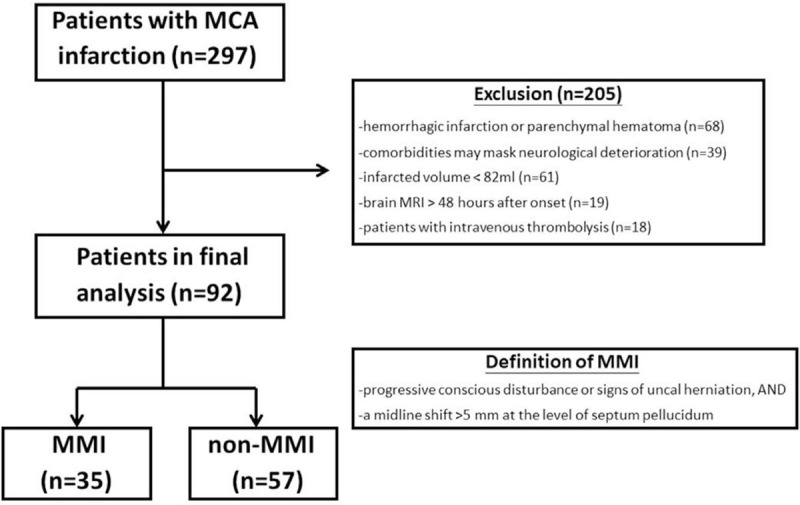
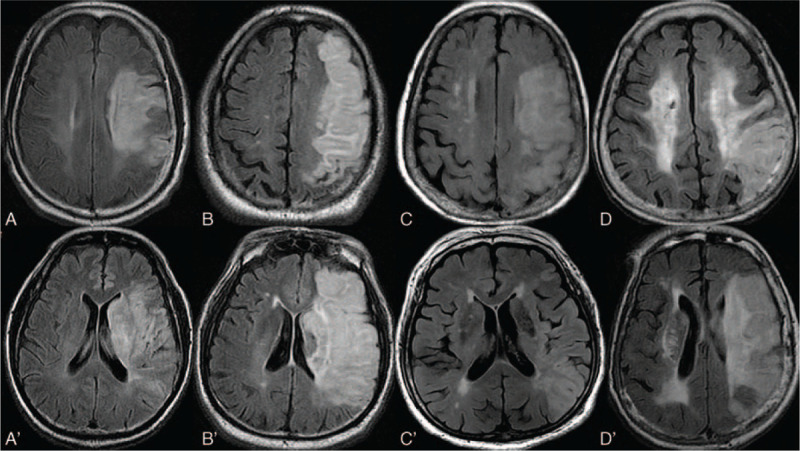
Disrupted blood-brain barrier (BBB) in patients with ischemic stroke plays a critical role in malignant middle cerebral artery infarction (MMI) development.Cerebral white matter changes (WMC), particularly in the deep subcortical area or in severe one, may be also underlain by disrupted BBB. It is unclear whether the presence of WMC with potential premorbid disruption of BBB makes patients susceptible to MMI. Therefore, this study aimed to clarify any putative relationship between the MMI and WMC in terms of their severity and locations.In this case-control study, patients with infarction in the middle cerebral artery territory were retrospectively reviewed. Brain magnetic resonance images were analyzed according to Fazekas scale, and identified WMC were divided into periventricular WMC (PV-WMC) and deep subcortical WMC (deep-WMC). Patients were scored as having WMC, PV-WMC, deep-WMC, severe PV-WMC, and severe deep-WMC according to the severity and locations. Patients were defined as having MMI if either a progressive conscious disturbance or signs of uncal herniation was recorded in combination with a midline shift >5 mm identified on the follow-up computed tomography.Among 297 patients admitted between July 2009 and February 2015, 92 patients were eligible for final analysis. Compared to patients without MMI, patients with MMI had a higher score of National Institutes of Health Stroke Scale, a larger infarct volume, and an increasingly greater proportion of severe PV-WMC, deep-WMC, and severe deep-WMC, respectively. After adjustment for sex, age, infarct volume, and history of hypertension, severe deep-WMC (odds ratio [OR] = 6.362, 95% confidence interval [CI] = 1.444-28.023, P = .0144) and severe PV-WMC (odds ratio = 5.608, 95% confidence interval = 1.107-28.399, P = .0372) were significantly associated with MMI development.MMI and WMC are significantly associated such that MMI development is more likely when PV-WMC or deep-WMC is more severe. We hypothesize that Fazekas scale-defined severe deep-WMC and PV-WMC may be considered as clinically approachable predictors of MMI development. These findings support that the WMC with potential premorbid disrupted BBB may make patients susceptible to MMI, and further prospective study should be conducted to clarify this hypothesis.
患有缺血性脑卒中的患者的血脑屏障(BBB)破坏在恶性大脑中动脉梗死(MMI)的发展中起着关键作用。脑白质病变(WMC),特别是在深部皮质下区域或严重的情况下,也可能是由 BBB 破坏引起的。目前尚不清楚是否存在潜在的 BBB 破坏的 WMC 是否使患者易发生 MMI。因此,本研究旨在阐明 MMI 与 WMC 在严重程度和位置方面的任何潜在关系。
在这项病例对照研究中,回顾性分析了大脑中动脉区域梗死的患者。根据 Fazekas 量表分析脑磁共振图像,并将识别出的 WMC 分为脑室周围 WMC(PV-WMC)和深部皮质下 WMC(deep-WMC)。根据严重程度和位置,患者根据严重程度和位置被评为存在 WMC、PV-WMC、deep-WMC、严重 PV-WMC 和严重 deep-WMC。如果在随访 CT 上发现中线移位>5mm 并伴有进行性意识障碍或小脑幕切迹疝迹象,则患者被定义为发生 MMI。
在 2009 年 7 月至 2015 年 2 月期间收治的 297 名患者中,有 92 名患者符合最终分析标准。与没有 MMI 的患者相比,发生 MMI 的患者 NIHSS 评分更高,梗死体积更大,严重 PV-WMC、deep-WMC 和严重 deep-WMC 的比例也越来越高。在校正性别、年龄、梗死体积和高血压病史后,严重 deep-WMC(优势比[OR] = 6.362,95%置信区间[CI] = 1.444-28.023,P =.0144)和严重 PV-WMC(优势比 = 5.608,95%置信区间 = 1.107-28.399,P =.0372)与 MMI 发展显著相关。
MMI 和 WMC 显著相关,因此当 PV-WMC 或 deep-WMC 更严重时,发生 MMI 的可能性更大。我们假设,Fazekas 量表定义的严重 deep-WMC 和 PV-WMC 可能被视为 MMI 发展的临床可接近预测因子。这些发现支持了潜在的 BBB 破坏的 WMC 可能使患者易发生 MMI 的假设,进一步的前瞻性研究应该进行以澄清这一假设。