Kesserwani Hassan
Neurology, Flowers Medical Group, Dothan, USA.
Cureus. 2021 Mar 25;13(3):e14103. doi: 10.7759/cureus.14103.
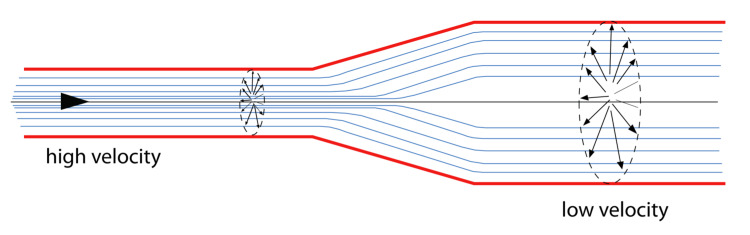
Recent data from astronauts who have returned to Earth from a long-duration space flight have unequivocally distinguished spaceflight-associated neuro-ocular syndrome (SANS) from idiopathic intracranial hypertension (IIH) and pseudotumor cerebri (PTC). We review the semiology and pathogenesis of these three entities, noting that optic disc edema is what unites them, and this where the similarities between SANS and IIH/PTC end. We distinguish between PTC and IIH and between SANS and IIH/PTC and review the medical and surgical therapy of IIH/PTC. The key to understanding the phenomenon of optic disc edema is the geometry of the optic nerve sheath, which is a simulacrum of an inverted Venturi tube. This allows us to theoretically study the hydrodynamics of the optic nerve sheath by applying simple physical laws, including the Venturi effect, Poiseuille's law, and Reynold's number, and we speculate on nature's design and the correlation of form and function in understanding how cerebrospinal fluid (CSF) circulates in the optic nerve sheath as it approaches the optic nerve head. Recent spectacular data on the histology of the blood nerve-barrier of the optic nerve disc and the glymphatic system of the optic nerve sheath will also help us understand the development of optic disc edema due to the microgravity-induced cephalad shift of CSF in SANS. We will explore the role of the sodium/potassium adenosine triphosphatase (ATPase) pump on choroid plexus epithelial cells and the aquaporin-4 water receptors located on astrocyte end-feet and their complex interactions with the tetracyclines, mineralocorticoids, and therapeutic agents with carbonic anhydrase activity. We also adumbrate the complex interactions between obesity, vitamin A, and 11-beta-hydroxysteroid dehydrogenase and how the aquaporin-4 receptor relates to these interactions.
近期,从长期太空飞行返回地球的宇航员提供的数据明确区分了太空飞行相关神经-眼部综合征(SANS)与特发性颅内高压(IIH)和假性脑瘤(PTC)。我们回顾了这三种病症的症状学和发病机制,注意到视盘水肿是它们的共同特征,但这也是SANS与IIH/PTC之间相似性的终结之处。我们区分了PTC和IIH,以及SANS和IIH/PTC,并回顾了IIH/PTC的内科和外科治疗方法。理解视盘水肿现象的关键在于视神经鞘的几何结构,它类似于倒置的文丘里管。这使我们能够通过应用简单的物理定律,包括文丘里效应、泊肃叶定律和雷诺数,从理论上研究视神经鞘的流体动力学,并推测自然的设计以及形态与功能的相关性,以了解脑脊液(CSF)在接近视神经乳头时如何在视神经鞘中循环。近期关于视神经盘血神经屏障组织学和视神经鞘淋巴系统的惊人数据,也将有助于我们理解SANS中由于微重力导致脑脊液向头侧移位而引起的视盘水肿的发展。我们将探讨脉络丛上皮细胞上的钠/钾腺苷三磷酸酶(ATPase)泵以及星形胶质细胞终足上的水通道蛋白-4水受体的作用,以及它们与四环素类、盐皮质激素和具有碳酸酐酶活性的治疗药物的复杂相互作用。我们还概述了肥胖、维生素A和11-β-羟基类固醇脱氢酶之间的复杂相互作用,以及水通道蛋白-4受体与这些相互作用的关系。