Fathi Rozita, Akbari Abolfazl, Nasiri Khadijeh, Chardahcherik Marjan
Department of Exercise Physiology, Faculty of Sport Science, University of Mazandaran, Babolsar, Iran.
Athletic Performance and Health Research Center, University of Mazandaran, Babolsar, Iran.
Avicenna J Phytomed. 2021 Mar-Apr;11(2):134-145.
Ginger has protective effects on the kidney, however the molecular mechanism of this effect has not yet been fully elucidated. Therefore, this work studied molecular mechanisms of ginger effects on ethanol-induced kidney injury.
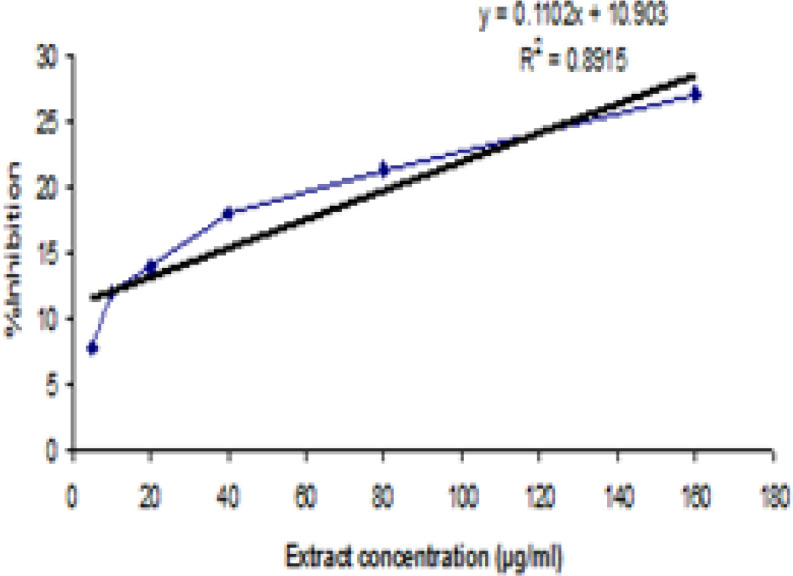
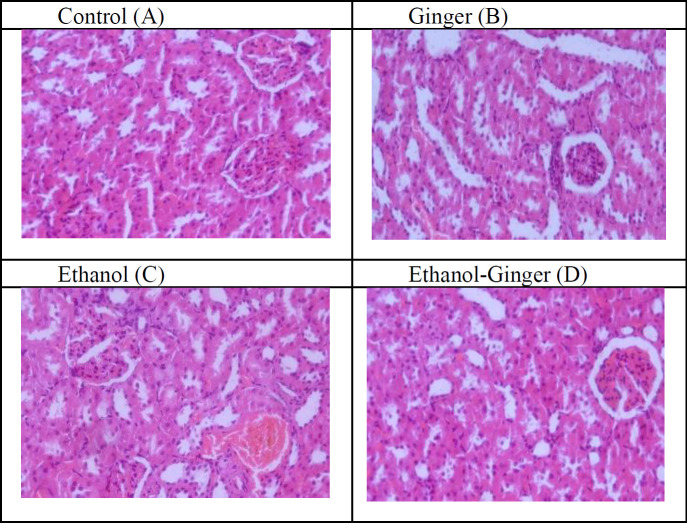
Twenty-four male Sprague-Dawley rats were randomly divided into four groups: control, ginger (1 g/kg/day ginger extract by oral gavage), ethanol (4 g/kg/day ethanol by oral gavage) and ginger-ethanol group and treated daily for 28 days. Kidney function, expression of nuclear factor erythroid 2-related factor 2 (NRF2) and tumor necrosis factor (TNF)-α genes and oxidative stress parameters in kidney tissue, were evaluated. Total phenolic content (TPC) and 2, 2-diphenyl-1-picrylhydrazyl (DPPH) scavenging activity of ginger extract were also evaluated.
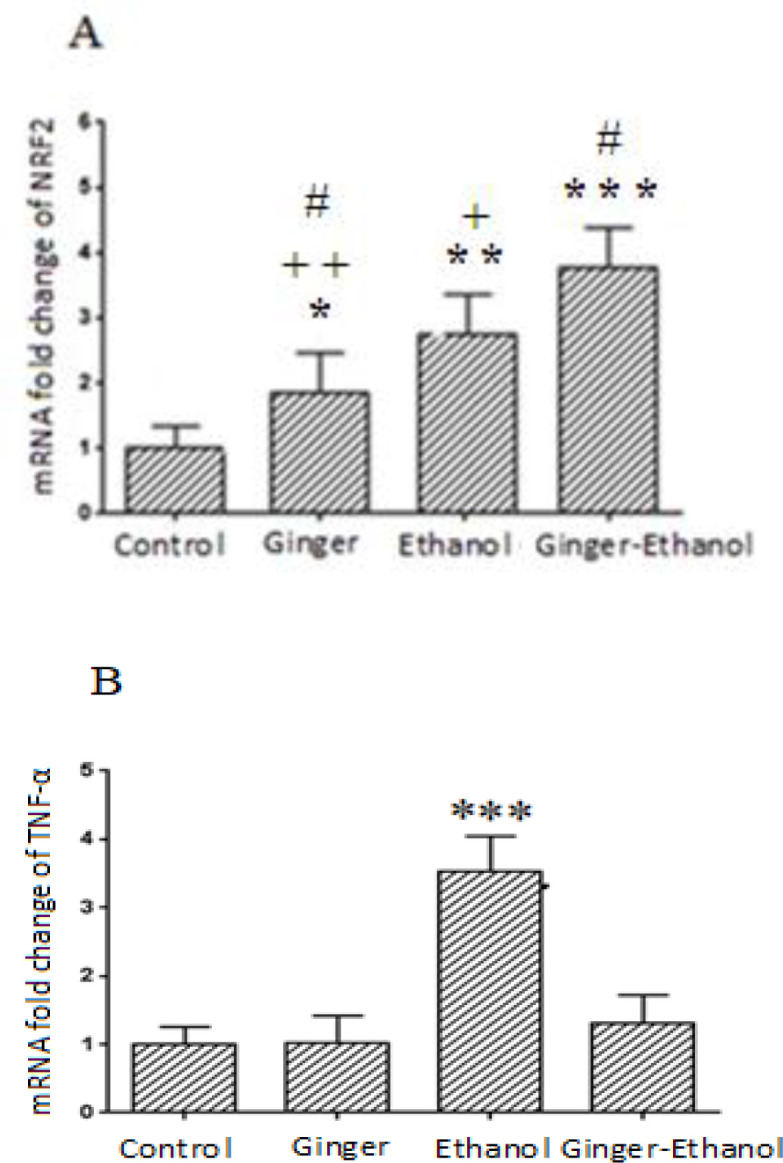
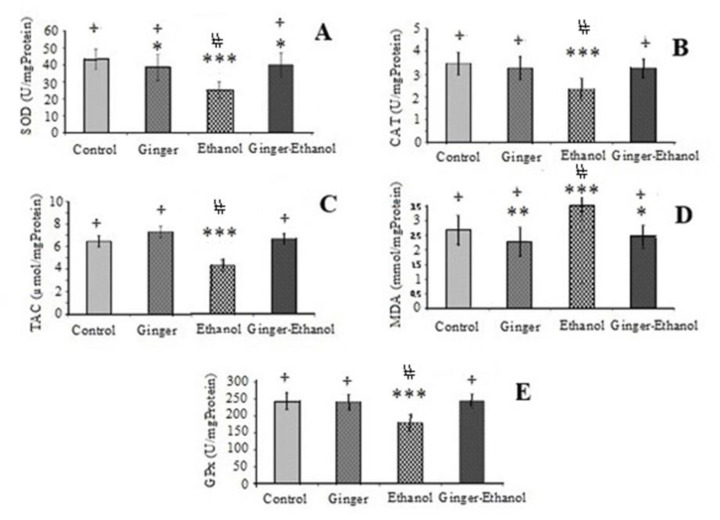
Hydroethanolic extract of ginger showed a good level of DPPH scavenging activity and TPC. In the ethanol group, serum level of urea, creatinine and uric acid and the expression of and significantly increased compared to control group, while co-treatment with ginger in ginger+ethanol group significantly ameliorated them compared to the ethanol group. Ethanol exposure significantly reduced the activity of superoxide dismutase (SOD), glutathione peroxidase (GPx) and catalase (CAT) compared to the control values ,while the level of malondialdehyde (MDA) significantly increased. Ginger significantly ameliorated the level of MDA and activity of SOD, GPx and CAT in the ginger-ethanol group compared to the ethanol group.
The results showed that ginger's protective effects against ethanol renotoxicity were mediated via enhancing the and expression.
生姜对肾脏具有保护作用,但其作用的分子机制尚未完全阐明。因此,本研究探讨生姜对乙醇诱导的肾损伤作用的分子机制。
将24只雄性Sprague-Dawley大鼠随机分为四组:对照组、生姜组(经口灌胃给予1 g/kg/天的生姜提取物)、乙醇组(经口灌胃给予4 g/kg/天的乙醇)和生姜-乙醇组,每日给药,持续28天。评估肾功能、肾组织中核因子红细胞2相关因子2(NRF2)和肿瘤坏死因子(TNF)-α基因的表达以及氧化应激参数。同时评估生姜提取物的总酚含量(TPC)和2,2-二苯基-1-苦基肼(DPPH)清除活性。
生姜的水乙醇提取物表现出良好的DPPH清除活性和TPC。与对照组相比,乙醇组的血清尿素、肌酐和尿酸水平以及TNF-α和NRF2的表达显著增加,而生姜-乙醇组中生姜与乙醇联合处理与乙醇组相比显著改善了这些指标。与对照值相比,乙醇暴露显著降低了超氧化物歧化酶(SOD)、谷胱甘肽过氧化物酶(GPx)和过氧化氢酶(CAT)的活性,而丙二醛(MDA)水平显著增加。与乙醇组相比,生姜显著改善了生姜-乙醇组中MDA的水平以及SOD、GPx和CAT的活性。
结果表明,生姜对乙醇肾毒性的保护作用是通过增强NRF2和TNF-α的表达介导的。