Joel Anjana, Georgy Josh Thomas, Thumaty Divya Bala, John Ajoy Oommen, Chacko Raju Titus, Rebekah Grace, Sigamani Elanthenral, Chandramohan Jagan, Manipadam Marie Therese, Cherian Anish Jacob, Abraham Deepak Thomas, Jacob Paul Mazhuvanchary, Sebastian Patricia, Backianathan Selvamani, Singh Ashish
Department of Medical Oncology, Christian Medical College, Vellore 632004, India.
Department of Biostatistics, Christian Medical College, Vellore 632004, India.
Ecancermedicalscience. 2021 Mar 19;15:1207. doi: 10.3332/ecancer.2021.1207. eCollection 2021.
Human epidermal growth factor receptor 2 (HER2)-positive breast cancer is associated with poor prognosis and access to anti-HER2 treatment is still a challenge in lower-middle income countries. The availability of the biosimilar trastuzumab has improved access by lowering the costs. We report the pattern of use of neoadjuvant ± adjuvant trastuzumab and outcomes in patients with HER2-positive non-metastatic breast cancer treated with regimens incorporating shorter durations of therapy and the use of the biosimilar trastuzumab compared to the innovator.
We conducted a retrospective analysis of patients with non-metastatic HER2-positive breast cancer treated with neoadjuvant ± adjuvant trastuzumab (innovator ( = 34 (33%)) and biosimilar ( = 70 (67%)) manufactured by Biocon Biologics) with chemotherapy. Information regarding chemotherapy regimens, duration of trastuzumab use (≤12 weeks and >12 weeks), pathological response (Miller Payne grade), disease free survival (DFS), overall survival (OS) and safety data were collected from electronic medical records.
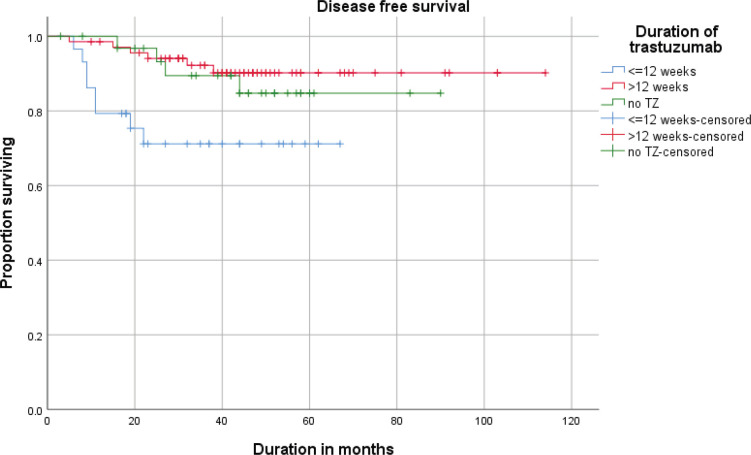
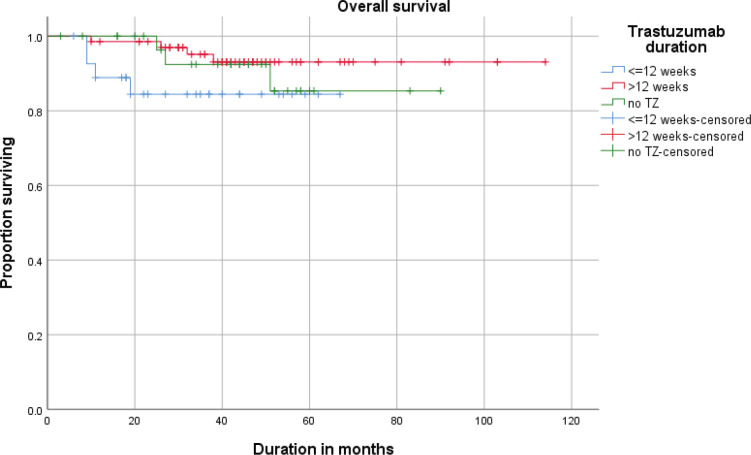
A total of 135 patients were analysed with a median age of 51 years (range: 23-82); of these, 57% were postmenopausal, 31.8% were hormone receptor positive and 62.9% had stage III disease. The overall pathological complete response (p-CR) in both breast and axilla increased to 37.6% in patients treated with trastuzumab preoperatively as compared to 22.2% in patients who did not receive any trastuzumab. Patients receiving innovator trastuzumab and biosimilar trastuzumab showed a p-CR of 28.5% and 41.7%, respectively. At a median follow-up of 42 months (range: 3-114), there were 18 relapses and 11 deaths. The 3-year DFS was 87.1% and OS was 92.2%. Cardiac dysfunction developed in 4 of 78 (5.1%) evaluable patients.
Access to anti-HER2 therapy in the treatment of non-metastatic HER2-positive breast cancer in resource-constrained settings has improved significantly with the availability of the biosimilar trastuzumab. Imbalances in patient profiles at baseline in routine clinical practice led to inconclusive outcomes of ≤12 weeks versus >12 weeks trastuzumab treatment. However, on the basis of historical data, patients could be offered shorter duration of trastuzumab when a standard 1-year treatment of adjuvant trastuzumab is not feasible in resource-constrained settings. The p-CR using the biosimilar trastuzumab in neoadjuvant treatment has been observed to be comparable to the innovator trastuzumab.
人表皮生长因子受体2(HER2)阳性乳腺癌预后较差,在中低收入国家,获得抗HER2治疗仍然是一项挑战。生物类似药曲妥珠单抗的可及性通过降低成本改善了治疗可及性。我们报告了新辅助±辅助曲妥珠单抗的使用模式以及HER2阳性非转移性乳腺癌患者采用疗程更短的治疗方案并使用生物类似药曲妥珠单抗(与原研药相比)后的治疗结果。
我们对接受新辅助±辅助曲妥珠单抗(原研药(n = 34(33%))和由百康生物制药公司生产的生物类似药(n = 70(67%)))联合化疗的非转移性HER2阳性乳腺癌患者进行了回顾性分析。从电子病历中收集了有关化疗方案、曲妥珠单抗使用时长(≤12周和>12周)、病理缓解(米勒-佩恩分级)、无病生存期(DFS)、总生存期(OS)和安全性数据的信息。
共分析了135例患者,中位年龄51岁(范围:23 - 82岁);其中,57%为绝经后患者,31.8%为激素受体阳性,62.9%为III期疾病。术前接受曲妥珠单抗治疗的患者,乳腺和腋窝的总体病理完全缓解(p-CR)率升至37.6%,而未接受任何曲妥珠单抗治疗的患者为22.2%。接受原研曲妥珠单抗和生物类似药曲妥珠单抗治疗的患者p-CR率分别为28.5%和41.7%。中位随访42个月(范围:3 - 114个月)时,有18例复发和11例死亡。3年DFS率为87.1%,OS率为92.2%。78例可评估患者中有4例(5.1%)发生心脏功能障碍。
生物类似药曲妥珠单抗的可及性显著改善了资源受限环境下非转移性HER2阳性乳腺癌抗HER2治疗的可及性。常规临床实践中基线患者特征的不平衡导致曲妥珠单抗治疗≤12周与>12周的结果尚无定论。然而,根据历史数据,在资源受限环境下,当辅助曲妥珠单抗标准的1年治疗不可行时,可为患者提供更短疗程的曲妥珠单抗治疗。新辅助治疗中使用生物类似药曲妥珠单抗的p-CR已观察到与原研曲妥珠单抗相当。