Lee Haemin, Lee Jeea, Lee Kwanbum, Kim Jee Ye, Park Hyung Seok
Division of Breast Surgery, Department of Surgery, Breast Cancer Center, Yonsei Cancer Center, Severance Hospital, Yonsei University College of Medicine, Seoul, Korea.
J Breast Cancer. 2021 Apr;24(2):183-195. doi: 10.4048/jbc.2021.24.e20.
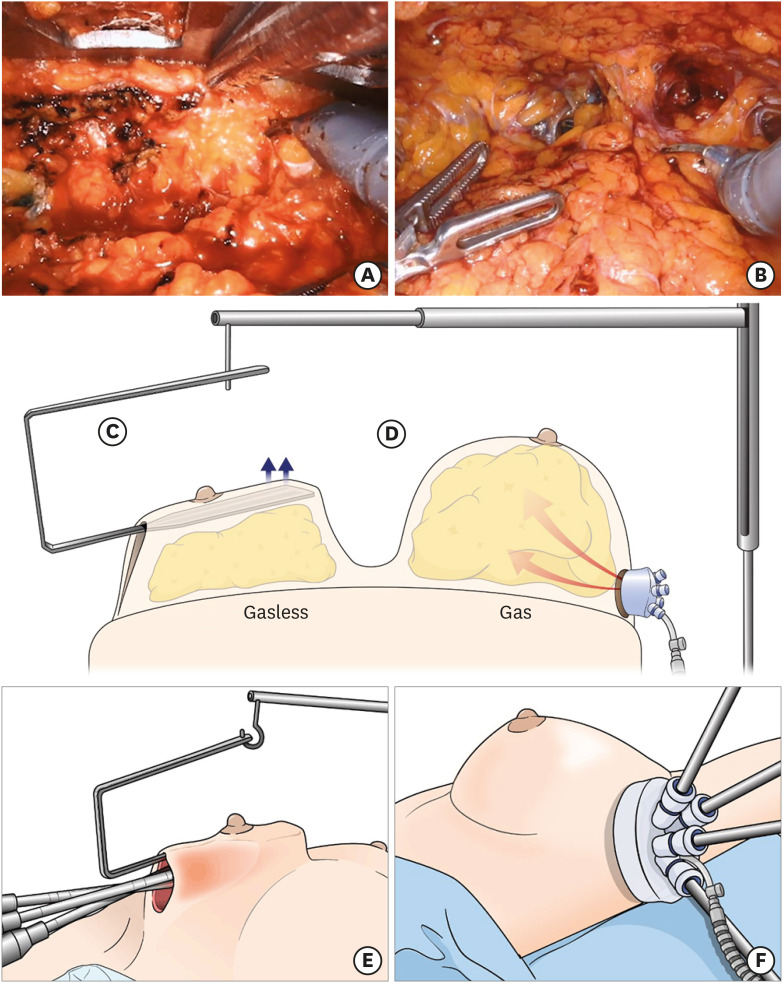
Nipple-sparing mastectomy (NSM) includes various techniques, including conventional or endoscopic mastectomies. Since the introduction of robot-assisted NSM (RANSM) in 2015, 2 main methods have been used: gasless and gas-inflated techniques. The aim of this study was to compare clinicopathologic characteristics, surgical outcomes, and postoperative complications between patients treated with gasless RANSM and those treated with gas-inflated RANSM.
We conducted a retrospective study of women who underwent gasless or gas-inflated RANSM with immediate breast reconstruction between November 2016 and May 2019. The indications for RANSM were early breast cancer, interstitial mastopathy, or 1/2 mutation carriers. Clinicopathologic characteristics, surgical outcomes, and postoperative complications were analyzed. The severity of complications was graded using the Clavien-Dindo system.
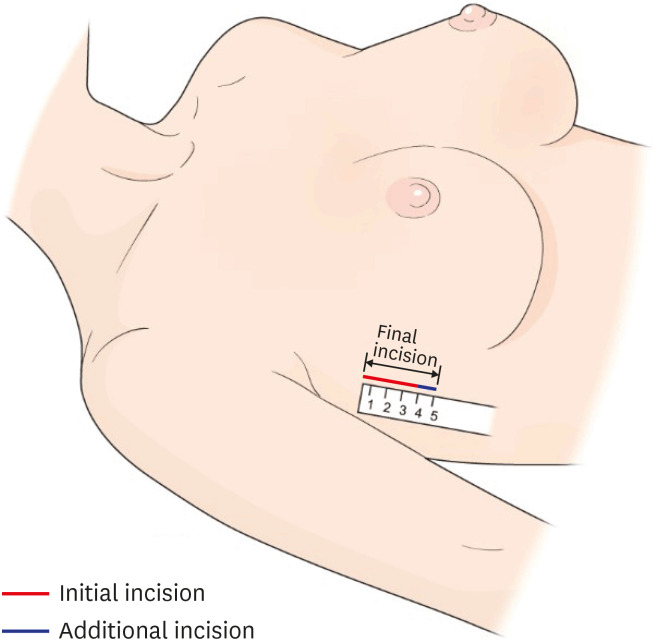
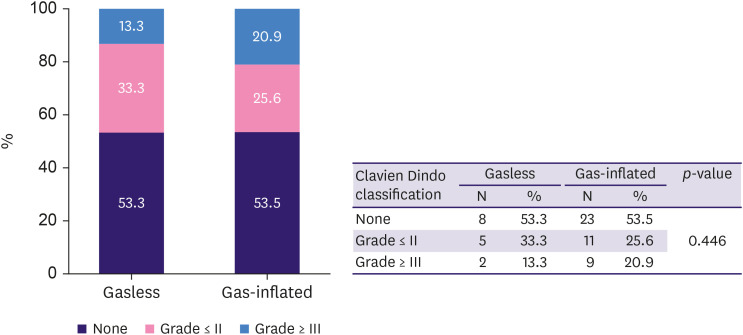
A total of 58 RANSM procedures were performed in 46 women: 15 cases of gasless RANSM and 43 cases of gas-inflated RANSM. The proportion of node-negative disease was higher in the gas-inflated group (97.1%) than in the gasless group (69.2%, = 0.016). Adjuvant radiotherapy was administered in 30.6% of the cases in the gasless group and only 5% of the cases in the gas-inflated group. Other clinicopathological factors were not significantly different between the groups. Regarding surgical outcomes, the initial incision was 1 cm longer in the gasless group (5.17 ± 0.88 cm) than that in the gas-inflated group (4.20 ± 1.05 cm; = 0.002). The final incision was also longer in the gasless group (5.17 ± 0.88 cm) than that in the gas-inflated group (4.57 ± 1.07 cm; = 0.040). Operation time, complication rate, and complication grade were not significantly different between the 2 groups.
In this study, there were no significant differences in surgical outcomes or postoperative complications between gasless and gas-inflated RANSM, except for a longer incision with the gasless technique. Both techniques are reasonable options for RANSM followed by immediate reconstruction.
保留乳头的乳房切除术(NSM)包括多种技术,如传统或内镜下乳房切除术。自2015年引入机器人辅助保留乳头乳房切除术(RANSM)以来,主要使用了两种方法:无气腹和充气技术。本研究的目的是比较接受无气腹RANSM治疗的患者与接受充气RANSM治疗的患者的临床病理特征、手术结果和术后并发症。
我们对2016年11月至2019年5月期间接受无气腹或充气RANSM并立即进行乳房重建的女性进行了一项回顾性研究。RANSM的适应证为早期乳腺癌、间质乳腺病或1/2突变携带者。分析了临床病理特征、手术结果和术后并发症。使用Clavien-Dindo系统对并发症的严重程度进行分级。
46名女性共进行了58例RANSM手术:15例无气腹RANSM和43例充气RANSM。充气组的无淋巴结转移疾病比例(97.1%)高于无气腹组(69.2%,P = 0.016)。无气腹组30.6%的病例接受了辅助放疗,而充气组仅5%的病例接受了辅助放疗。两组之间的其他临床病理因素无显著差异。关于手术结果,无气腹组的初始切口(5.17±0.88 cm)比充气组(4.20±1.05 cm)长1 cm(P = 0.002)。无气腹组的最终切口(5.17±0.88 cm)也比充气组(4.57±1.07 cm)长(P = 0.040)。两组之间的手术时间、并发症发生率和并发症分级无显著差异。
在本研究中,无气腹和充气RANSM在手术结果或术后并发症方面无显著差异,除了无气腹技术的切口更长。两种技术都是RANSM后立即重建的合理选择。