Chang Yuh-Shin, Chang Yo-Chen, Chen Po-Han, Li Chia-Yang, Wu Wen-Chuan, Kao Ying-Hsien
Chi Mei Medical Center, Department of Ophthalmology, Tainan 71004, Taiwan.
Graduate Institute of Medical Science, College of Health Science, Chang Jung Christian University, Tainan 71101, Taiwan.
Pharmaceuticals (Basel). 2021 Apr 1;14(4):314. doi: 10.3390/ph14040314.
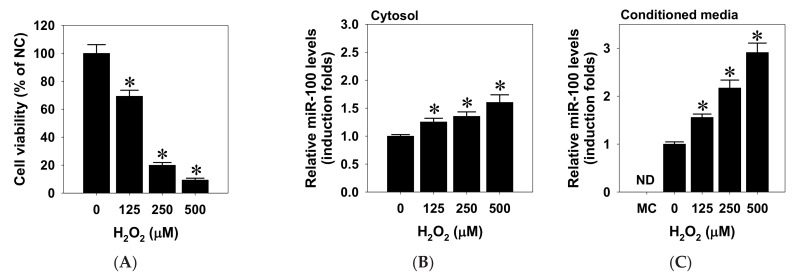
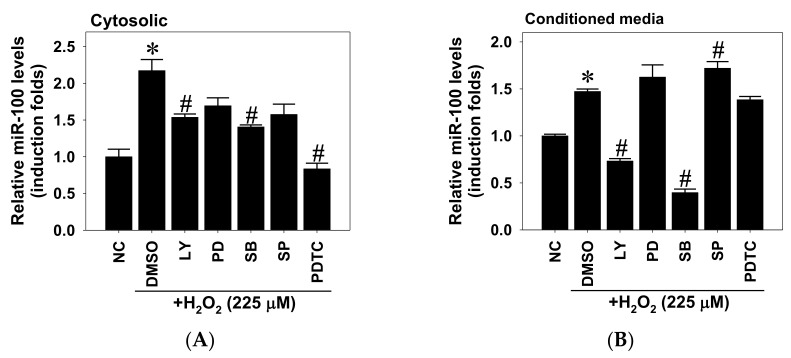
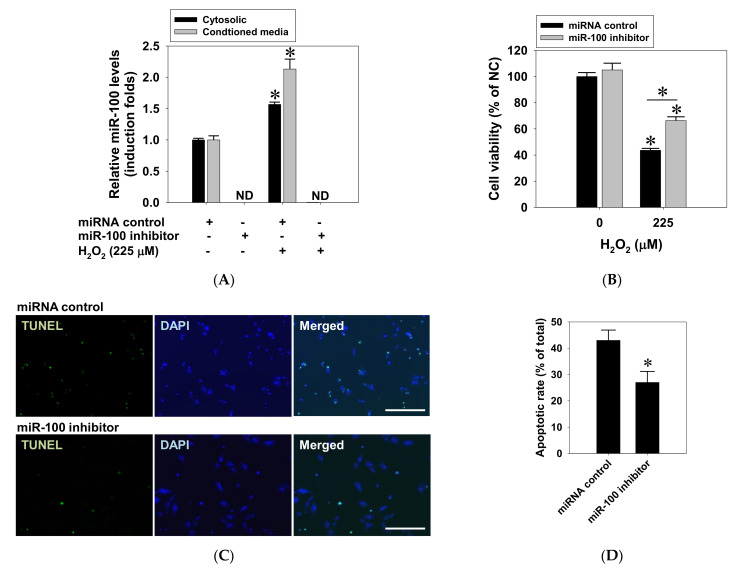
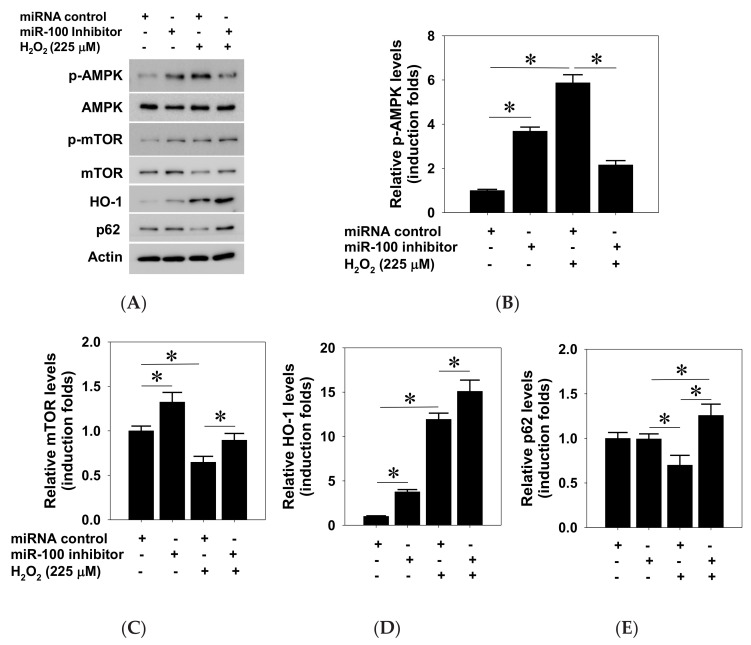
This study investigated the regulatory role of microRNA 100 (miR-100) in hydrogen peroxide (HO)-induced apoptosis of human retinal pigment epithelial ARPE-19 cells. HO induced oxidative cell death of cultured ARPE-19 cells was measured by cytotoxicity assay. qRT-PCR was used to quantify cytosolic and extracellular contents of miR-100. Kinase and miR-100 inhibition treatments were applied to determine the regulatory signaling pathways involved in cell death regulation. HO dose-dependently reduced viability of ARPE-19 cells and simultaneously upregulated miR-100 levels in both cytosolic and extracellular compartments. Western blotting detection indicated that HO elicited hyperphosphorylation of PI3K/Akt, ERK1/2, JNK, p38 MAPK, and p65 NF-κB. Further kinase inhibition experiments demonstrated that PI3K, p38 MAPK, and NF-κB activities were involved in oxidative-stress-induced miR-100 upregulation in ARPE-19 cells, while blockade of PI3K, JNK, and NF-κB signaling significantly attenuated the oxidative cell death. Intriguingly, MiR-100 antagomir treatment exerted a cytoprotective effect against the HO-induced oxidative cell death through attenuating the oxidation-induced AMPK hyperphosphorylation, restoring cellular mTOR and p62/SQSTM1 levels and upregulating heme oxygenase-1 expression. These findings support that miR-100 at least in part mediates HO-induced cell death of ARPE-19 cells and can be regarded as a preventive and therapeutic target for retinal degenerative disease.
本研究调查了微小RNA 100(miR-100)在过氧化氢(H₂O₂)诱导的人视网膜色素上皮ARPE-19细胞凋亡中的调节作用。通过细胞毒性试验检测H₂O₂诱导的培养ARPE-19细胞的氧化细胞死亡。采用qRT-PCR定量miR-100的胞质和细胞外含量。应用激酶和miR-100抑制处理来确定参与细胞死亡调节的信号通路。H₂O₂剂量依赖性地降低ARPE-19细胞的活力,同时上调胞质和细胞外区室中miR-100的水平。蛋白质免疫印迹检测表明,H₂O₂引起PI3K/Akt、ERK1/2、JNK、p38 MAPK和p65 NF-κB的过度磷酸化。进一步的激酶抑制实验表明,PI3K、p38 MAPK和NF-κB活性参与了ARPE-19细胞中氧化应激诱导的miR-100上调,而阻断PI3K、JNK和NF-κB信号显著减轻氧化细胞死亡。有趣的是,MiR-100拮抗剂处理通过减弱氧化诱导的AMPK过度磷酸化、恢复细胞mTOR和p62/SQSTM1水平以及上调血红素加氧酶-1表达,对H₂O₂诱导的氧化细胞死亡发挥细胞保护作用。这些发现支持miR-100至少部分介导H₂O₂诱导的ARPE-19细胞死亡,可被视为视网膜退行性疾病的预防和治疗靶点。