Bakour Noor, Moriarty Frank, Moore Gillian, Robson Tracy, Annett Stephanie L
Department of Surgery, Trinity Translational Medicine Institute, Trinity College Dublin, D08 W9RT Dublin 8, Ireland.
School of Pharmacy and Biomolecular Science, RCSI University of Medicine and Health Science, 123 St Stephen's Green, D02 YN77 Dublin 2, Ireland.
Cancers (Basel). 2021 Apr 1;13(7):1649. doi: 10.3390/cancers13071649.
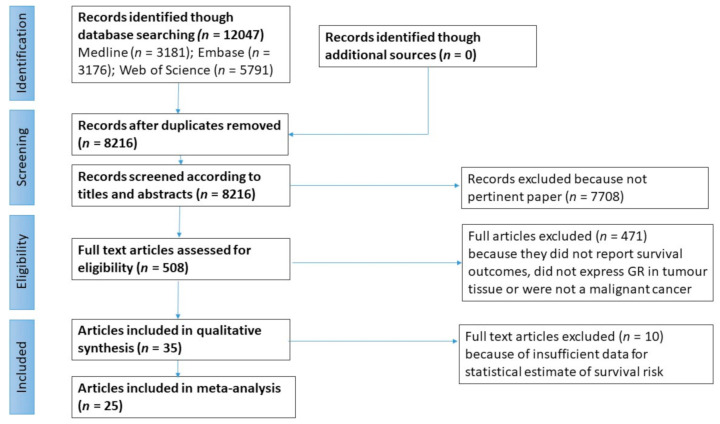
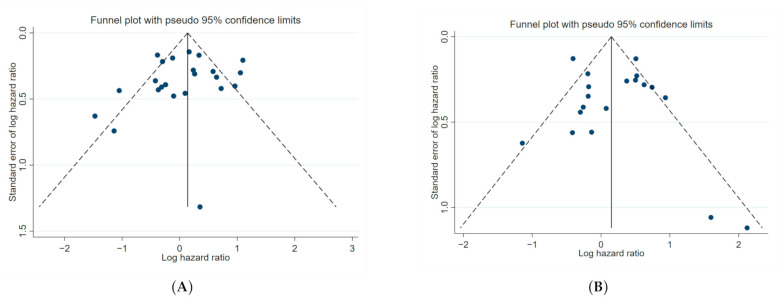
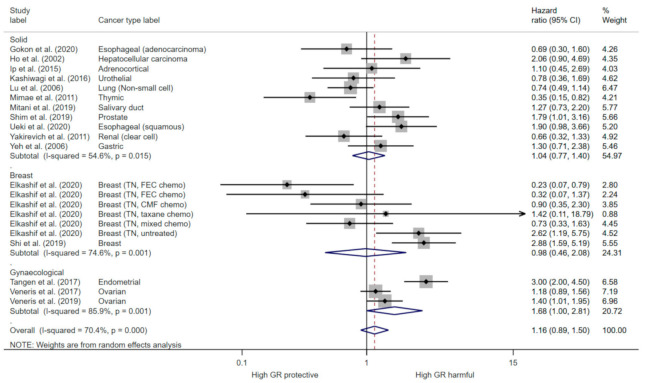
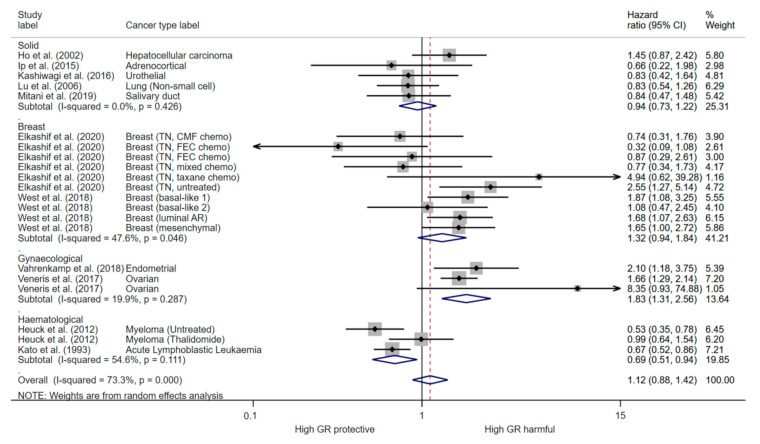
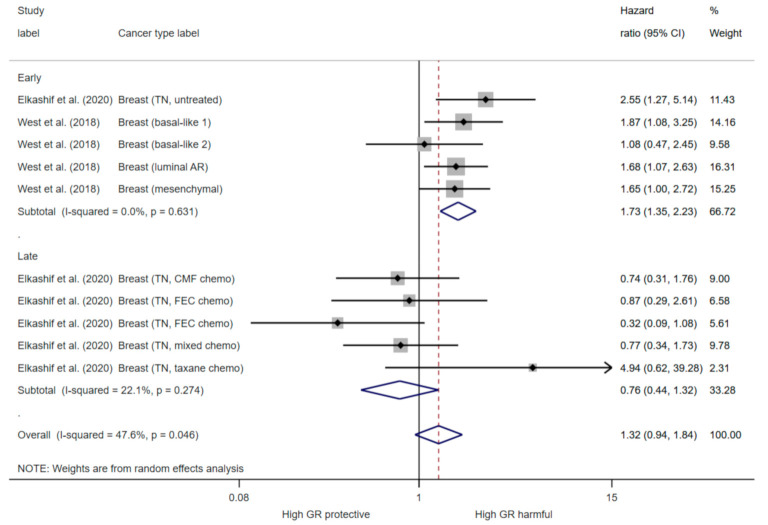
In solid malignancies, the glucocorticoid receptor (GR) signalling axis is associated with tumour progression and GR antagonists are in clinical development. Therefore, GR expression may be a useful potential prognostic or predictive biomarker for GR antagonist therapy in cancer. The aim of this review is to investigate if GR expression in tumours is predictive of overall survival or progression free survival. Twenty-five studies were identified through systematic searches of three databases and a meta-analysis conducted using a random effects model, quantifying statistical heterogeneity. Subgroup analysis was conducted for cancer types and publication bias was assessed via funnel plots. There was high heterogeneity in meta-analysis of the studies in all cancer types, which found no association between high GR expression with overall survival (pooled unadjusted HR 1.16, 95% CI (0.89-1.50), = 2814; pooled adjusted HR 1.02, 95% CI (0.77-1.37), = 2355) or progression-free survival (pooled unadjusted HR 1.12, 95% CI (0.88-1.42), = 3365; pooled adjusted HR 1.04, 95% CI (0.6-1.81), = 582) across all cancer types. However, subgroup meta-analyses showed that high GR expression in gynaecological cancers (endometrial and ovarian) (unadjusted HR 1.83, 95% CI (1.31-2.56), = 664) and early stage, untreated triple negative breast cancers (TNBCs) (unadjusted HR 1.73, 95% CI (1.35-2.23), = 687) is associated with disease progression. GR expression in late stage, chemotherapy treated TNBC was not prognostic (unadjusted HR 0.76, 95% CI (0.44, 1.32), = 287). In conclusion, high GR expression is associated with an increased risk of disease progression in gynaecological and early stage, untreated TNBC. Additional studies are required to elucidate the tumour specific function of the GR receptor in order to ensure GR antagonists target the correct patient groups.
在实体恶性肿瘤中,糖皮质激素受体(GR)信号轴与肿瘤进展相关,GR拮抗剂正处于临床开发阶段。因此,GR表达可能是癌症中GR拮抗剂治疗的一种有用的潜在预后或预测生物标志物。本综述的目的是研究肿瘤中的GR表达是否能预测总生存期或无进展生存期。通过对三个数据库进行系统检索,确定了25项研究,并使用随机效应模型进行荟萃分析,对统计异质性进行量化。对癌症类型进行亚组分析,并通过漏斗图评估发表偏倚。在所有癌症类型的研究荟萃分析中存在高度异质性,结果发现高GR表达与总生存期(合并未调整风险比1.16,95%置信区间(0.89 - 1.50),n = 2814;合并调整风险比1.02,95%置信区间(0.77 - 1.37),n = 2355)或无进展生存期(合并未调整风险比1.12,95%置信区间(0.88 - 1.42),n = 3365;合并调整风险比1.04,95%置信区间(0.6 - 1.81),n = 582)之间无关联。然而,亚组荟萃分析表明,妇科癌症(子宫内膜癌和卵巢癌)中的高GR表达(未调整风险比1.83,95%置信区间(1.31 - 2.56),n = 664)以及早期、未经治疗的三阴性乳腺癌(TNBC)中的高GR表达(未调整风险比1.73,95%置信区间(1.35 - 2.23),n = 687)与疾病进展相关。晚期、接受化疗的TNBC中的GR表达无预后价值(未调整风险比0.76, 95%置信区间(0.44, 1.32),n = 287)。总之,高GR表达与妇科癌症以及早期、未经治疗的TNBC的疾病进展风险增加相关。需要进一步的研究来阐明GR受体的肿瘤特异性功能,以确保GR拮抗剂针对正确的患者群体。