Department of Gastrointestinal Surgery, Tohoku University Graduate School of Medicine, 1-1 Seiryo-machi, Aoba-ku, Sendai, 980-8574, Japan.
Department of Pathology, Tohoku University Graduate School of Medicine, 1-2 Seiryo-machi, Aoba-ku, Sendai, 980-8574, Japan.
BMC Cancer. 2020 Feb 27;20(1):161. doi: 10.1186/s12885-020-6652-7.
Esophageal squamous cell carcinoma (ESCC) is a highly malignant neoplasm. The glucocorticoid (GC)-glucocorticoid receptor (GR) pathway plays pivotal roles in cellular response to various stresses of tumor cells, including chemotherapy. However, the status of the GC-GR pathway in ESCC, including its correlation with chemotherapeutic responses, is largely unknown.
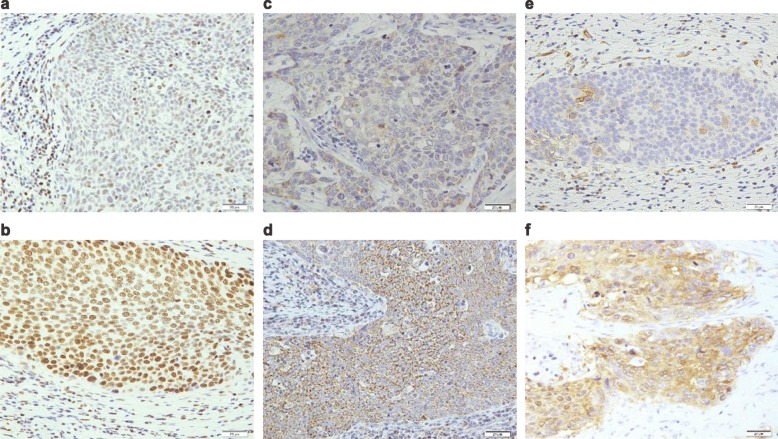
GR, serum-and glucocorticoid-regulated kinase 1 (Sgk1), and N-myc down regulation gene 1 (NDRG1) were immunolocalized in 98 patients with ESCC who had undergone esophagectomy following neoadjuvant chemotherapy (NAC) with 2 courses of 5-fluorouracil + cisplatin. We also examined biopsy specimens before NAC in 42 cases and compared the results between those before and after NAC.
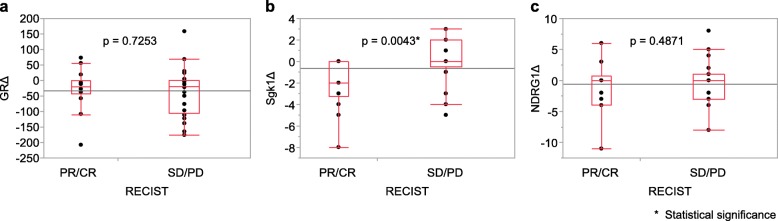
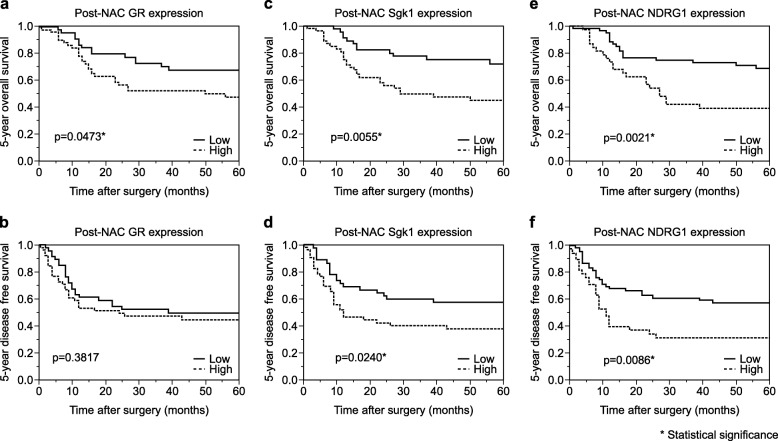
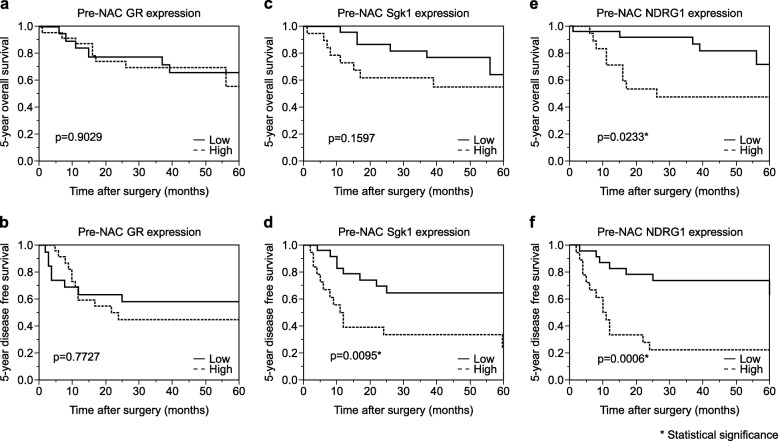
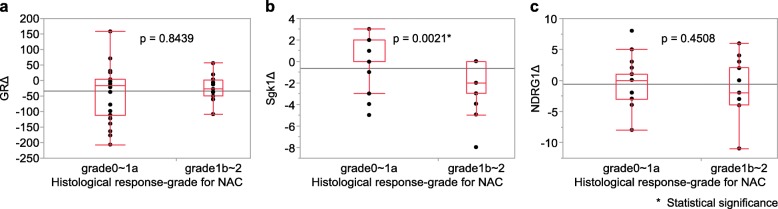
Overall survival (OS) of the patients treated with surgery following NAC was significantly shorter in the group with high GR than that with low GR status (P = 0.0473). Both OS and disease-free survival (DFS) were significantly shorter in both Sgk1- and NDRG1-high groups than in the low groups (OS: Sgk1, P = 0.0055; NDRG1, P = 0.0021; DFS: Sgk1, P = 0.0240; NDRG1, P = 0.0086). Biopsy specimens before NAC showed significantly shorter DFS in the high Sgk1 group (P = 0.0095), while both OS and DFS were shorter in the high NDRG1 group (OS, P = 0.0233; DFS, P = 0.0006) than in the respective low groups. In the high NDRG1 group of biopsy specimens before NAC, the tumor reduction rate by NAC was significantly attenuated (P = 0.021).
High GR, Sgk1, and NDRG1 statuses in ESCC after NAC was significantly associated with an overall worse prognosis, with no significant changes in their expression levels before and after NAC. Therefore, increased activity of the GC-GR pathway with enhanced induction of Sgk1 and NDRG1 in carcinoma cells play pivotal roles in tumor progression and development of chemo-resistance in patients with ESCC undergoing NAC.
食管鳞状细胞癌(ESCC)是一种高度恶性的肿瘤。糖皮质激素(GC)-糖皮质激素受体(GR)通路在肿瘤细胞对各种应激的细胞反应中发挥着关键作用,包括化疗。然而,ESCC 中的 GC-GR 通路状态,包括其与化疗反应的相关性,在很大程度上尚不清楚。
在 98 例接受新辅助化疗(NAC)加 2 疗程氟尿嘧啶+顺铂治疗后接受手术的 ESCC 患者中,免疫定位了 GR、血清和糖皮质激素调节激酶 1(Sgk1)和 N- MYC 下调基因 1(NDRG1)。我们还检查了 42 例 NAC 前的活检标本,并比较了 NAC 前后的结果。
接受 NAC 后手术治疗的患者的总生存(OS)在高 GR 组明显短于低 GR 状态组(P=0.0473)。在 Sgk1 和 NDRG1 高表达组,OS 和无病生存(DFS)均明显短于低表达组(OS:Sgk1,P=0.0055;NDRG1,P=0.0021;DFS:Sgk1,P=0.0240;NDRG1,P=0.0086)。NAC 前活检标本中 Sgk1 高表达组 DFS 明显缩短(P=0.0095),而 NDRG1 高表达组 OS 和 DFS 均缩短(OS,P=0.0233;DFS,P=0.0006),低于各自的低表达组。在 NAC 前 NDRG1 高表达组中,NAC 的肿瘤退缩率明显减弱(P=0.021)。
NAC 后 ESCC 中高 GR、Sgk1 和 NDRG1 状态与总体预后较差显著相关,NAC 前后其表达水平无显著变化。因此,GC-GR 通路活性增加,癌细胞中 Sgk1 和 NDRG1 的诱导增强,在接受 NAC 的 ESCC 患者中发挥着重要作用,促进肿瘤进展和化疗耐药的发展。