Chen Chih-Wei, Pavlova Julia A, Lukianov Dmitrii A, Tereshchenkov Andrey G, Makarov Gennady I, Khairullina Zimfira Z, Tashlitsky Vadim N, Paleskava Alena, Konevega Andrey L, Bogdanov Alexey A, Osterman Ilya A, Sumbatyan Natalia V, Polikanov Yury S
Department of Biological Sciences, University of Illinois at Chicago, Chicago, IL 60607, USA.
Department of Chemistry, Lomonosov Moscow State University, 119991 Moscow, Russia.
Antibiotics (Basel). 2021 Apr 5;10(4):390. doi: 10.3390/antibiotics10040390.
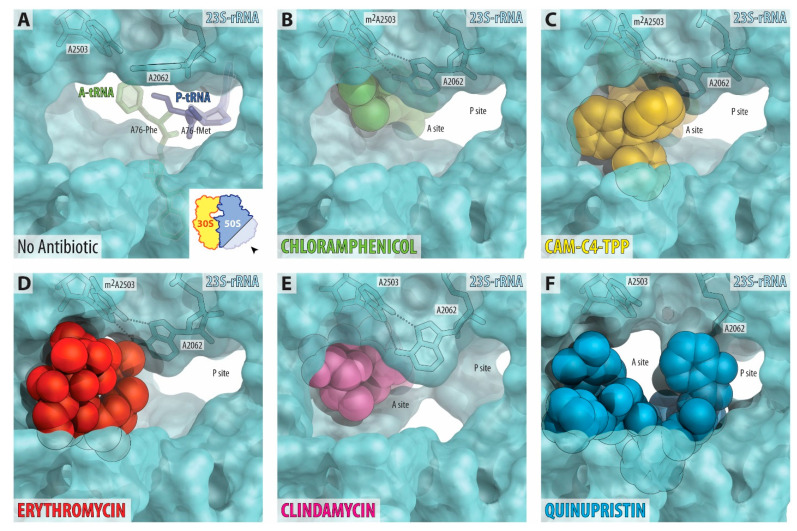
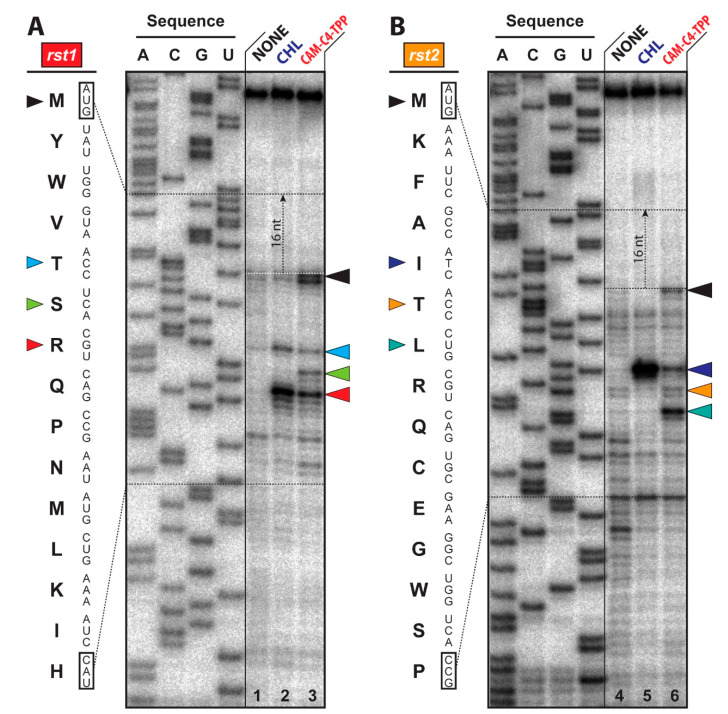
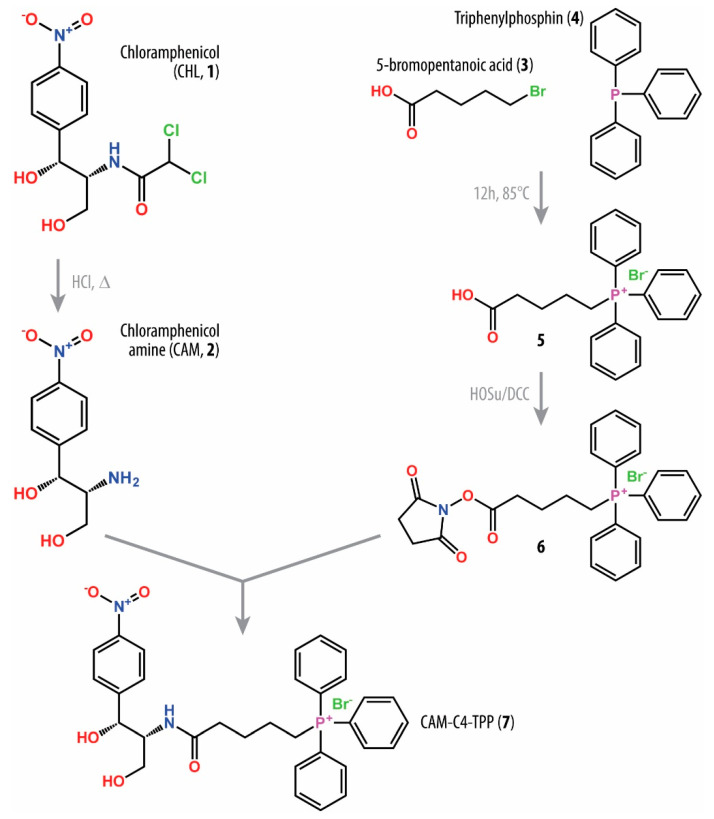
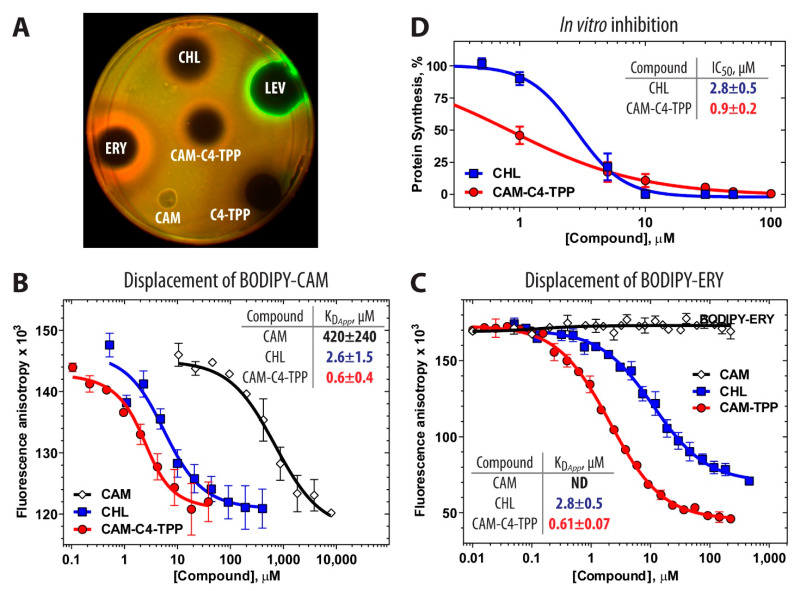
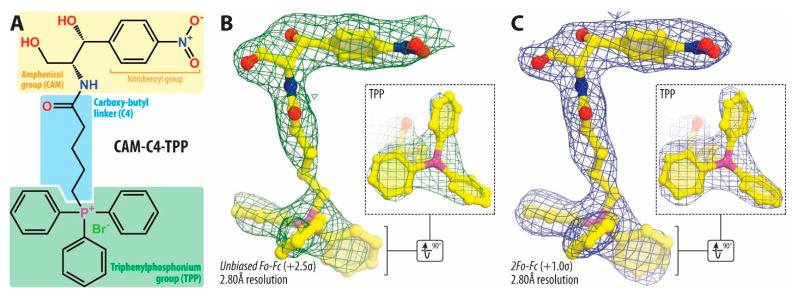
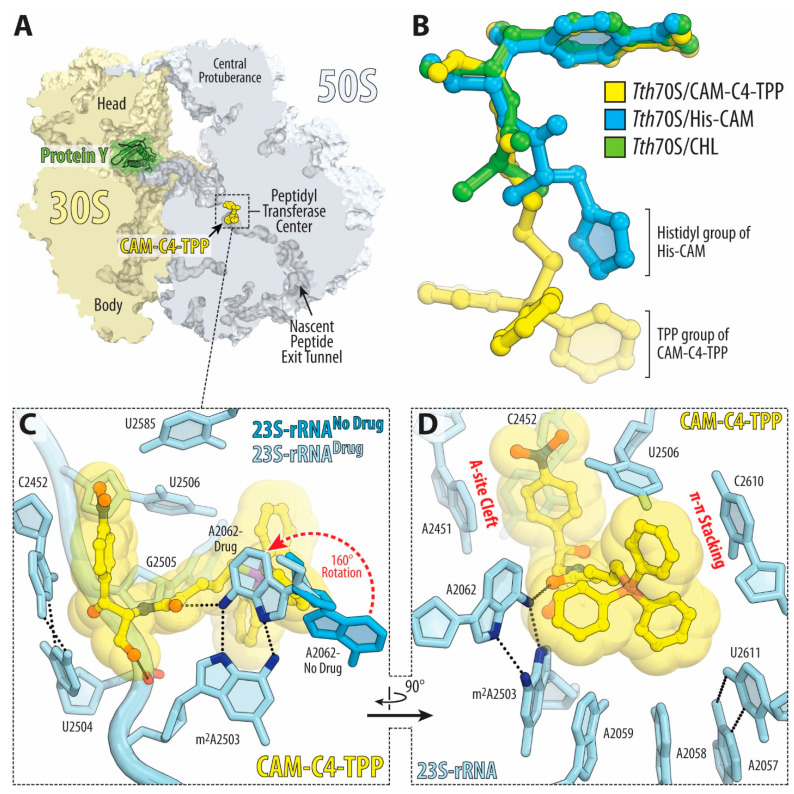
Chloramphenicol (CHL) is a ribosome-targeting antibiotic that binds to the peptidyl transferase center (PTC) of the bacterial ribosome and inhibits peptide bond formation. As an approach for modifying and potentially improving the properties of this inhibitor, we explored ribosome binding and inhibitory properties of a semi-synthetic triphenylphosphonium analog of CHL-CAM-C4-TPP. Our data demonstrate that this compound exhibits a ~5-fold stronger affinity for the bacterial ribosome and higher potency as an in vitro protein synthesis inhibitor compared to CHL. The X-ray crystal structure of the 70S ribosome in complex with CAM-C4-TPP reveals that, while its amphenicol moiety binds at the PTC in a fashion identical to CHL, the C4-TPP tail adopts an extended propeller-like conformation within the ribosome exit tunnel where it establishes multiple hydrophobic Van der Waals interactions with the rRNA. The synthesized compound represents a promising chemical scaffold for further development by medicinal chemists because it simultaneously targets the two key functional centers of the bacterial ribosome-PTC and peptide exit tunnel.
氯霉素(CHL)是一种作用于核糖体的抗生素,它与细菌核糖体的肽基转移酶中心(PTC)结合,抑制肽键形成。作为一种修饰并可能改善这种抑制剂性质的方法,我们探索了氯霉素半合成三苯基鏻类似物CHL-CAM-C4-TPP的核糖体结合和抑制特性。我们的数据表明,与氯霉素相比,该化合物对细菌核糖体的亲和力强约5倍,作为体外蛋白质合成抑制剂的效力更高。70S核糖体与CAM-C4-TPP复合物的X射线晶体结构表明,虽然其氯霉素部分以与CHL相同的方式结合在PTC处,但C4-TPP尾部在核糖体出口通道内呈延伸的螺旋桨状构象,在那里它与rRNA建立了多个疏水范德华相互作用。合成的化合物是药物化学家进一步开发的有前景的化学骨架,因为它同时靶向细菌核糖体的两个关键功能中心——PTC和肽出口通道。