Department of Hematology and Oncology, Medical Faculty Mannheim, Heidelberg University, 68167 Mannheim, Germany.
Department of Clinical Chemistry, University Medical Center Mannheim, 68167 Mannheim, Germany.
Cells. 2021 Apr 7;10(4):827. doi: 10.3390/cells10040827.
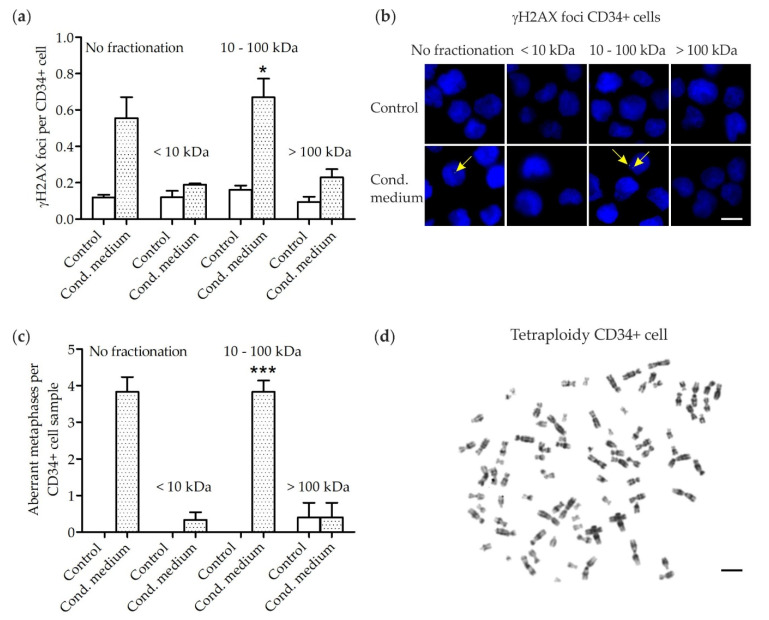
Genotoxic bystander signals released from irradiated human mesenchymal stromal cells (MSC) may induce radiation-induced bystander effects (RIBEs) in human hematopoietic stem and progenitor cells (HSPC), potentially causing leukemic transformation. Although the source of bystander signals is evident, the identification and characterization of these signals is challenging. Here, RIBEs were analyzed in human CD34+ cells cultured in distinct molecular size fractions of medium, conditioned by 2 Gy irradiated human MSC. Specifically, γH2AX foci (as a marker of DNA double-strand breaks) and chromosomal instability were evaluated in CD34+ cells grown in approximate (I) < 10 kDa, (II) 10-100 kDa and (III) > 100 kDa fractions of MSC conditioned medium and un-/fractionated control medium, respectively. Hitherto, significantly increased numbers of γH2AX foci ( = 0.0286) and aberrant metaphases ( = 0.0022) were detected in CD34+ cells grown in the (II) 10-100 kDa fraction (0.67 ± 0.10 γH2AX foci per CD34+ cell ∨ 3.8 ± 0.3 aberrant metaphases per CD34+ cell sample; mean ± SEM) when compared to (I) < 10 kDa (0.19 ± 0.01 ∨ 0.3 ± 0.2) or (III) > 100 kDa fractions (0.23 ± 0.04 ∨ 0.4 ± 0.4) or un-/fractionated control medium (0.12 ± 0.01 ∨ 0.1 ± 0.1). Furthermore, RIBEs disappeared after heat inactivation of medium at 75 °C. Taken together, our data suggest that RIBEs are mainly mediated by the heat-sensitive (II) 10-100 kDa fraction of MSC conditioned medium. We postulate proteins as RIBE mediators and in-depth proteome analyses to identify key bystander signals, which define targets for the development of next-generation anti-leukemic drugs.
由辐照人骨髓间充质干细胞(MSC)释放的遗传毒性旁观者信号,可能在人造血干/祖细胞(HSPC)中诱导辐射诱导的旁观者效应(RIBE),从而潜在地导致白血病转化。尽管旁观者信号的来源是明确的,但这些信号的鉴定和特征分析具有挑战性。在这里,我们分析了在不同大小分子的培养基中培养的人 CD34+细胞中的 RIBE,这些培养基是由 2 Gy 辐照人 MSC 条件化的。具体而言,我们评估了在生长于 MSC 条件培养基的近似(I)<10 kDa、(II)10-100 kDa 和(III)>100 kDa 分数以及未分馏对照培养基中的 CD34+细胞中的 γH2AX 焦点(作为 DNA 双链断裂的标志物)和染色体不稳定性。迄今为止,在生长于(II)10-100 kDa 分数中的 CD34+细胞中,显著增加了 γH2AX 焦点的数量(=0.0286)和异常有丝分裂(=0.0022)(=0.0286)(每 CD34+细胞 0.67 ± 0.10 γH2AX 焦点∨每 CD34+细胞样本 3.8 ± 0.3 异常有丝分裂;平均值±SEM),与(I)<10 kDa(0.19 ± 0.01∨0.3 ± 0.2)或(III)>100 kDa 分数(0.23 ± 0.04∨0.4 ± 0.4)或未分馏对照培养基(0.12 ± 0.01∨0.1 ± 0.1)相比。此外,当培养基在 75°C 下进行热失活时,RIBE 消失。总之,我们的数据表明,RIBE 主要由 MSC 条件培养基的热敏(II)10-100 kDa 分数介导。我们推测蛋白质是 RIBE 介质,并进行深入的蛋白质组分析以鉴定关键的旁观者信号,这些信号定义了开发下一代抗白血病药物的靶标。